

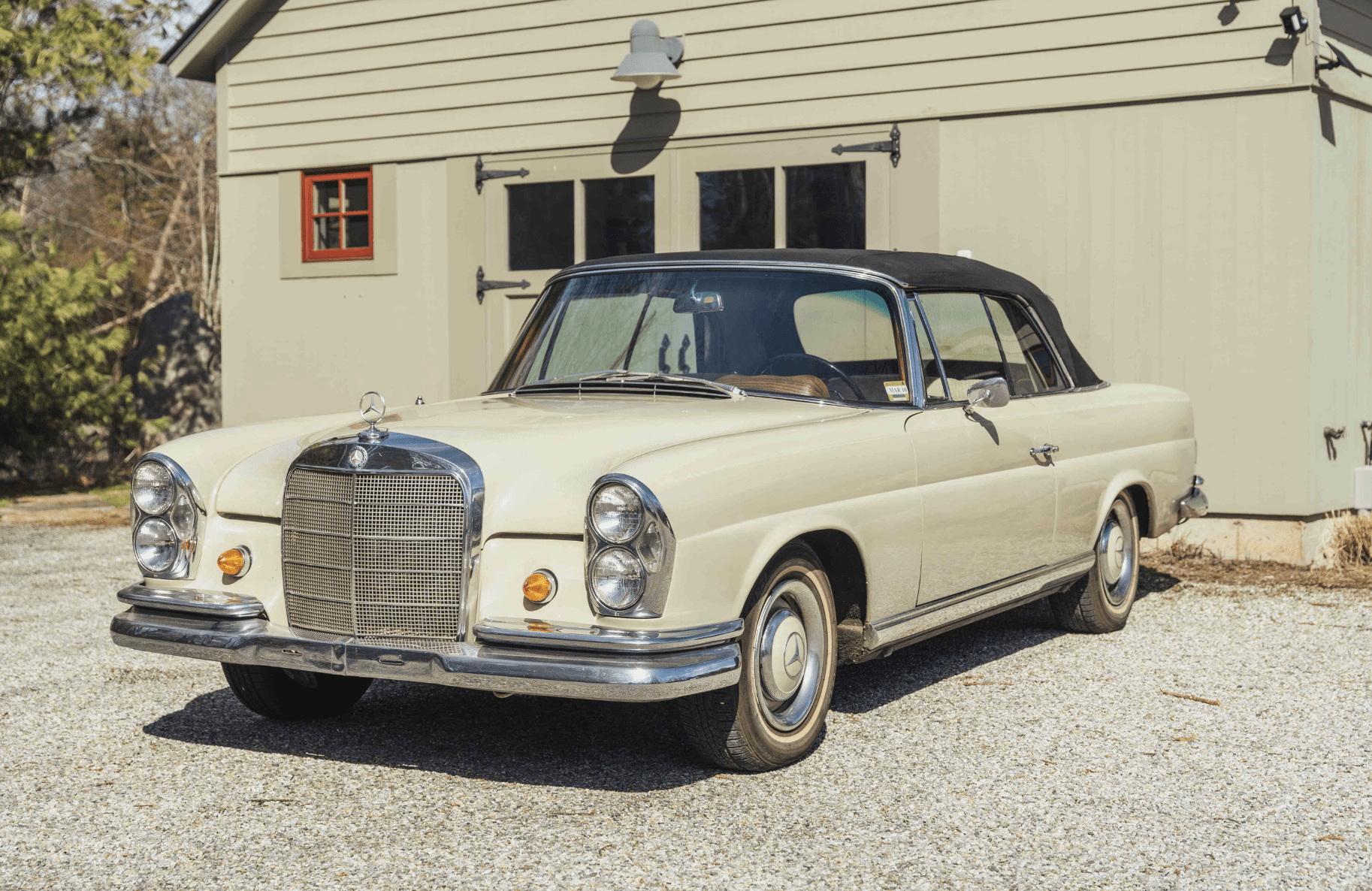
Somebody bought a 1967 Mercedes-Benz 250 SE Cabriolet for $35,000, a number that wouldn’t raise an eyebrow at any regional collector-car sale. What makes the transaction worth a second look is what the car was supposed to be: the personal convertible of conductor and composer Leonard Bernstein, wearing New Jersey vanity plates reading MAESTRO1, allegedly fitted with a cassette deck by the maestro himself. Hagerty Marketplace’s own team tried to confirm that story before the auction ran. They couldn’t. The car sold anyway, for a figure that looks a lot like what an unremarkable, undocumented 250 SE Cabriolet would bring. That gap between the pitch and the price is the actual story here, and it says more about how the market treats an unprovable claim than any single celebrity rumor could.
A claim that couldn’t be verified
The listing itself is fairly ordinary underneath the headline claim. Chassis 111.023.12.087375 is a U.S.-market automatic with 60,895 miles marked “too mileage unknown,” service records dating to 1988, and a consignor who has owned it since 1991. It also carries real, disclosed flaws: the original hydro-pneumatic rear suspension has been swapped for a conventional setup, the cold-start injector needs about ten seconds to catch, and the clock doesn’t run. None of that is disqualifying for a 58-year-old convertible, but it places the car solidly in driver territory rather than concours territory.
The Bernstein claim is where things get interesting. According to the consignor, the car was purchased in 1978 by Amberson Enterprises, Bernstein’s publishing company, and later carried a New Jersey plate reading MAESTRO1 that Bernstein supposedly ordered himself. What’s unusual is that Hagerty’s own listing discloses its attempt to check this out and admits it came up short: the company says it contacted The Leonard Bernstein Office, which found no record connecting him to this specific car but did confirm that in the 1980s he had a taupe Mercedes convertible with the MAESTRO1 license plates. That detail lends some texture to the story, but it stops well short of confirming this VIN. Most auction copy would have quietly dropped that ambiguity. Hagerty printed it.
What the bidders actually said
Buyers noticed the gap immediately. One commenter, posting under the handle CharlesMitchell_j2rb, wrote plainly that without documentation the Bernstein story is of no value, having apparently owned a lookalike car decades earlier. Another commenter, identifying himself as a former elected official from Bernstein’s hometown of Lawrence, Massachusetts, recalled seeing what he believed was Bernstein’s Mercedes convertible there in 1983, but remembered it as a darker, brownish color with a New York plate, which doesn’t quite square with the consignor’s account of grey-beige paint and a New Jersey-to-New York registration history. That’s not proof of anything either way. It’s two imperfect memories politely disagreeing in a comment section, which is exactly the kind of scrutiny a six-figure claim on a five-figure car invites.
None of that skepticism kept people away. The listing drew 21 bids and nearly 11,800 views over two weeks, numbers that suggest the Bernstein story drew real interest. Whether that interest translated into a higher price is a separate question, and the sale price is where that question gets answered.
Pricing an ordinary driver
Set against comparable 250 SE Cabriolet sales, $35,000 lands closer to the floor of this market than the middle. The Classic Valuer, which tracks roughly a dozen public sales of this model since 2020, puts the median at $70,350 and the low mark at $19,950. A parts-only, non-running 250 SE Cabriolet sold by RM Sotheby’s out of the Rudi Klein Junkyard collection brought $20,160 in late 2024, establishing something close to a scrap-value floor for the model. At the other end, a nicer 1966 example consigned to Gooding & Co.’s 2024 Pebble Beach sale carried a $250,000 to $300,000 estimate and still sold without reserve for $179,200, itself a reminder that even well-presented, presumably better-documented cars in this range routinely miss their targets. None of these are apples-to-apples comps; body condition, drivetrain originality, and consignment venue all move the number independently of any provenance story. But the pattern is consistent enough to be useful: this car’s actual mechanical condition, not its celebrity backstory, appears to explain where it landed. That’s worth remembering next time a listing leans on numbers-matching claims or lookalike history instead of paperwork, because the market tends to price what it can verify.
The reserve, the rebid, and two pricing details worth confirming
There are a couple of pricing details in this sale worth clarifying. The listing shows a top live bid of $31,500 when the clock ran out, but the final result is recorded as sold after for $35,000. Per the marketplace FAQ, that phrase means the reserve wasn’t met live and a specialist brokered a deal with an interested party afterward. It isn’t clear from public information whether the eventual buyer was the top bidder upping their offer, the underbidder circling back, or someone else entirely, and it isn’t clear whether its standard 7 percent buyer’s premium applies on top of that $35,000 figure the way it would on a live winning bid. Both details matter to the all-in price, and neither is something a reader, or a future buyer of this car, should assume one way or the other without asking the platform directly.
What documentation actually buys
The honest read on this sale isn’t that documentation adds a premium, it’s that the absence of documentation for an extraordinary claim seems to add nothing at all. Hagerty tried to verify the Bernstein connection and disclosed that it couldn’t. Bidders read that disclosure, argued about it in the comments, and then priced the car like the driver-quality survivor sitting in front of them, replaced suspension and sticky cold-start injector included. That’s arguably the market working exactly as it should. A colorful family story is worth writing down and keeping with the car’s file; old photographs, registration copies, even a secondhand anecdote have value as a starting point. But at the moment bidders have to commit real money, they tend to pay for what they can check, not what they’re asked to believe. If there’s a lesson for sellers sitting on a similar tale, it’s this one: chase the paperwork before you chase the listing headline, because the record you can produce will do more for your number than the record you can only describe.
Source note: This article draws on Hagerty Marketplace’s public auction listing, bid history, and comment thread for the 1967 Mercedes-Benz 250 SE Cabriolet (chassis 111.023.12.087375), Hagerty’s published marketplace FAQ, RM Sotheby’s and Gooding & Co. auction results, and aggregated sales data from The Classic Valuer. Claims about prior ownership, including the alleged Leonard Bernstein connection, originate with the vehicle’s consignor and could not be independently verified; they are presented here as disputed, unconfirmed claims, not established fact.
The collector car market, every weekday morning.
Auction results, price moves and what’s crossing the block, read in four minutes. Free, from Modern Car Collector.
No spam, unsubscribe in one click. Or read more about the Brief.



 Elizabeth Puckett
  John Lloyd
  Kyle Matthews