

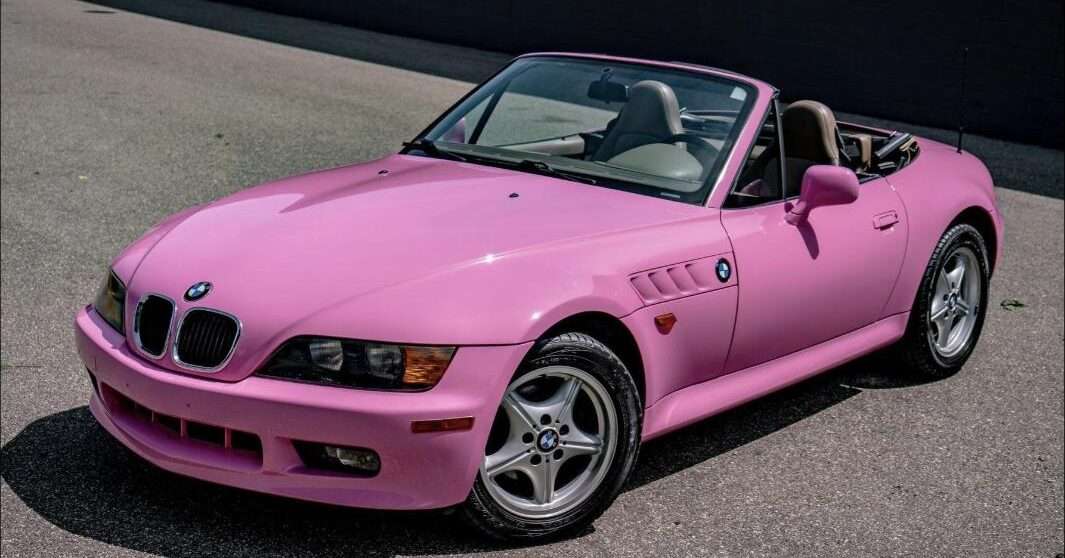
A Sydney Sweeney-signed movie car reveals more about celebrity provenance than it does about BMW’s most affordable roadster
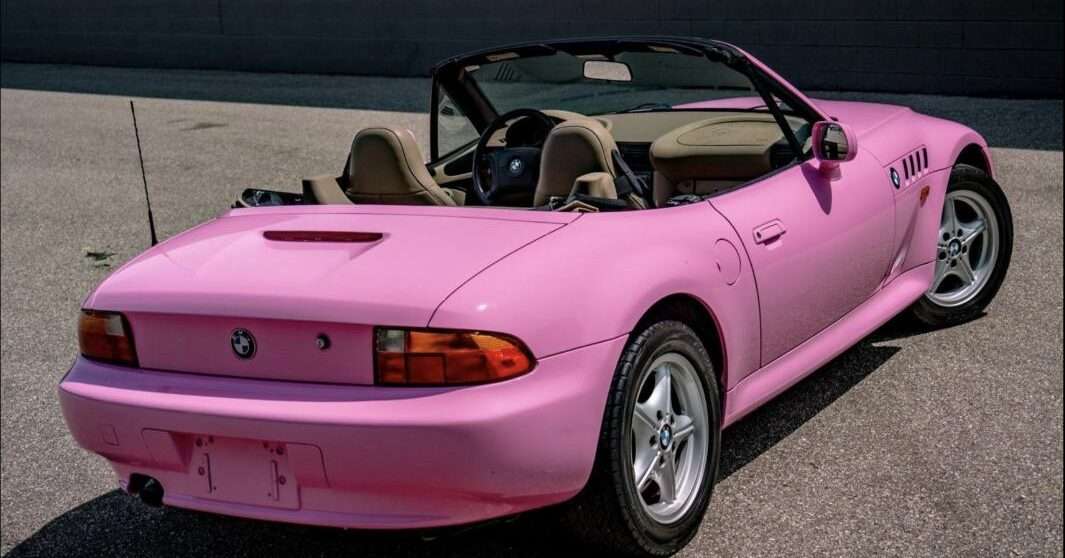
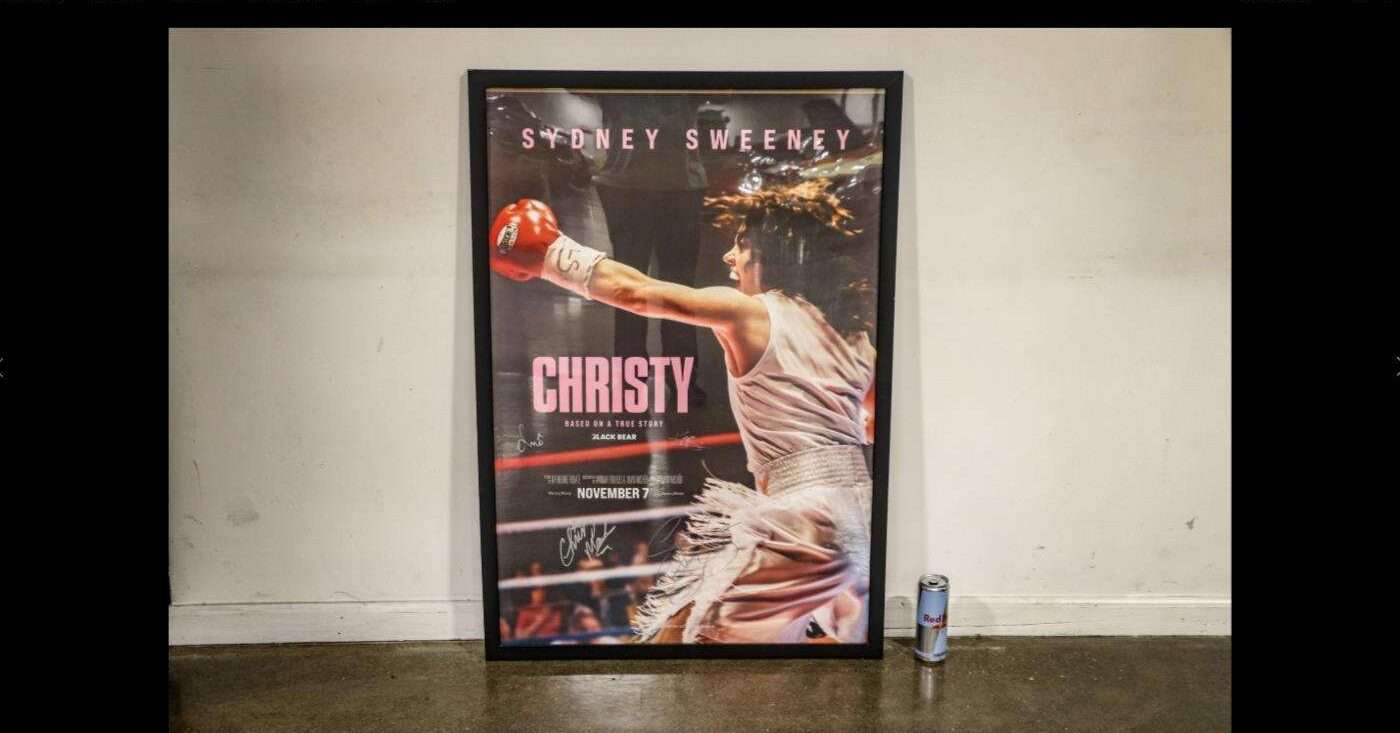
Cars & Bids closed the sale of a 1997 BMW Z3 1.9i Roadster this week for $12,855 — a price that would raise eyebrows for a base-model Z3 in any context, let alone one wearing a non-factory pink repaint, an automatic gearbox, an illuminated airbag light, and 65,100 miles. The car’s appeal has nothing to do with driving dynamics. It was repainted for use in Christy, the biographical film starring Sydney Sweeney as boxer Christy Martin, and the dashboard carries Sweeney’s signature. A movie poster signed by both Sweeney and Martin herself came with the sale.
The obvious question for collectors watching this result: did the Sweeney connection actually move the number, or would this car have brought similar money as a plain used BMW regardless of what Hollywood did to it? That distinction matters enormously, because “celebrity provenance” and “genuine collector value” are not the same asset class, and conflating them is how buyers overpay for the wrong reasons.
Why the pink matters beyond the paint
The color isn’t an arbitrary production choice. Christy Martin fought through the 1990s under Don King’s promotional banner, and she built her identity in the ring by wearing pink — a deliberate rejection of the idea that a fighter needed to look tough to be taken seriously. The car’s finish, then, isn’t just a movie prop gimmick; it’s a visual callback to the real person’s public image, which is precisely the kind of detail that separates a thoughtful piece of entertainment memorabilia from a cheap tie-in. According to the auction listing, the car itself was reportedly “given away in promotion of the film,” meaning its film-world provenance is documented rather than assumed — an important distinction for any buyer considering this category.
What a plain Z3 1.9i actually brings
To answer the valuation question honestly, you have to look past the headline number and at what unmodified, comparable cars are actually trading for in the current market. Hagerty’s price guide places a #3-condition (“Good”) 1997 Z3 1.9i at $9,100, with a further 15 percent deduction for automatic transmission — the same gearbox as our subject car — bringing a realistic like-for-like benchmark down to roughly $7,700. Hagerty’s own data shows the average sale price for a good-condition 1.9i currently sits closer to $10,400.
Real auction results tell the same story with more precision. A one-family-owned 1996 Z3 1.9 — manual transmission, clean history, the kind of documentation collectors actually pay for — sold on Bring a Trailer for $7,719 in mid-June 2026. Another unmodified 1996 1.9 sold for $6,200 in late May. Even stepping up to the more powerful and inherently more desirable 2.8-liter six-cylinder cars, a 42,000-mile 1997 Z3 2.8 with a five-speed manual brought $12,750 in late May — essentially identical money to what our automatic, higher-mileage, repainted four-cylinder car achieved.
That last comparison is the one that matters most. A base four-cylinder Z3 with an automatic gearbox and a non-original paint job — three attributes that would each individually depress value in a conventional collector transaction — sold for the same money as a manual six-cylinder example in better original specification. The gap between what this car “should” have brought as a Z3 and what it actually brought as a piece of Christy memorabilia is somewhere between 65 and 100 percent, depending on which benchmark you use.
Two different markets, briefly occupying the same auction listing
This is the real significance of the sale, and it’s a pattern collectors will see more often as auction platforms increasingly host entertainment-adjacent vehicles alongside genuine collector cars. The bidders competing for this Z3 were not cross-shopping it against other 1997 roadsters. They were bidding against each other for a tangible connection to a film and, through it, to Christy Martin’s story — a true story significant enough that a studio built a biopic around it and cast one of the more bankable actresses working today. The Z3 itself is almost incidental; it’s the canvas the story was painted on.
That’s an important thing for serious collectors to internalize before writing a check for something similar. Automotive provenance that compounds in value over decades — matching-numbers race history, factory competition use, ownership by figures central to a marque’s own story — draws its strength from the car’s relationship to automotive history itself. Entertainment provenance draws its strength from cultural relevance that can fade, be recast, or simply be forgotten within a generation. A Steve McQueen film car endures because McQueen’s connection to car culture was genuine and permanent. A repainted rental-fleet roadster used briefly in a single production is a different proposition entirely, and its long-term liquidity depends entirely on whether Christy remains culturally relevant a decade from now — something no amount of paint or autographs can guarantee.
None of this means the buyer overpaid in any meaningful sense. Eleven thousand, eight hundred views and 348 watchers on a base-model Z3 tell you this listing generated attention no ordinary example would ever attract, and that attention is precisely what the winning bidder purchased. But it’s worth being clear-eyed about what changed hands: not a meaningfully better BMW, but a more interesting story attached to an ordinary one.
Collectors rarely pay a premium for horsepower alone. They pay for moments — real or cinematic — that a car happens to have been present for. The moment this Z3 was part of cost roughly five thousand dollars more than the car underneath it. Whether that premium holds is a question the collector market, not the automotive one, will ultimately answer.
Source: 1997 BMW Z3 1.9i Roadster from “Christy,” Cars & Bids. Photos courtesy of Cars & Bids.
The collector car market, every weekday morning.
Auction results, price moves and what’s crossing the block, read in four minutes. Free, from Modern Car Collector.
No spam, unsubscribe in one click. Or read more about the Brief.



 Kyle Matthews