

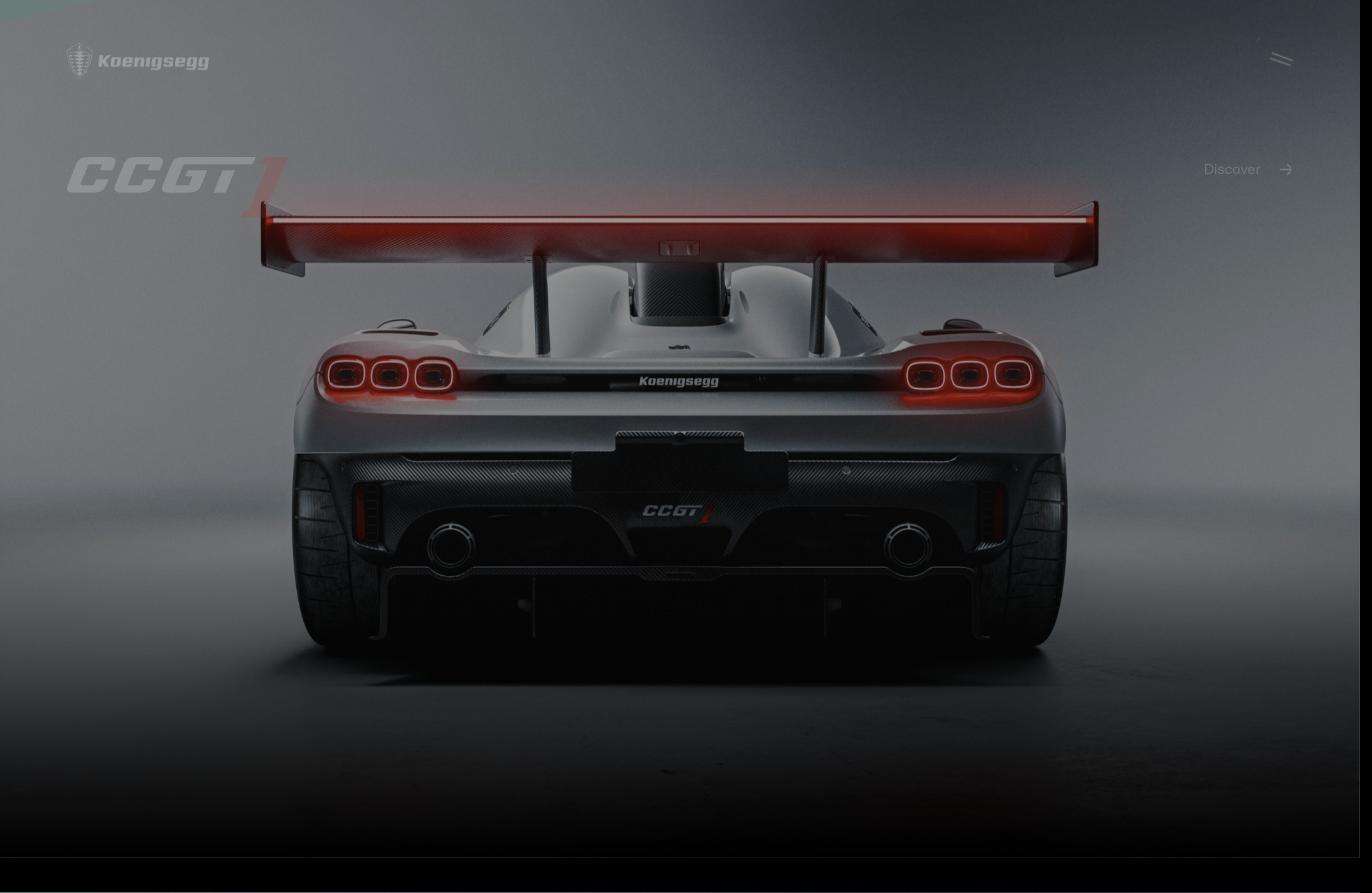
Every one of the seventy Koenigsegg CCGT1s built will find an owner. That much we already know, because it happened before most of the world had seen the car, and before Koenigsegg disclosed what it costs. Collectors committed to a bespoke, track-focused hypercar sight-priced, on the strength of a name and a story alone. That detail says more about the state of hypercar collecting in 2026 than any horsepower figure could.
The CCGT1, revealed this month during Monterey Car Week, was built to commemorate an unfinished chapter of Koenigsegg’s own history. Understanding why that chapter matters, and why sophisticated buyers were willing to commit before ever seeing a price, means going back more than two decades, to a race car that was never allowed to race.
In the mid-2000s, Christian von Koenigsegg set out to build a car for the FIA’s GT1 class at Le Mans. He engineered the CCGT to every regulation the category required. Then the FIA changed course, shifting GT1 eligibility toward high-volume manufacturers rather than boutique builders producing a handful of cars a year. A rulebook written for mass-production homologation effectively wrote Koenigsegg out of its own class. The CCGT program ended after a single prototype, and that prototype never turned a competitive lap.
Twenty-some years later, that lone CCGT has been restored, and it is finally set to compete, in a GT1 historic class, against cars from the era it was built for. For a manufacturer whose identity rests on doing the impossible thing properly, an unraced race car left an open wound that no spec sheet could close. The CCGT1 is Koenigsegg closing it, publicly, on its own terms.
The name is deliberate, and so is the lineage. Just as the CC850 was built to honor the CC8S, the car that made Koenigsegg a homologated manufacturer in the first place, the CCGT1 is built to honor the CCGT. It is, in effect, a tribute to a tribute. Koenigsegg does not treat its own history as marketing copy; it treats it as unfinished business. And unfinished business, this reveal suggests, sells.

Underneath the sentiment is a genuinely serious machine. The CCGT1 begins life as a CC850 chassis, but every body panel apart from the roof and doors has been redesigned for aerodynamic load rather than styling. Koenigsegg’s twin-turbocharged V8 produces 1,280 horsepower on standard pump fuel and 1,600 horsepower on E85, sent through the company’s Light Speed Transmission, available with a standard sequential shifter or an optional six-speed Engage Shift System that adds a gated manual pattern, a clutch pedal, and a fully automatic mode for road use. An active rear wing, cycling automatically between low-drag, air-brake, and high-downforce settings, works with a front splitter and sculpted underbody to generate roughly 1,760 pounds of downforce at 155 mph. Much of the bodywork is finished in what Koenigsegg calls Ghost Fibre, a proprietary lightweight composite the factory offers as an alternative to exposed carbon weave.
None of that, by itself, makes a car collectible. Koenigsegg builds scarcity by default; every model it has produced has been scarce. What makes the CCGT1 worth a collector’s attention is what its sales process reveals about how this manufacturer’s clientele actually behaves. Production was capped at seventy cars, and by the time of the public reveal, all seventy were reportedly already claimed. If accurate, Koenigsegg’s most committed buyers signed on for an unseen, unpriced, motorsport-flavored hypercar on the strength of the brand’s word alone.
That appetite is not confined to factory-original cars, either. Earlier this year, a heavily customized Koenigsegg Jesko commissioned through Mansory changed hands for a reported five million dollars, evidence that Koenigsegg ownership itself has become a kind of currency inside the collector world, independent of any single car’s factory specification.
This is not a new pattern for the brand, either. The Regera, Koenigsegg’s first hybrid hypercar, sold out its run of eighty-five examples by 2017, before many had even been delivered. Cars that carried an original list price near $1.9 million are now surfacing at auction with estimates well north of $2.8 million. Buyers who commit early to a Koenigsegg idea are, functionally, underwriting the company’s next one before it exists. The CCGT1 asks the same question the Regera did nearly a decade ago: does the story carry enough weight to commit without a number attached to it? Seventy times, at minimum, the answer was yes.
For collectors evaluating CCGT1 examples once they eventually reach secondary owners, and some will, regardless of what today’s allocation agreements say, documentation will matter more than it does on an ordinary limited-run hypercar. This car was built explicitly to honor a specific, verifiable piece of unraced motorsport history. Buyers should expect, and should demand, factory paperwork connecting each chassis to that story: build records, delivery documentation, and eventually an ownership history that ties back to Koenigsegg’s own archive. A CCGT1 divorced from that narrative is simply an extremely fast, extremely limited car. A CCGT1 with the paperwork intact is a documented chapter in a twenty-year story, and that distinction is where long-term value will actually live.
It also fits a pattern this publication has tracked all summer. At this year’s Ghost Squadron Tour into Monterey Car Week, dozens of Koenigsegg owners, including Christian von Koenigsegg himself, drove their cars three hundred miles into the Peninsula rather than trailer them in. That is not incidental to the CCGT1’s story. It is the same collector base, exhibiting the same instinct: buying into a manufacturer’s mission rather than merely its output, and treating ownership as participation rather than acquisition.
Horsepower figures age quickly; every hypercar manufacturer will eventually build something faster than the CCGT1. What doesn’t age is a company finishing an argument it started twenty years ago, in front of the same community it started it with. That is the actual collectible here, not the wing, not the chassis count, but the proof that Koenigsegg’s buyers will underwrite an ending before they have seen the price of admission. For a manufacturer whose reputation was built on refusing to compromise with regulators, there may be no more fitting way to close the loop than finally racing the car the rulebook wouldn’t let it run, and selling out its tribute before anyone thought to ask what it cost.
The collector car market, every weekday morning.
Auction results, price moves and what’s crossing the block, read in four minutes. Free, from Modern Car Collector.
No spam, unsubscribe in one click. Or read more about the Brief.



 Elizabeth Puckett
  John Lloyd
  Kyle Matthews