

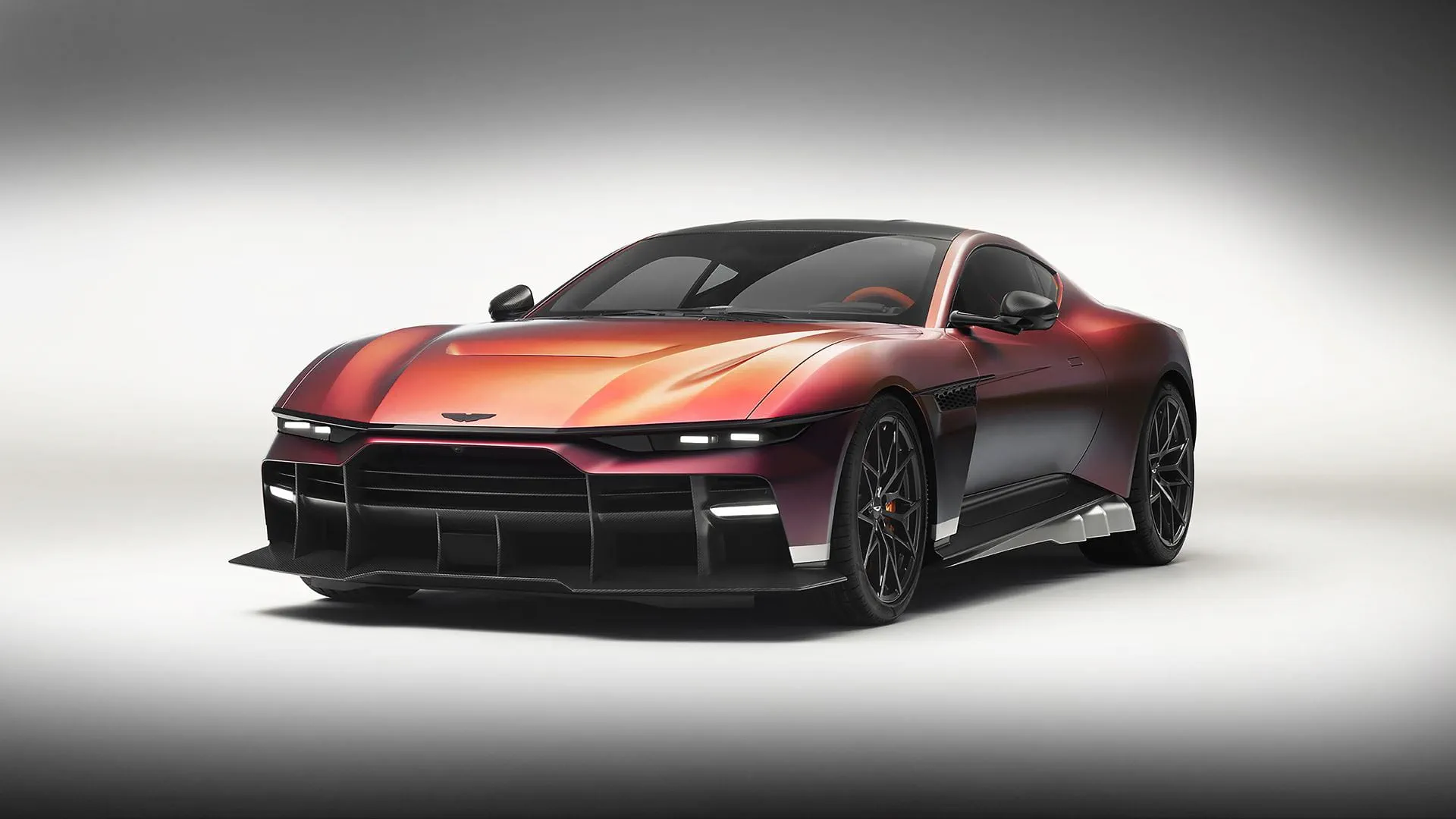
Aston Martin introduced Valen on the lawns of Monterey during Car Week on August 14, backed by the kind of numbers that make for an easy headline: 850PS, 1,000Nm of torque, a 3.0-second run to 60 mph, and a 214 mph top speed from a 5.2-litre twin-turbocharged V12. Aston Martin calls it the most powerful front-engined production car in the world, and the most powerful front-engined car the company has built in its 113-year history. Both claims are true. Neither is the reason serious collectors should be paying attention.
A Lineage Moving Toward the Middle
The real story is timing. Valen is the fourth car to emerge from Q by Aston Martin’s bespoke V12 special-series program, following DBR22, Valour, and Valiant, and it arrives at a moment when Aston Martin’s broader lineup is moving in the opposite direction. Valhalla is a mid-engine plug-in hybrid. Valkyrie is a mid-engine hybrid hypercar developed with knowledge from the company’s Formula 1 program. The center of gravity, literally and figuratively, has shifted toward the middle of the car and toward electrification. Valen, front-engined and powered by nothing but a V12 and two turbochargers, is a deliberate swim against that current.
That is worth sitting with. When a manufacturer builds a defiantly analog flagship at the exact moment its broader lineup is moving toward hybridization, the resulting car tends to carry more historical weight than its specification sheet suggests. It becomes the clearest, most extreme statement of an engineering philosophy just before that philosophy recedes. Collectors have seen this pattern before, and the cars that occupy that position, the last of an era rather than simply another entry in it, tend to age well in the market regardless of what they cost when new.
Rarity Is a Multiplier, Not a Substitute
Production is capped at 150 cars, which sits between the two most relevant reference points in Aston Martin’s current special-series lineage: Valour, limited to 110 examples, and Valiant, limited to just 38. On paper, Valen is the least rare of the three. That does not make it the least significant, and it is worth being direct about why. Rarity multiplies desirability; it does not substitute for it. A run of 150 examples is still minuscule against Aston Martin’s overall output, and Valen has something neither Valour nor Valiant can claim: it is the most powerful expression of the formula, arriving as what looks very much like the final word before the V12 special series either evolves or ends. History tends to reward the car that closes a chapter more than the one that merely continues it.
The Manual Question
There is a quieter detail in the specification sheet that matters more than it first appears. Both Valour and Valiant were built around six-speed manual transmissions, a deliberate and expensive engineering decision at a time when three-pedal cars had all but disappeared from anything with this much power. Valen goes the other direction, pairing its V12 with an 8-speed ZF automatic tuned with shift logic developed for Aston Martin’s Vantage GT4 racing program. Enthusiasts will debate whether that is a step backward. For collectors, it is not, so much as it is a signal. Aston Martin is treating Valen less as a driver’s toy and more as the outer limit of what its front-engined GT architecture can achieve, tuned for outright capability rather than mechanical romanticism. That makes it a different kind of collectible than a manual Valour, and it should be judged on those terms rather than penalized for lacking a clutch pedal.
Configuration Will Decide the Long-Term Story
Design tells a similar story. The full carbon fibre body, available with an exposed weave finish, and the option of Q Ultra’s colour-shifting Andromeda Red paint are exactly the kind of details that matter enormously to the eventual resale conversation, because they are what will separate a well-optioned example from an exceptional one. So will the choice between the standard Sport Plus seats and the lightweight carbon fibre buckets, and the five-tier interior trim hierarchy Aston Martin has built around Valen. On a car this limited, configuration will do as much to determine long-term value as anything under the bodywork. Buyers who treat Q by Aston Martin’s personalization program as a curation exercise rather than a checklist are the ones who tend to own the examples people still want a decade later.
Monterey Timing, and What Collectors Should Watch
Valen’s debut at Monterey Car Week was not incidental. It placed the car in front of the most concentrated audience of serious collectors anywhere in the world, in the same week Modern Car Collector examined what a half-billion-dollar auction week does and doesn’t say about the broader market, and the same gathering that has helped fuel the rise of a new kind of hypercar collector. Monterey has become the venue where manufacturers learn which stories resonate with the buyers who actually move the market, and an uncompromising, front-engined, non-hybrid V12 special is a very different kind of story than an electrified halo car. Both can be legitimate. They are not, however, the same bet on the future.
What should collectors actually watch here? Allocation will tell the real story. Q by Aston Martin has historically prioritized existing clients for its special series, an approach not unlike how Ferrari has managed access to its own limited editions, and not unlike the dynamics behind Ferrari’s recent $40 million sale of its first electric car to a repeat client rather than a new buyer. Whether Valen’s 150 slots go primarily to Aston Martin loyalists or open more broadly to new hypercar money will shape how the car is perceived a decade from now. A special series closely associated with genuine marque loyalists tends to build the kind of coherent, documented ownership history that collectors pay a premium for later. One that gets flipped through consignment houses within eighteen months typically does not.
None of this requires Valen to be underpriced, oversubscribed, or record-setting to matter. It requires only that it be honest about what it is: not the fastest or the rarest car Aston Martin has ever built, but very possibly the last car of its kind the company will build in exactly this way. Collectors have historically paid less attention to the car that started something and more to the one that finished it. Valen is a strong candidate to be remembered as the latter, and that is a far more interesting story than 850 horsepower.
The collector car market, every weekday morning.
Auction results, price moves and what’s crossing the block, read in four minutes. Free, from Modern Car Collector.
No spam, unsubscribe in one click. Or read more about the Brief.
Related Posts:
- Record Ferraris, Rare Icons and 15,000 RPM: The Week…

- Everything Modern Car Collector Covered Last Week
- The Aston Martin AMB 002 Isn't Collectible Because…

- Ferrari F50 Value Nearly Tripled in Two Years.…
- Weekly Roundup: Everything Modern Car Collector…

- The Collector Car Market Paid Up for Certainty This…

 Eve Nowell
  Shawn Henry