

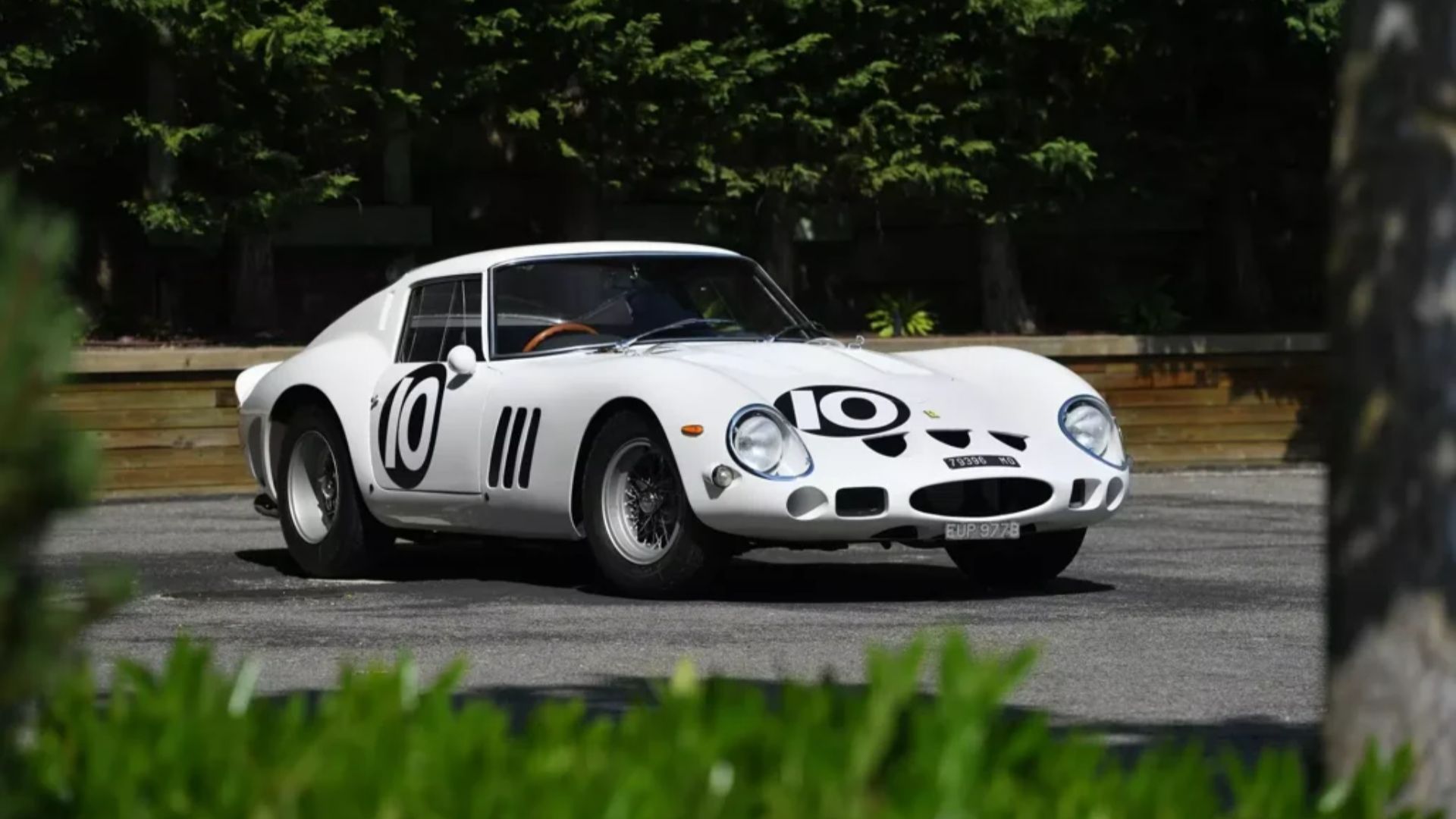
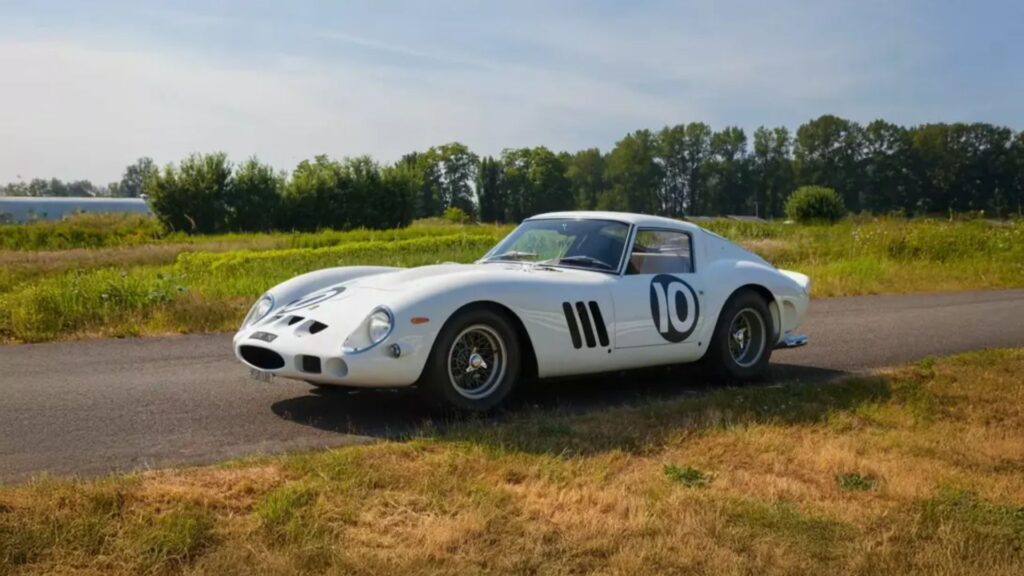
When a Ferrari 250 GTO changes hands, the headline number is rarely the real story. At Mecum’s Kissimmee sale on January 17, the only 250 GTO Ferrari ever finished at the factory in white sold for $38.5 million, well below the $70 million-plus that had been floated ahead of the auction and roughly half of what a GTO commanded in a private sale back in 2018. Within hours, a tidy explanation was circulating: the car, chassis 3729GT, doesn’t carry its original engine. Some posts went further, tying that missing engine to the fireball that consumed a 250 GTO’s V-12 at the 2023 Goodwood Revival. Neither explanation holds up well once you look closely at the car’s actual history.
The GTO shared its Kissimmee lot list with a nearly no-mile LaFerrari Aperta, a pairing Modern Car Collector flagged before the sale as a choice between two very different visions of Ferrari collecting. The Aperta, one of 210 built, sold on the strength of a factory plaque and single-digit mileage. Bianco Speciale was always going to sell on something else entirely: a documented racing life spanning three seasons of top-flight European competition, an unbroken ownership chain, and a color no other 250 GTO left the factory wearing.
Two Fires, One Confusion
The 2023 fire was real, dramatic, and widely filmed: a 250 GTO driven by former Formula 1 racer Karun Chandhok expelled hot oil onto its exhaust approaching the Lavant Straight at the Goodwood Revival and briefly became a fireball. But that was an entirely different chassis, with a completely separate history. The white Bianco Speciale sold at Kissimmee wasn’t anywhere near Goodwood that week, and its own engine story is a period one, decades old, not a recent one.
According to marque historians who have researched the chassis, 3729GT’s original Tipo 168/62 competition V-12 was removed from the car during the 1960s and installed in a Cooper Formula 1 chassis run by the Coombs team. That car, engine included, was destroyed when its transporter caught fire in a remote corner of the Silverstone circuit, decades before anyone treated a 250 GTO as an appreciating asset rather than a weekend racer. When Jon Shirley, the former Microsoft president and longtime Ferrari collector who bought 3729GT in 1999, returned the car to Maranello, Ferrari’s Classiche division cast a new block to the correct specification, a process completed around 2008. The car races today, and sold at Mecum, on that Ferrari-built replacement engine, carrying full Ferrari Classiche Red Book certification.
Why a Swapped Engine Isn’t the Scandal It Sounds Like
This is worth pausing on, because it cuts against the instinct to treat any non-original engine as disqualifying. In period, engines were serviced, blown, and swapped between chassis as a matter of routine; Ferrari’s own works team did it, and privateers like Coombs did too. Matching numbers is a concept the collector market largely imported decades later and applied backward onto cars that were never built, or used, with permanence in mind. A 250 GTO’s value has always rested more on what it did in period, and who did it, than on whether one particular block of aluminum has stayed bolted to the chassis since 1962.
What Bianco Speciale Actually Did
Ordered new by John Coombs, the Guildford Jaguar dealer and team owner who used the GTO partly to benchmark his own E-Type program, chassis 3729GT is one of only nine 250 GTOs built in right-hand drive, a configuration Coombs specified so it could be driven and campaigned on British roads and circuits. Graham Hill, Roy Salvadori, Mike Parkes, Jack Sears and Richie Ginther all drove it in period, and it finished second overall in both the 1962 and 1963 RAC Tourist Trophy at Goodwood, results that helped Ferrari secure back-to-back FIA International Championships for GT Manufacturers. Loaned briefly to Jaguar’s competition department, it reportedly outperformed the E-Type in nearly every test Jaguar’s own engineers ran, an inconvenient data point Coombs absorbed on his own dime. After Coombs sold the car in early 1964, it passed through owners including Jack Sears, who held it for nearly thirty years, before Shirley acquired it in 1999 and returned it to its factory white livery for concours showings at Pebble Beach, the Cavallino Classic and the Goodwood Revival.
The winning bidder at Kissimmee was David S.K. Lee, a Southern California collector well known in Ferrari circles for pursuing the marque’s most significant hypercars in multiple colorways. He described the GTO on social media as the last piece of a long-running collecting goal. That framing fits neatly into a broader pattern: even enthusiastic, well-capitalized GTO buyers today more often arrive by way of modern Ferrari collecting than a lifetime spent following 1960s sports car racing.
The Numbers Collectors Will Actually Compare
A 250 GTO has not traded for under an eight-figure sum in years, and the ceiling is well established. Chassis 4153GT sold privately in 2018 for a reported $70 million, still the highest price ever attached to a GTO. At public auction, the record belongs to chassis 3765, a GTO built to 330 LM specification, which brought $51.7 million at RM Sotheby’s in November 2023, itself the current auction record for any Ferrari. Modern-era Ferrari racing cars occupy a different tier entirely, as Michael Schumacher’s Monaco-winning F2001 showed when it set its own auction record at $18 million. Chassis 3413GT set the previous benchmark at $48.4 million at RM Sotheby’s Monterey sale in 2018, a car RM itself described as among the most original GTOs in existence. Measured against those figures, and against Hagerty’s own pre-sale valuation of $47.85 million for 3729GT, $38.5 million looks like a real discount, and it lands the car comfortably inside the all-time top tier of cars sold at auction, though a distant fifth among GTO results alone.
But the bidding in the room tells a more specific story than a single flaw suppressing an otherwise-hot lot. Mecum opened the car at $50 million and found no takers; the number fell as low as $25 million before bidders engaged in earnest around $31 million to $32 million, and it took nearly ten minutes to grind to a $35 million hammer bid, $38.5 million with fees. That pattern reads as soft, hesitant demand, the kind that shows up when a car has already been shopped privately for a couple of years, as 3729GT reportedly had, without finding a buyer near its ask.
Hagerty analyst John Mayhead, who tracks the GTO market closely, pointed to a combination of factors rather than a single culprit: the replacement engine, yes, but also the car’s exclusively British club-racing resume rather than a Le Mans or Sebring result, its right-hand-drive configuration, its unusual white paint, and a comparatively light restoration history that included a significant repair after a 1963 crash at Silverstone. Every one of those is a legitimate, GTO-specific consideration on its own terms. None of them, individually, explains a nine-million-dollar gap to Hagerty’s own estimate.
A Market Recalibrating, Not Just a Car
What explains the rest of that gap, at least in part, is a market quietly recalibrating around 1960s Ferraris generally. Sports Car Market publisher Keith Martin put it bluntly after the sale, noting that cars of the 1960s are falling off the radar for a collector base whose center of gravity has shifted. The generation that watched Graham Hill and Jack Sears race GTOs in period is now largely in its eighties, and the buyers replacing them increasingly want the cars of their own youth: Testarossas, 288 GTOs, F40s, F50s and later. That shift showed up at the very same Kissimmee sale, where Ferrari Enzo prices moved sharply upward. It also showed up earlier this year when a documented, ultra-low-mileage Jaguar XJR-15 outperformed expectations on certainty rather than rarity alone, and when a Ferrari 250 GT SWB California Spyder set a record at RM Sotheby’s built on paperwork rather than scarcity. Across all three results, documentation and era are doing as much work as chassis numbers.
There is a useful historical comparison here, and it is more damning than any engine story. In 2014, chassis 3851GT, a GTO with a fatal accident in its history, sold at Bonhams’ Monterey auction for $38.115 million, a result seen at the time as disappointing because of that history. Adjusted for inflation, that same result would be roughly $51 million to $52 million today. Mecum’s GTO sold this January for essentially the same nominal number that a considerably more troubled GTO brought twelve years earlier. In real terms, this tier of the market has not simply cooled. It has gone backward.
What Serious Buyers Should Take From This
This is not a story about Ferrari losing its grip on the top of the market. A 250 GT California Spyder Competizione was expected to command over $20 million at Pebble Beach in 2025, and blue-chip Enzo-era cars keep finding buyers when the story and the paperwork line up. It is a story about one specific, aging tier of the pyramid: purely 1960s racing history, sold to a buyer pool that increasingly did not watch that history happen.
For serious buyers, the lesson is not that replacement engines are worthless information. Ferrari Classiche certification, and the honesty with which a seller discloses what it does and does not cover, remains essential diligence. Mecum’s own catalog notably buried the replacement-engine detail rather than featuring it, leaving journalists and marque specialists to surface it after the fact. That gap between what a seller emphasizes and what a knowledgeable buyer needs to know is worth remembering the next time a nine-figure car crosses a block with a tidy highlight sheet and an incomplete engine story.
With all 36 examples of the 250 GTO accounted for and no new supply possible, the car’s scarcity was never in question and never will be. What is now in question is demand, and specifically whether the collectors who set prices for cars like this are still the collectors who once watched them race. Bianco Speciale is a genuinely important Ferrari: one-of-one in color, raced by a murderers’ row of period talent, and honestly presented as a car that lived a working life rather than a sheltered one. That it sold for $38.5 million rather than $70 million says less about a sixty-year-old engine swap than it does about who, today, is willing to pay for a memory instead of a spec sheet.
The collector car market, every weekday morning.
Auction results, price moves and what’s crossing the block, read in four minutes. Free, from Modern Car Collector.
No spam, unsubscribe in one click. Or read more about the Brief.


 Shawn Henry
  Kyle Matthews
  Eve Nowell