

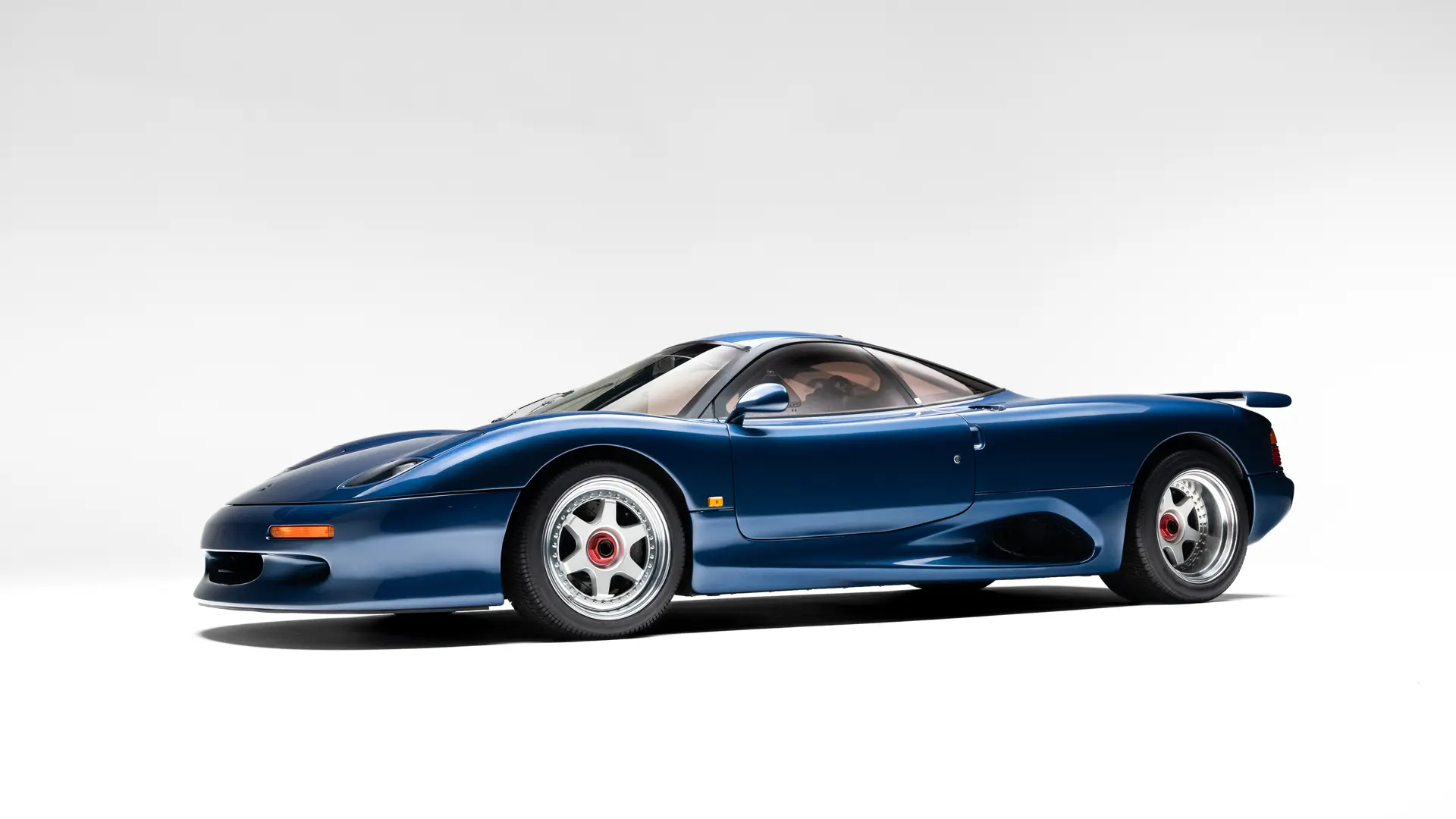
Chassis 029 is a 1991 Jaguar XJR-15 that has spent nearly its entire life in a climate-controlled garage rather than on a road. Completed at JaguarSport’s Oxfordshire works on August 8, 1991, it shows 191 miles, has never been titled or registered anywhere, and is being offered this August by RM Sotheby’s in Monterey with an estimate of $1,000,000 to $1,400,000. That is a striking number for a car most American collectors have never seen in person. It is not, however, the real story.
The real story is what a nearly untouched, unregistered supercar reveals about how seriously the market now takes analog, motorsport-bred machinery from a manufacturer that is actively dismantling everything that made cars like this possible in the first place. The XJR-15 is not valuable simply because it is rare, though it is: only 50 were built, and just 27 left JaguarSport in road-legal trim. It is valuable because it is one of the last surviving documents of a version of Jaguar that competed, won, and then built a road car to prove it could.
That version of Jaguar existed for a remarkably short window. Tom Walkinshaw Racing partnered with Jaguar in 1986 to form JaguarSport, aiming squarely at the World Sportscar Championship the marque had once ruled with the C-Type and D-Type. The XJR-9 delivered, winning the 24 Hours of Le Mans in 1988, and the XJR-12 repeated the feat in 1990. Demand for a road-going interpretation of that success followed almost immediately, and JaguarSport obliged with a car that borrowed far more from the racer than badge and reputation. TWR has kept that lineage alive into the present day, most recently through a V-12-powered XJ-S restomod built for buyers who want the engineering ethos without the 1990s chassis.
The XJR-15 used a central monocoque tub conceptually related to the Le Mans-winning XJR-9’s, engineered by Jim Router and Dave Fullerton and wrapped in bodywork by Peter Stevens, who would go on to shape the McLaren F1. It was, notably, the first production road car built entirely from a carbon fiber and Kevlar composite, years before that material became a marketing headline on any other road car sold to the public. Beneath the bodywork sat a 6.0-liter, 450-horsepower version of the V12 that had powered Jaguar’s Le Mans winners, driving through the same suspension architecture, AP Racing brakes at all four corners, and a curb weight of roughly 2,300 pounds. On paper, that power-to-weight ratio outran nearly every rival of the era, and it did so through a five-speed, unsynchronized gearbox the driver operated without any electronic assistance whatsoever.
JaguarSport did not simply sell the XJR-15 as a road car and call it finished. Sixteen of the fifty examples built were prepared for the 1991 Intercontinental Challenge, a three-race, single-make series that supported the Formula 1 weekends at Monaco, Silverstone, and Spa-Francorchamps, reportedly with a seven-figure prize awaiting the season’s overall winner. No other manufacturer of the era asked its customers to go wheel-to-wheel in identical machinery on a genuine Grand Prix undercard. It remains one of the more unusual bundled propositions in postwar automotive history: buy the car, and you bought a seat on the grid.
Chassis 029’s own history explains why originality carries more weight here than outright rarity. Delivered new to a private collector in Singapore, it was stored in a climate-controlled facility and driven only enough to keep it serviceable, accumulating fewer than 150 miles before that owner parted with it in 2015. It then passed through Australia before joining its current American collection in 2017, still on a bill of sale and never issued a title. It is not the only XJR-15 to surface this way. A sister car that came to market showing just 78 original miles tells the same story: original owners who understood immediately what they had, and who simply put the car away rather than drive it. That is not typical behavior for a 1991 supercar owner. It is closer to how a family treats an heirloom.
Collectors sometimes talk about low mileage as though it were the whole story. It isn’t. A car can be driven sparingly and still be re-registered, re-titled, serviced by three different shops, and quietly, incrementally altered along the way. Chassis 029 has none of that history to explain away. It has never been registered at all, which means there is no accumulated paper trail of ownership transfers, no re-titling in a new state or country, and no incentive for anyone along the way to have freshened panels, replaced trim, or quietly improved anything ahead of a resale. For a car whose entire structure is a single carbon fiber and Kevlar tub, that distinction matters more than it would on a conventional steel-bodied classic. Composite structures are difficult and expensive to repair invisibly, and a tub that has never needed repair is worth a genuine premium over one that merely looks unmarked.
It is worth asking why the XJR-15 commands this kind of reverence while its better-known sibling, the Jaguar XJ220, still carries some baggage in the collector conversation. The XJ220 was faster in a straight line and far more famous to the public, but it arrived with a turbocharged V6 in place of the promised V12 and all-wheel drive, and speculators who had queued up during the boom years of the late 1980s were left nursing both financial losses and grudges. The XJR-15 never made that promise and never broke it. It was a smaller, harder-edged project built by people who had just won Le Mans, sold in far fewer numbers, and never associated with the exuberant excess that came to define its more famous stablemate. Between the two, the XJR-15 has aged as the more honest car, and the market has increasingly agreed.
Timing gives this sale an added edge. Jaguar in 2026 bears almost no resemblance to the company that built chassis 029. The brand has halted combustion sales in its home market and unveiled the Type 00 concept as the face of an all-electric relaunch, drawing no shortage of internal and public skepticism along the way as it reworks its identity from the ground up. Whatever one thinks of that strategy, it has the effect of making a car like the XJR-15 read less like a used supercar and more like a historical artifact: proof that this manufacturer once built a V12-powered, carbon-tubbed, driver-operated machine to celebrate winning the world’s toughest endurance race, using nothing but its own engineering department and a racing partner. That version of Jaguar is not coming back. The car is what is left of it.
This is not the only Le Mans-winning bloodline making an appearance at Monterey Car Week this year. A 1991 Mazda 787B is heading to the Motorsports Reunion at Laguna Seca on similarly rare terms. Placed side by side, both machines say something about where serious collector attention is migrating: toward cars whose road-going or track-going existence is inseparable from a specific, verifiable competition result, rather than toward horsepower or top-speed claims alone.
Collectors rarely pay a premium for horsepower alone. They pay for proof: proof of a result, proof that a car was never asked to be anything other than what it was built to be, and proof that nobody along the way tried to improve on the original. Chassis 029 offers all three, in a chassis that has barely moved since a factory technician signed off on it in August 1991. Whether it sells at the top of its estimate or beyond it, the number that will matter most to serious buyers is not the hammer price. It is 191, and the fact that almost no one has ever seen this car move. See it here.
The collector car market, every weekday morning.
Auction results, price moves and what’s crossing the block, read in four minutes. Free, from Modern Car Collector.
No spam, unsubscribe in one click. Or read more about the Brief.
Related Posts:
- Record Ferraris, Rare Icons and 15,000 RPM: The Week…

- Lot of the Day: A Factory-Converted 1983 Lancia 037…
- The Collector Car Market Paid Up for Certainty This…
- Everything Modern Car Collector Covered Last Week
- Ferrari F50 Value Nearly Tripled in Two Years.…
- Ferrari Daytona SP3 Value Jumped 168% in Ten Months.…
 Shawn Henry
  Kyle Matthews
  Eve Nowell