
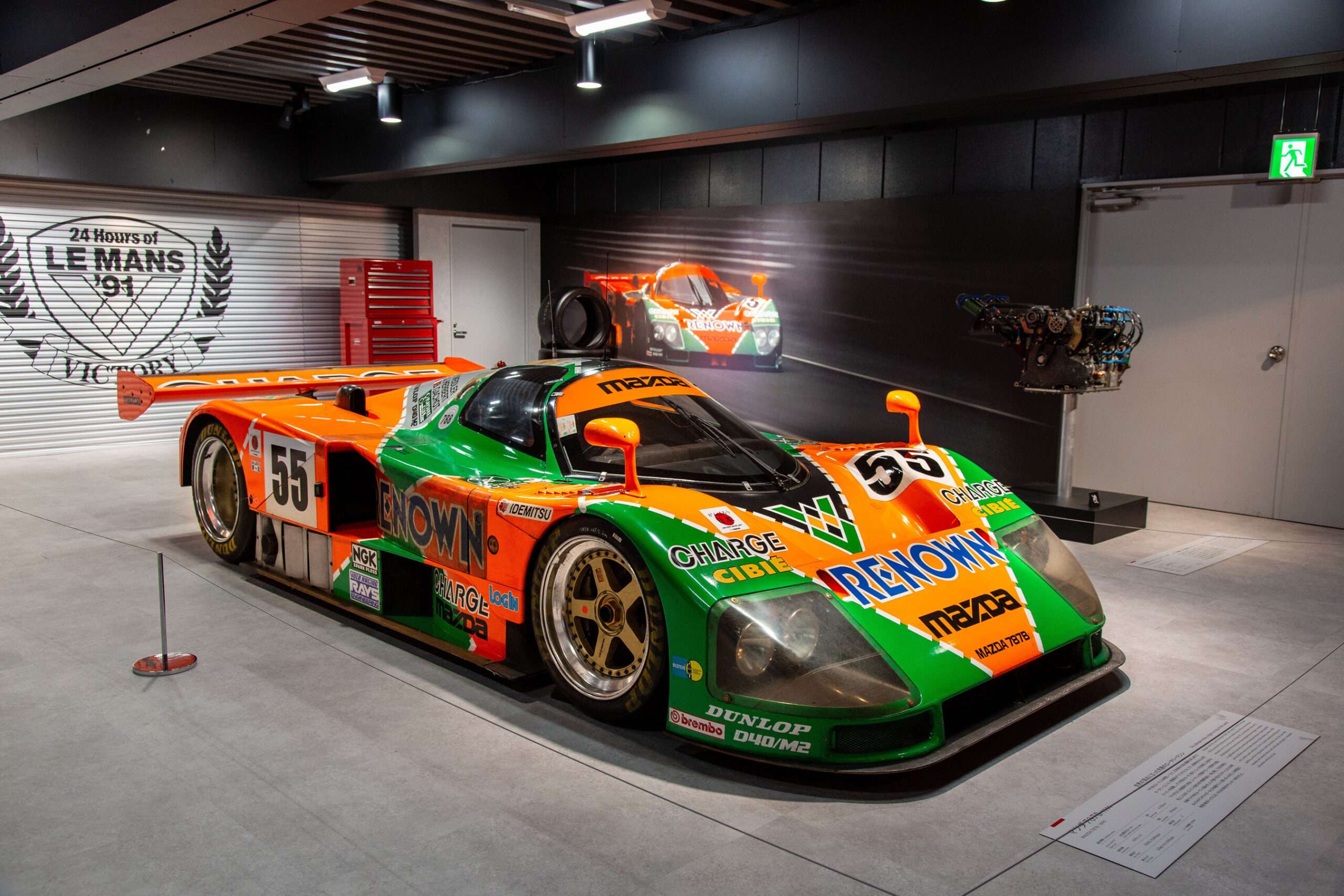
There’s exactly one rotary-engined car that has ever won the 24 Hours of Le Mans, and Mazda is putting it on a plane. The company confirmed that its 1991 Le Mans-winning 787B is coming from Japan to headline the 2026 Rolex Monterey Motorsports Reunion, running August 12–15 at WeatherTech Raceway Laguna Seca. For a lot of American enthusiasts, this is the first realistic shot at hearing the thing in person—and “hearing” is the operative word.
Why this specific car matters more than most museum pieces
Let’s be precise about what’s being shipped, because Mazda built more than one of these. Three 787Bs were constructed for the 1991 season, and the one that matters is chassis 002—the No. 55 car that Johnny Herbert, Volker Weidler, and Bertrand Gachot drove to overall victory at Le Mans. Mazda states it’s bringing the Le Mans winner, wearing its orange-and-green Renown livery. That car was retired from competition immediately after the race and has lived at Mazda’s Hiroshima headquarters ever since, which is exactly why seeing it run on U.S. soil is a genuine event and not just another heritage-fleet appearance.
The win itself remains a statistical freak. As of today, chassis 002 is still the only car to win Le Mans outright without a conventional piston engine, and it was the first overall victory by a Japanese manufacturer—Toyota wouldn’t manage the same until 2018. The winning car covered 362 laps and 4,932.2 km, both records for the reconfigured Circuit de la Sarthe at the time.
The engine is the whole story—and the reason it’s so loud
Under the bodywork sits the R26B, a 2.6-liter four-rotor Wankel. If you only know rotaries from a tired RX-8, recalibrate: this is a different animal built on the same operating principle. Instead of pistons pumping up and down, triangular rotors sweep around inside epitrochoidal housings, firing three combustion events per rotor per revolution. Spin four of those to 9,000 rpm and you get an acoustic signature no V8 or V12 can replicate—higher-pitched, more frequent power pulses, and physically painful up close. Contemporary accounts from 1991 describe marshals warning spectators to cover their ears. Mazda has scheduled demonstration laps and live engine fire-ups across all four days at Laguna Seca, so plan accordingly.
Related Article
- Broad Arrow’s First Quail Auction: 175 Cars, One Market Read
- Bentley’s Mulliner Gives the Supersports a Side-to-Side Paint Fade
Here’s the engineering that separated the 787B from the 787 that flopped a year earlier. Mazda’s engineers gave each rotor three spark plugs, fitted ceramic apex seals to fix the reliability weakness that had haunted earlier rotaries, and added a continuously variable intake system with telescoping runners that slid between long and short to keep torque flooding across the rev range—the one thing rotaries are historically bad at. In race trim the R26B made roughly 700 horsepower, with qualifying maps reportedly nudging 900. The whole car weighed only about 830 kg.
But the win wasn’t about outright power. Mazda knew it lacked the single-lap pace of the Mercedes and Jaguar entries—the fastest 787B qualified well down the order. So the team optimized for fuel economy and durability, hired six-time Le Mans winner Jacky Ickx as a consultant, and drilled its drivers to run fast on the straights while feathering the throttle through slow corners to hit fuel targets. Over 24 hours and 28 pit stops, the winning car needed only fuel, tires, one oil top-up, a brake change, a nose swap, and a precautionary wheel-bearing change. The favorites broke or got penalized. Consistency won.
One detail worth filing away: the 787B was the first car to win Le Mans on carbon brakes, a technology now standard at the top of endurance racing.
The “banned for winning” myth, corrected
You’ll hear that Mazda’s rotary was outlawed because it won. That’s backwards. Sports-prototype regulations were already shifting toward 3.5-liter naturally aspirated engines aligned with Formula 1, and 1991 was set as the last season rotaries could run. Mazda committed to its Wankel precisely because it was the swan song. The 787B won under a rule set that was already sunsetting its engine—the timing just made it look like retaliation. Rotaries were gone from the championship for 1992, which is a big part of why this car carries the weight it does.
The supporting cast and the practical takeaway
The 787B anchors a broader Mazda display spanning six decades: the 1967 Cosmo Sport that kicked off the rotary road-car era, the 1989 767B-002, the 1990 787-002, a 1991 RX-7 GTO, the 1992 RX-792P, and the 2019 RT24-P prototype. On the driver side, Japanese endurance icon Yojiro Terada is slated to pilot the 787B during Friday and Saturday’s Japanese Cars Exhibition Sessions, with Tristan Nunez and Tom Long handling the 767B and 787 in Group C running, and IMSA veteran Tommy Kendall appearing with his own championship-winning RX-7.
Related Articles
- Porsche’s “Raceborn” Exhibition Marks 75 Years of Motorsport
- 10 Coolest Restomods for Sale Right Now
Two more things for anyone planning the trip. Both the 787 and 787B are also slated for the Pebble Beach Concours lawn on August 16 in a Japanese Motorsports class—a notable milestone, since a concours long defined by prewar European coachwork inviting a screaming rotary prototype tells you Japanese racing machinery has fully crossed into blue-chip collector territory. And if you can’t get to California, Mazda points to a livestream on the track’s Facebook and YouTube channels. But understand what you’d be missing: the 787B’s entire appeal is a thing microphones have never fully captured. This is a car you feel in your sternum. Go stand next to it.
Images Via: Mazda
The collector car market, every weekday morning.
Auction results, price moves and what’s crossing the block, read in four minutes. Free, from Modern Car Collector.
No spam, unsubscribe in one click. Or read more about the Brief.
Related Posts:
- A Mazda Prototype Caught Fire at Laguna Seca. The…
- Monterey Car Week 2026: Complete Weekend Round-Up…
- Mazda Staged a Music Festival to Launch the ND MX-5.…
- Mazda's Le Mans History Goes to Mecum Monterey: The…
- This 191-Mile Jaguar XJR-15 Is a Record of Who…
- Ayrton Senna’s Honda NSX Heads to RM London. The…
 John Lloyd