

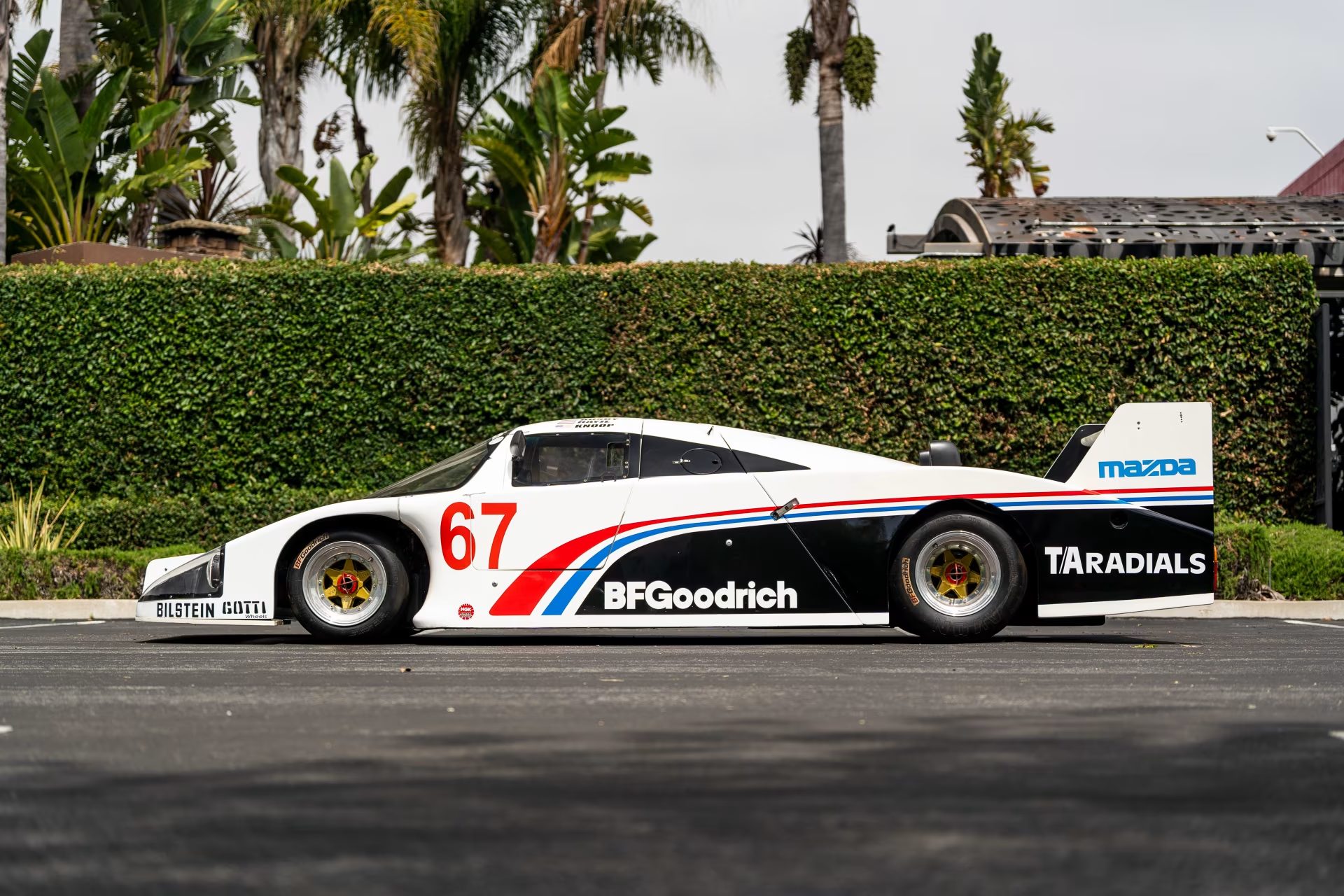
When the Mecum Monterey 2026 auction crosses the block this summer, two of the most historically significant Japanese-powered prototypes ever built will be offered back to back. Lots R21 and R22 are sister cars from Jim Busby Racing’s legendary 1984 campaign: a pair of Lola T616 prototypes powered by Mazda’s screaming 13B rotary engine. Together they represent the moment a Japanese manufacturer first conquered its class at the 24 Hours of Le Mans.
Built in England by team manager Jim Tully, Chuck Patrick and Jim Busby, the T616 was a purpose-built C2-class endurance racer. Each car was wrapped around an aluminum honeycomb monocoque chassis and carried a 1.3L Mazda 13B rotary producing roughly 300 horsepower, fed through MSD ignition and routed to a Hewland 5-speed manual transaxle. Light, compact and rated for a top speed of 200 MPH, the package was perfectly suited to the efficiency-driven battles of mid-1980s sports car racing. Both cars wore the distinctive BFGoodrich white-and-black livery with red and blue stripes over a black interior.
Beyond their racing pedigree, the pair played a pivotal role in tire development. As part of the BFGoodrich 3,000-mile tire development program, these were among the first two cars to run radial street tires on the high banks of Daytona, proving that production-based radials could survive the punishment of top-flight endurance competition.
Lot R21: Chassis HU-2, the Le Mans Class Winner
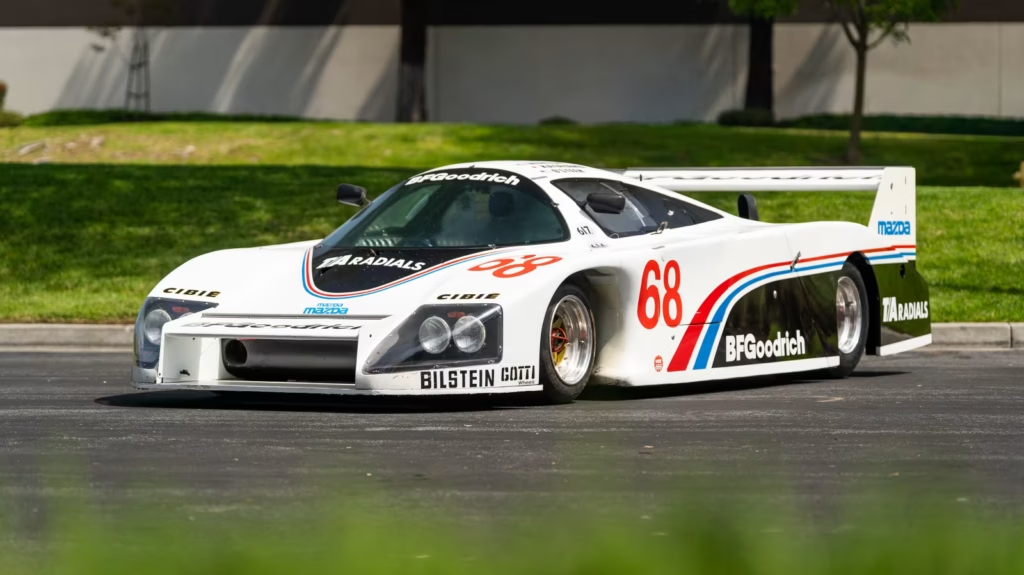
Chassis HU-2 carries the headline achievement of the program. Wearing the no. 68 livery, it was driven to a C2 Class 1st Place finish at the 1984 24 Hours of Le Mans by John Morton, Yoshimi Katayama and John O’Steen. With that victory, Mazda became the first Japanese manufacturer to score a class win at Le Mans, laying the groundwork for the marque’s historic overall triumph with the 787B seven years later. Over its career HU-2 competed at Le Mans, the Nurburgring, Monza, Fuji, Daytona, Sebring, Miami and Watkins Glen.
Lot R22: Chassis HU-3, the Monza Winner and Le Mans Podium Car
Its sibling, chassis HU-3 in the no. 67 livery, was every bit as competitive. Jim Busby and Rick Knoop drove it to a C2 Class 1st Place at the 1984 Monza 1,000-Kilometer Race, and Busby, Knoop and Boy Hayje followed up with a 3rd-place C2 finish at the 1984 24 Hours of Le Mans. HU-3’s resume spans Monza, Le Mans, the Nurburgring, Fuji, Daytona, Sebring, Miami, Road Atlanta, Charlotte, Columbus and Road America.
A Shared Preservation Journey
Remarkably, both chassis have followed nearly parallel paths in preservation. In 2003, Jim Busby and Rick Knoop reacquired the cars and gave each a comprehensive frame-off, tub-up restoration. Both appeared at the 2004 Road and Track U.S. Sports Car Invitational at Laguna Seca and the 2005 Goodwood Festival of Speed. In 2009, John Davis acquired the cars, commissioning mechanical maintenance and fire-system work from Virtuoso Performance of Hayward, California, and in 2010 both returned to the track at the HMSA Portland Historics and the Rolex Monterey Motorsports Reunion at Laguna Seca.
In 2016, each car received a cosmetic restoration of the body, interior, engine compartment, chassis, suspension, brakes, wheels and tires by the renowned Canepa of Scotts Valley, California. Most recently, in 2025, the fuel cell on each was rebuilt and fitted with a new liner, leaving both cars sorted and ready for vintage competition or display.
Offered as Lots R21 and R22 at Monterey 2026, chassis HU-2 and HU-3 are a rare opportunity to own a piece of Mazda’s Le Mans legacy. Whether acquired individually or as a matched pair, these BFGoodrich-liveried rotary prototypes carry the kind of documented, trophy-winning provenance that defines blue-chip motorsport collecting.
Visit our website to register to bid, consign your vehicle and browse all consignments. The Mecum Monterey Auction takes place August 13-15 in beautiful Monterey, California.
The collector car market, every weekday morning.
Auction results, price moves and what’s crossing the block, read in four minutes. Free, from Modern Car Collector.
No spam, unsubscribe in one click. Or read more about the Brief.
Related Posts:
- A Mazda Prototype Caught Fire at Laguna Seca. The…
- Record Ferraris, Rare Icons and 15,000 RPM: The Week…

- Mazda's Le Mans-Winning 787B Heads to 2026 Monterey…
- This Lola T70 Isn't Valuable Because Dan Gurney Won…
- Mazda Staged a Music Festival to Launch the ND MX-5.…
- Weekly Roundup: Everything Modern Car Collector…
 Kyle Matthews