

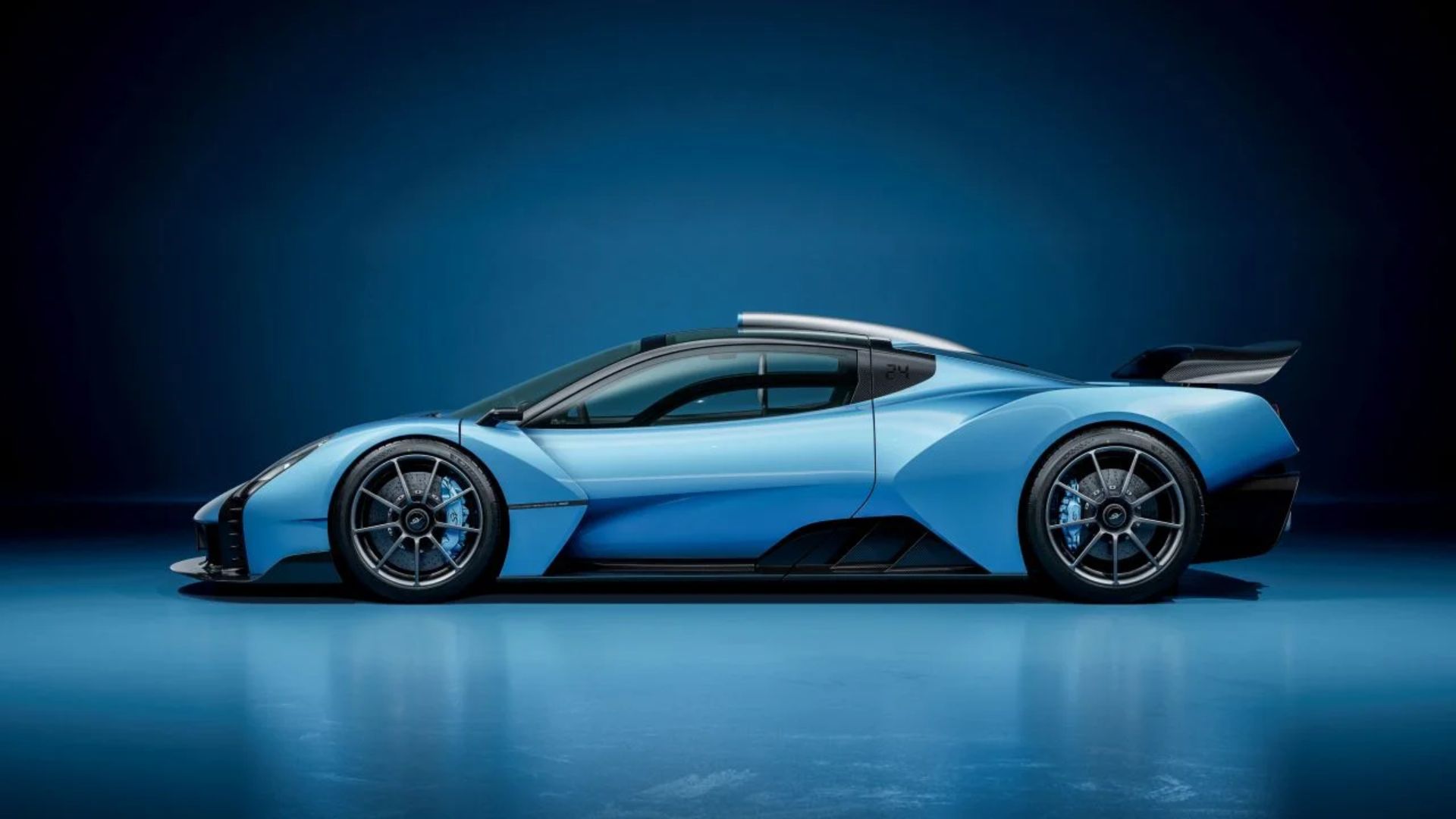
At the 2026 Le Mans Classic, on the Circuit de la Sarthe, a heritage-green prototype wearing the chassis code XP1 finally did what no Gordon Murray car had done in public for a year: it moved under its own power, driven in anger, loud enough to hear before you could see it. That car was the Le Mans GTR, Gordon Murray Special Vehicles’ second model, and its global dynamic debut answered a question that matters more to serious collectors than any spec sheet or headline price: does the car live up to the idea it was sold on?
The idea had already been sold. Every one of the 24 Le Mans GTRs was allocated within hours of its static reveal at Monterey Car Week in August 2025, before Gordon Murray Special Vehicles had disclosed a price, a horsepower figure, or a single lap time. That detail is worth sitting with. Collectors did not commit to the Le Mans GTR because they had experienced it. They committed because they trusted the man who designed it, and because of what his name has meant to this hobby since 1992.
Gordon Murray built his reputation as Formula 1’s most decorated technical director before channeling that obsession with weight and efficiency into the McLaren F1, still regarded by most serious collectors as the purest expression of a road-legal supercar ever built. He has spent the years since arguing that the wider industry lost its way, warning publicly that modern cars have grown heavier, more digital, and less honest about what a great driving experience actually requires. The Le Mans GTR is his rebuttal, built in metal rather than words: a naturally aspirated Cosworth V12 that revs to 12,100 rpm, a six-speed manual gearbox, rear-wheel drive, and a dry weight of just 986 kilograms, arriving at a moment when most of the industry is adding batteries rather than subtracting mass.
The Le Mans GTR is the second model to emerge from Gordon Murray Special Vehicles, the division Murray formed in 2025 to build cars unconstrained by everyday usability. Its sibling is the S1 LM, a tribute to the 1995 Le Mans-winning McLaren F1 GTR limited to five examples, one of which sold for a record $20.63 million during Formula One weekend in Las Vegas last November, the highest price ever paid for a new car at auction outside a charity sale. Where the S1 LM looks back at a single legendary chassis, the Le Mans GTR looks across an entire era, its longtail bodywork drawing on endurance racers such as the Matra-Simca MS660, the Porsche 917, and the Alfa Romeo Tipo 33/3. Together, the two cars frame Gordon Murray Special Vehicles’ entire argument: that lightweight, driver-focused engineering is not nostalgia. It is a coherent alternative to where the rest of the hypercar market is heading.
That argument is what made Le Mans Classic the right stage, and why the debut itself is the real news rather than a footnote to a sold-out order book. With three-time Indianapolis 500 winner Dario Franchitti at the wheel, the Le Mans GTR ran demonstration laps alongside the T.50, the track-only T.50s Niki Lauda, a T.33 validation prototype, and historic machinery tied to Murray’s career, including McLaren F1 GTR Shorttails and Brabham Formula 1 cars. Murray himself was invited to formally start the historic race, waving the tricolour from the start gantry. None of that theater was needed to sell a single car. It existed to prove something to buyers who had already paid: that the philosophy behind their purchase holds up once the car is actually asked to perform. Murray called seeing the Le Mans GTR run at the circuit that inspired it “a very special moment.”
This is the part of the modern hypercar market that price alone can never explain. A $20 million auction result is a headline. A fully reserved production run is a marketing outcome. But a driver of Franchitti’s caliber taking an unproven prototype onto the same circuit that shaped its silhouette, a year after the deposits cleared, is a test of conviction rather than commerce. Collectors did not need Le Mans Classic to buy the car. Gordon Murray needed it to prove the car was worth having bought.
First customer Le Mans GTRs are now scheduled for completion in 2027, a year later than the timeline suggested at the car’s unveiling, reflecting the difficulty of re-engineering a chassis, cooling package, and aerodynamic package around a race-honed body rather than simply restyling a road car. In the days following Le Mans Classic, Gordon Murray brought the S1 LM and a T.33 Spider to the Goodwood Festival of Speed hillclimb, giving the wider public its first real sense of what a modern GMA V12 sounds like at full song outside a controlled unveiling. For a company built on driver engagement rather than digital spectacle, that sound is not incidental. It is the argument, repeated in public, twice in one summer.
For collectors weighing where Gordon Murray Special Vehicles sits in a market increasingly crowded with hybrid hypercars chasing lap times over feel, the lesson of the Le Mans GTR’s debut has little to do with horsepower or rarity, though both are considerable. It is that the most durable collector cars are rarely bought because buyers have driven them first. They are bought because buyers trust the story, the engineer, and the philosophy enough to wait years for proof. The XP1 prototype that ran at La Sarthe will likely never reach a customer’s garage, but as the car that first validated the Le Mans GTR in public, it may end up mattering more to historians than any of the 24 examples that follow it.
The collector car market, every weekday morning.
Auction results, price moves and what’s crossing the block, read in four minutes. Free, from Modern Car Collector.
No spam, unsubscribe in one click. Or read more about the Brief.





 Kyle Matthews