
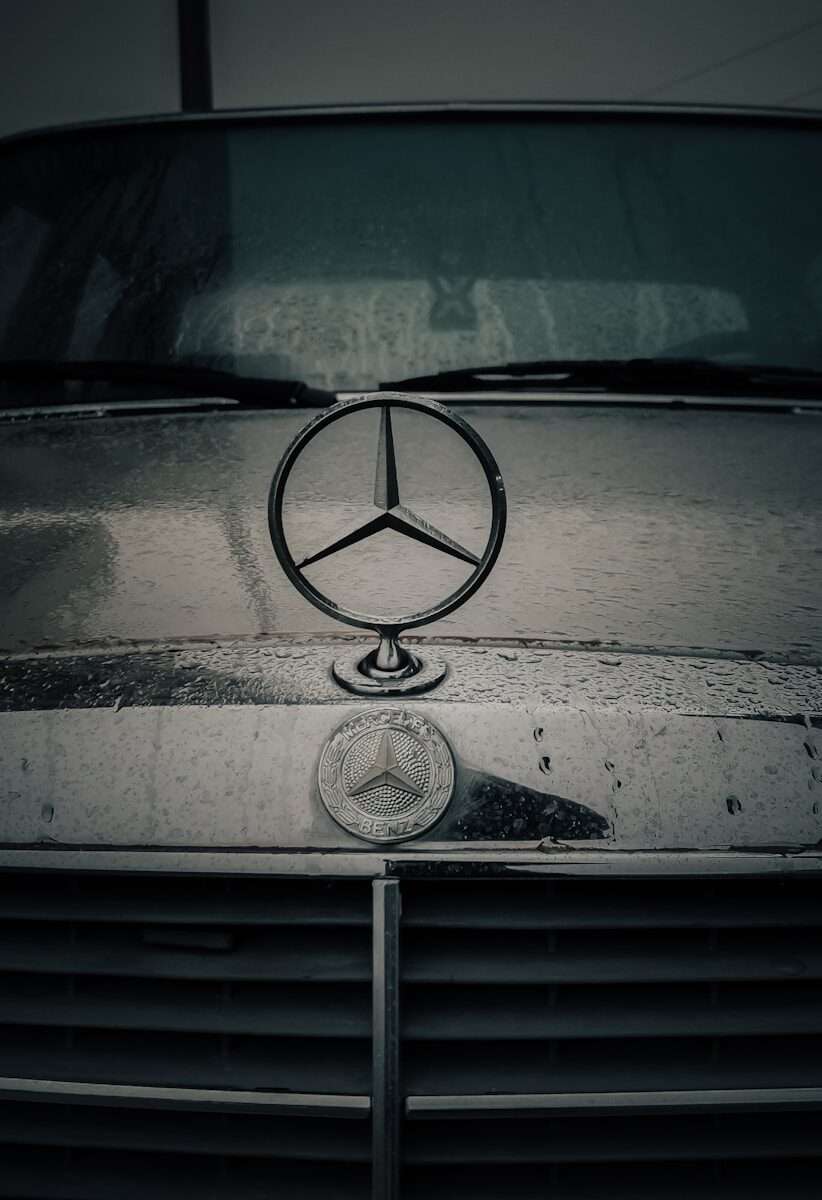
On August 3, 2026, Mercedes-Benz Heritage quietly launched one of the more consequential documentation programs to come out of Stuttgart in years. For €130 (about $150), owners of Mercedes-Benz passenger cars built between January 1, 1986, and December 31, 2010, can now order a factory Birth Certificate, an archival record pulled directly from the company’s own production files detailing exactly how a given car left the assembly line. It sounds modest. It isn’t.
The document itself is straightforward: the vehicle identification number, model and body designation, original paint code, engine and transmission numbers, interior trim, and every factory-ordered option, printed on heavy stock and delivered in a crested presentation folder. Owners order it through the Mercedes-Benz Classic Store, supply the VIN and proof of ownership, and the paperwork typically arrives within five business days. Alexandra Süß of Mercedes-Benz Heritage GmbH described it as a way of connecting an individual car to its own history, a sentiment that undersells what’s actually happening here.
Documentation, Not Authentication
Here is the detail worth sitting with: Mercedes-Benz is explicit that this is not a certificate of authenticity. The company makes no claim about a car’s current originality, condition, or value. That distinction is the real story. A birth certificate, in life or in this case, only tells you who something was when it arrived. It says nothing about who it became.
Collectors already know two versions of this idea, and the difference between them matters. Porsche’s Certificate of Authenticity is, like Mercedes’ new document, an archival pull, a paper record built from factory data and issued without anyone laying hands on the actual car. Ferrari’s Classiche program is a different animal: Maranello’s technicians physically inspect the car, verify its numbers, and stamp the Red Book only after the vehicle itself passes muster, a level of scrutiny not unlike what determines whether a Ferrari 250 GTO commands $38.5 million or something closer to $70 million. Mercedes has built the Porsche model here, not the Ferrari one. It is documentation, not verification. Nobody from Stuttgart is coming to look at your car.
Why 1986 to 2010, and Why Now
The date range deserves attention too. 1986 through 2010 is not an arbitrary window. It roughly tracks the era in which Mercedes-Benz’s internal record-keeping shifted onto systems the company can still query efficiently today, which is likely why earlier icons like the W111 coupes or the original 300SL and Pagoda SL aren’t included despite plenty of collector demand. But the window also happens to capture exactly the cars entering their collector moment right now: the R129 SL, the W140 S-Class, the 500E built alongside Porsche at Rastatt, and the homologation-special 190E 2.5-16 Evolution II, of which Mercedes built only 502 examples for Group A racing eligibility. These are the youngtimers a newer, younger wave of buyers is chasing, often without the deep paper trail a Gullwing or a W113 accumulated over decades of prior collector attention. Mercedes just gave that generation of cars an official paper trail on demand.
What This Means for Buyers and Sellers
At roughly $150, this isn’t a program built around scarcity. Anyone with a VIN and a title can get one, and that’s precisely the point. Its value to the market isn’t in being rare, it’s in becoming a baseline expectation. Once a meaningful share of E-Class, S-Class, and SL cars from this era carry factory-verified specification sheets, buyers will start asking why a given car doesn’t have one, the same way a Ferrari buyer today asks about Classiche status or a Porsche buyer asks to see the Kardex. Documentation, once common enough, stops being a bonus and starts being the ante for a serious sale.
There’s a practical dividend here too, and it will matter more to restorers than to auction floors. A factory-confirmed paint code, interior spec, and options list settles arguments that used to require chasing build sheets through parts departments and enthusiast forums. Anyone who has followed a long-dormant Mercedes-Benz 450SEL 6.9back to the road knows how much restoration quality depends on getting those details exactly right rather than merely close. A birth certificate doesn’t restore a car. It tells the restorer what correct actually looked like in period, which is a very different and far more useful thing.
The Limits Worth Knowing
The limitations matter as much as the ambition. The program currently runs only through Mercedes-Benz’s German channels, with no confirmed timeline for U.S. availability, a real constraint given how much of the American classic Mercedes market is built on grey-market European imports of exactly these models. AMG, van, and smart variants are excluded outright. And a birth certificate, however official, is not provenance in the fuller sense collectors mean when they use the word. It says nothing about ownership history, competition record, or the chain of custody that turns a well-optioned car into a genuinely important one, the kind of story that separates a routine survivor from something like Steve McQueen’s Husqvarna motocrosser, where the ownership record itself is the asset.
None of that diminishes what Mercedes-Benz has done. It has simply been precise about it, which is rarer than it should be in an industry prone to overselling paperwork. The company has opened its archive, priced access to it fairly, and declined to claim more than the data supports. For a market that increasingly rewards documented originality over restored perfection, that kind of restraint is its own quiet signal. A birth certificate only ever tells you where something started. What a Mercedes-Benz became over the following three or four decades, through ownership, use, restoration, and neglect, is still a story only the car itself, and the people who cared for it, can tell.
The collector car market, every weekday morning.
Auction results, price moves and what’s crossing the block, read in four minutes. Free, from Modern Car Collector.
No spam, unsubscribe in one click. Or read more about the Brief.



 Kyle Matthews
  John Lloyd