

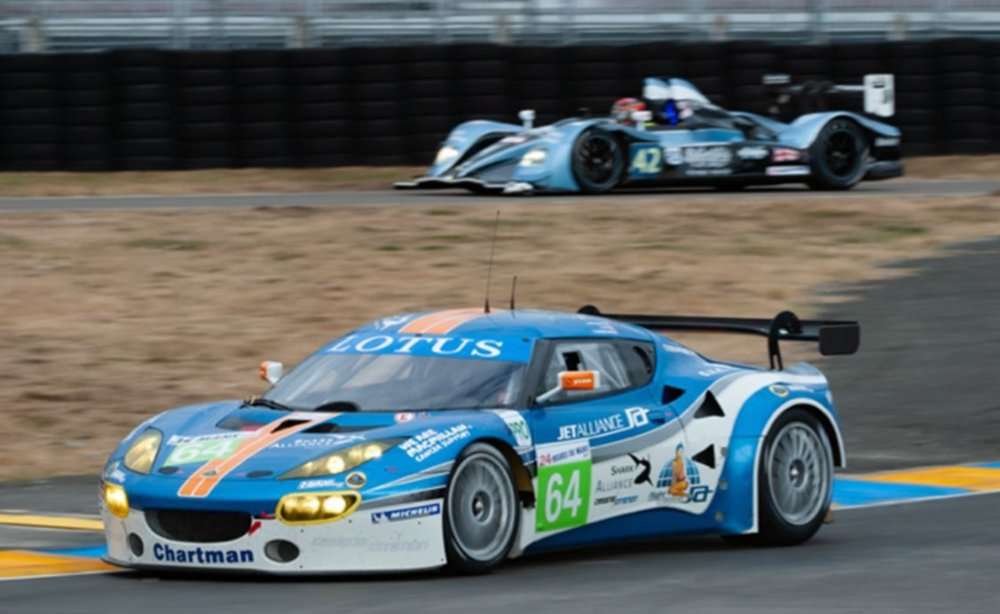
A race car listed for sale in Germany carries an asking price of €550,000 and a description that undersells its own significance: “Chassis #1.” It is the first of only two Lotus Evora GTEs ever built, the opening chapter of a factory Le Mans program that lasted barely eighteen months before Lotus quietly folded it. The car isn’t important because it won anything at Circuit de la Sarthe. It never got that far. It’s important because it, and one sister car, are the only physical proof that the program existed at all.
Lotus announced its return to top-level endurance racing at the 2011 Geneva Motor Show, unveiling the Evora Enduro GT concept as the basis for an assault on the FIA’s new GTE-Pro category. The plan called for a 444-horsepower Toyota-sourced V8. What actually turned a wheel at Le Mans that June was more modest: a highly tuned, naturally aspirated version of the production Evora’s own V6, reworked with Cosworth. That gap between the announcement and the racing reality is itself instructive. Factory programs are sold to the public as finished ambitions. They rarely arrive that way.
Two cars were built, entered under the banner of Jetalliance Racing with direct factory support from Lotus Motorsport, a two-car works effort not unlike the sister-chassis pairs that occasionally surface together in today’s market. Car No. 65 was the more fortunate of the pair, crossing the finish line 22nd overall after completing 295 laps. Its sibling, car No. 64, chassis one, the car now for sale, retired after 126 laps following an on-track accident, its Le Mans debut over well before the checkered flag. Both cars had struggled with overheating through practice and qualifying, a detail the official results don’t erase no matter how the sale literature frames the effort.
That the car for sale is the one that didn’t finish is not a mark against it. If anything, it sharpens the story. Chassis one was the first Evora GTE off the build line, the physical starting point of Lotus’s entire GTE-Pro ambition, months before its sister car ever turned a wheel. Collectors who chase finishing positions are chasing the wrong metric here. What chassis one represents is origin, not outcome, and in a program this short-lived, origin is the rarer commodity.
The program didn’t get a second act worth remembering. For 2012, Jetalliance failed to arrange a European campaign, so the effort shifted to the American Le Mans Series under Alex Job Racing. Results were poor enough that the team replaced the Evora GTE with a Ferrari 458 Italia GT2 before the season was out. Lotus has not fielded a factory-backed GT racing program since. Whatever else this car is, it is also the physical bookend to that chapter of the marque’s history, not unlike the way Lotus’s Formula 1 legacy, including the cars once campaigned by Ayrton Senna, still anchors the value of the marque’s single-seater history decades after the results stopped mattering.
There’s a second closing worth noting. The GTE-Pro category itself no longer exists. The FIA World Endurance Championship retired the class after the 2022 season, folding its top GT tier into a GT3-based formula from 2024 onward. So this car sits at the intersection of two endings: a factory program that barely got started, contesting a class that has since been retired outright. For collectors who care about categorical significance rather than lap times, that combination is difficult to replicate.
None of this means the car should be taken entirely at its seller’s word. The listing attributes roughly £14 million to the program’s development and credits Dallara and YCOM alongside Cosworth in the car’s engineering, claims that don’t appear in the independent racing record and that serious buyers should verify against Lotus Motorsport’s own documentation rather than sale copy. The same goes for the “chassis one” designation itself. Official Le Mans results track cars by race number, not by manufacturer build sequence, so establishing that this specific chassis was genuinely the first built requires factory correspondence or build sheets, not just a listing headline. In a market this thin, two cars, ever, there are no auction comparables to lean on. As with other Le Mans-history cars that have reached the market on the strength of their paper trail, price discovery here depends on documentation more than precedent.
What is verifiable is the completeness of the package. The car is offered with its original 2011 Le Mans bodywork and sponsor graphics alongside the black-and-gold livery it wore during its 2012 American Le Mans Series campaign, plus two spare engines, five additional sets of wheels, and a documented history file covering both seasons. It has been prepared by Komo-Tec, a specialist with a long relationship with Lotus’s racing programs, and has already returned to the Circuit de la Sarthe for a Le Mans Legends demonstration, reportedly turning quicker laps than it managed in period. It also comes with a paid entry to a November 2026 historic race weekend at Monza, meaning a buyer isn’t acquiring a static museum piece so much as a car built to keep running.
That distinction matters for how this sale should be read. Collectors have long paid premiums for cars that won. This one asks them to pay for a program that never got the chance to. In a hobby increasingly crowded with perfectly documented winners, the more interesting artifacts may be the ones that prove a manufacturer tried, spent real money, and still came up short, because so few of those cars survive to tell the story at all.
The collector car market, every weekday morning.
Auction results, price moves and what’s crossing the block, read in four minutes. Free, from Modern Car Collector.
No spam, unsubscribe in one click. Or read more about the Brief.
Related Posts:
- Record Ferraris, Rare Icons and 15,000 RPM: The Week…

- The Collector Car Market Paid Up for Certainty This…

- Dan Gurney's Eagle Chassis 103 Didn't Win at Spa.…

- Porsche Didn't Build a Smaller 550 Spyder. It Built…

- Collector Car Market Brief: A One-of-Three Veyron…
- Lotus Is Bringing Back the V8. The Real News Is Why.
 John Lloyd
  Kyle Matthews