

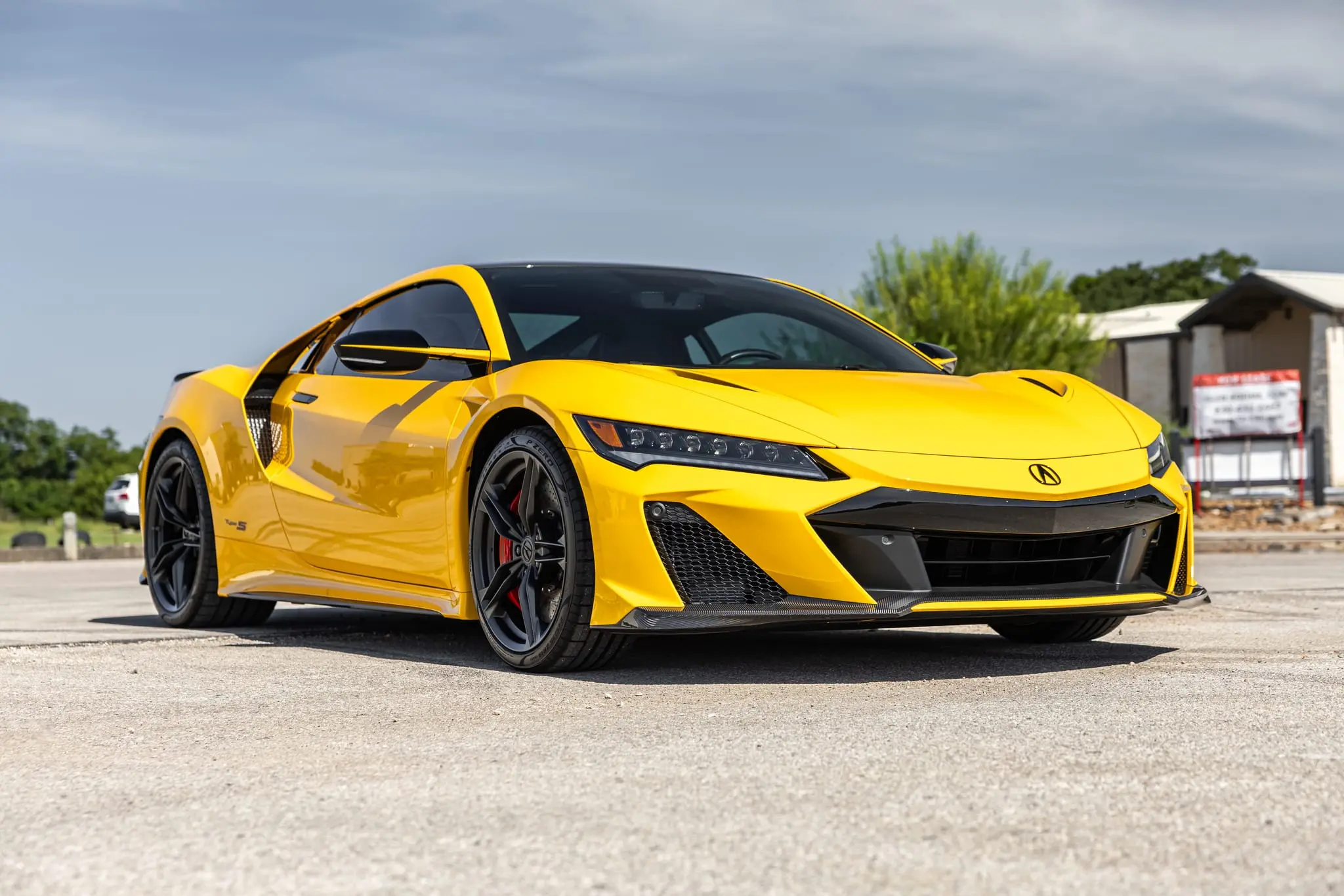
A 2022 Acura NSX Type S is about to close a no-reserve sale on Bring a Trailer with 261 miles on its odometer, a clean Carfax, its original window sticker, and a service record that includes an oil change performed nearly three years after it left the factory floor. None of that is remarkable on its own. Together, it describes something collectors are only beginning to take seriously: a modern supercar treated, from day one, like an artifact rather than a toy.
This car is #107 of 350 NSX Type S examples built for the 2022 model year, the send-off edition for the second-generation NSX before Honda closed the line at its Performance Manufacturing Center in Marysville, Ohio. Three hundred fifty cars is not an exotic number by supercar standards, and it is not the kind of scarcity that alone justifies a premium. What makes this car matter is timing, not quantity. It represents the final specification of a nameplate that spent two separate generations trying to prove a supercar could also be dependable, drivable, and honest. That thesis, not the mile count, is what should interest serious buyers.
The NC1-generation NSX arrived for 2017 as Honda’s second attempt at reinventing the same idea that made the original 1990s NSX a benchmark: a mid-engine exotic that did not punish its owner for driving it daily. The second try was more radical under the skin than most buyers realized at the time. A twin-turbocharged 3.5-liter V6 was paired with three electric motors, two at the front axle for torque vectoring and one integrated into a nine-speed dual-clutch transaxle, then routed through Acura’s Super Handling All-Wheel-Drive system. It was a genuinely novel architecture, arriving years before hybrid hardware became the default language of hypercar performance. Modern Car Collector has made a similar case about the Porsche 918 Spyder, a car that proved hybrid components could sharpen a supercar rather than merely offset its emissions. The NSX Type S makes the same argument at a fraction of the price and production volume.
By the time Type S arrived, the formula had been refined rather than reinvented. Peak output rose to a combined 600 horsepower and 492 lb-ft of torque, and Acura added the options that mattered to enthusiasts who understood the platform. This particular example carries the $13,000 factory Lightweight Package, documented on its original window sticker, which added a carbon-fiber roof, a fixed decklid spoiler, and a retuned suspension aimed at shedding weight rather than adding drama. Layered rarity like this deserves attention: within an already-limited run of 350 cars, only a portion were ordered with the Lightweight Package, and that kind of factory-level distinction separates a well-specified example from a merely numbered one. The car’s Indy Yellow Pearl finish carries its own quiet significance, echoing the racing yellow long associated with Honda and Acura’s open-wheel programs rather than simply standing out in a parking lot.
None of this would matter as much without the paper trail. The selling dealer retained the original window sticker showing initial delivery to an Acura dealership in San Juan, Texas, at a total price of $185,995, along with a clean Carfax report, a Texas title carrying an actual-mileage notation, the owner’s manual, and NSX-branded accessories. Modern Car Collector has argued, in examining a 1955 Chrysler C-300’s contested paperwork, that documentation is what separates a good used car from a defensible collector car, and that principle applies just as forcefully to a six-year-old Acura as it does to a seventy-year-old Chrysler. Even the decision to perform a routine oil change in August 2025, despite negligible mileage, reads less like maintenance and more like stewardship.
That confidence extends to how the car is being sold. Offering a nearly new, single-owner, low-mile supercar at no reserve is a deliberate signal, not a concession. Sellers who trust their documentation and their audience increasingly skip the reserve altogether, letting transparent history do the work that a floor price used to do. It is a tactic worth watching, because it tends to appear on cars with nothing to hide rather than cars in need of a rescue bid.
The buyers most likely to chase this kind of car are not the same collectors who built their reputations on Ferrari 250s and Series I Cobras. Modern Car Collector has tracked how Gen X and millennial buyers are reshaping the collector market: bidders who grew up idolizing Honda and Acura performance the way earlier generations idolized Maranello and Stuttgart, and who are now old enough, and liquid enough, to buy the cars they once put on bedroom walls. A pristine NC1 NSX Type S sits precisely at the intersection of nostalgia and engineering credibility that this demographic values most.
Recent auction results elsewhere reinforce the pattern. When Modern Car Collector examined a record-setting Jaguar XJ220 sale in the UK, the more instructive story was not the headline number. It was everything that sold around it, and what that said about depth returning to the halo-car segment. The NSX Type S belongs in that same conversation: a low-production, engineering-forward halo car whose real test will not be the closing bid, but whether the broader market for documented, honestly preserved modern exotics keeps strengthening behind it.
Honda’s own recent moves suggest that support is coming. The company’s decision to launch a factory heritage parts program for the first-generation NSX signals an institutional respect for the nameplate that bodes well for long-term ownership of the NC1 generation too. A manufacturer that treats its own history seriously tends to keep the cars that carry it running.
Whatever this NSX Type S ultimately brings when bidding closes, the number will tell buyers less than the file that comes with it. Collectors do not preserve 261 miles on a 600-horsepower supercar to protect resale value. They preserve it to protect a moment, the moment a manufacturer closed a chapter it never fully got credit for opening. That is the real reason this car deserves attention, and it would be true even if the final bid never made a headline at all.
The collector car market, every weekday morning.
Auction results, price moves and what’s crossing the block, read in four minutes. Free, from Modern Car Collector.
No spam, unsubscribe in one click. Or read more about the Brief.
Related Posts:
- Acura's Zanardi Edition NSX Was Always a Tribute.…
- First-Generation Acura NSX (1991–2005): Collector Spec Sheet
- Dodge Viper vs Acura NSX: Which Is The Better Collector Car?

- Black 1996 Dodge Viper RT/10 Roadster With a Dyno…
- Today in Collector Car History: Honda Became a…
- The Complete Guide to the Yenko Camaro
 John Lloyd
  Kyle Matthews