

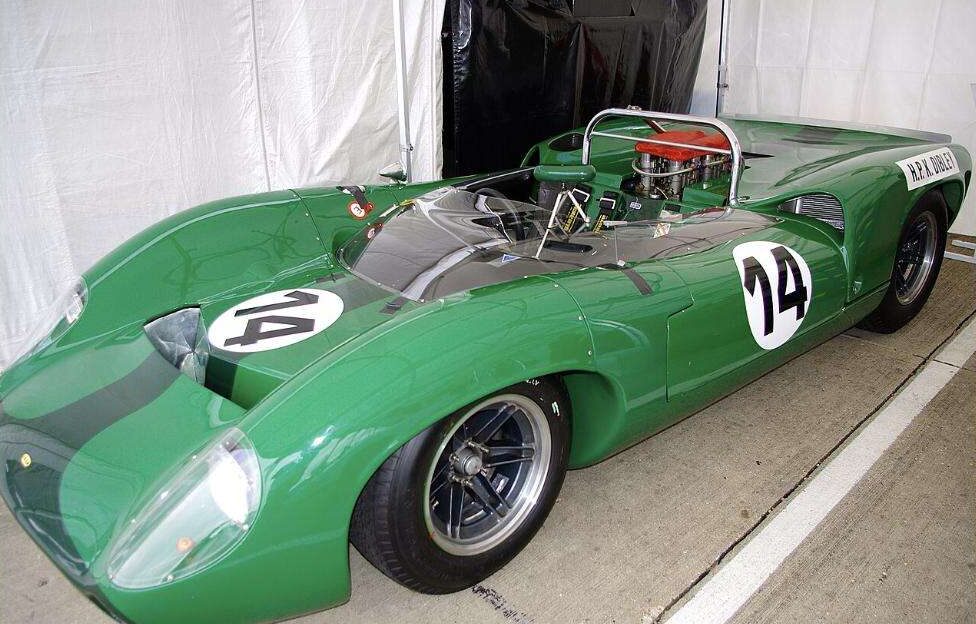
When Bonhams’ inaugural Laguna Seca Auction opens on August 13, one lot carries a story that has almost nothing to do with its auction estimate. Chassis SL71/34, a 1966 Lola-Ford T70 Mk II Can-Am Spyder consigned at $1,100,000 to $1,500,000, still wears a modified rear cockpit bulkhead built in period by All-American Racers, cut and reshaped to give a six-foot-four-inch Dan Gurney enough room to drive it. Sixty years on, that bulkhead is still there. Nobody has ever thought it wise to fix it.
The Only Ford Ever to Win a Can-Am Race
That detail matters more than the estimate, and arguably more than the trophy. This Lola’s real distinction is that it is the only car ever to win a round of the Can-Am Challenge Cup with a Ford engine, a single result standing across the series’ entire nine-year run from 1966 to 1974, an era otherwise owned outright by small-block Chevrolet power. Gurney drove it to that win in the second round ever contested under the Can-Am banner, at Bridgehampton on Long Island in September 1966, beating a field that included John Surtees and Mark Donohue in sister Lola T70s, Jim Hall and Phil Hill in works Chaparral 2Es, and Bruce McLaren and Chris Amon in factory Elva-McLarens. That is about as strong a grid as 1966 sports car racing could assemble, and Gurney beat all of it in a chassis built by Eric Broadley’s Lola works and bodied by Specialised Mouldings, running an engine combination nobody else in the paddock was betting on.
Why does that combination, one result, one engine, one driver, deserve more attention than the number stamped on the chassis plate? Because rarity by itself proves very little. More than a hundred Lola T70s were built across three iterations, and a healthy number survive today in private collections and vintage racing paddocks; chassis count alone does not make SL71/34 special. What makes it special is that it did something no other T70, and no other Can-Am Ford, ever managed, and that the car crossing the block this August still carries the physical evidence of the man who did it.
A Signature Cut Into the Chassis
Gurney’s height was a persistent problem throughout his career. Contemporary race cars were built to fit average frames, and a driver standing six-foot-four rarely climbed into one without compromise; Stirling Moss, who considered Gurney the finest American racer of his generation, watched him fold into cockpits built for smaller men more than once. What separates SL71/34 from a generic period photograph of that problem is that the fix survives on the actual object. All-American Racers, Gurney’s own team, reshaped the rear bulkhead specifically to accommodate him, and Bonhams’ own cataloguing calls it a “surviving original feature,” department language for exactly the kind of detail that a lesser restoration would have quietly smoothed away in the name of tidiness.

This is where the market’s instincts usually get scrambled. Collectors are trained to prize originality, and restorers are trained to correct deviations from factory specification. Applied literally to a competition car, that instinct runs backward. A works or team-built alteration made in period, to fit a driver, meet a rule, or solve a real problem on a real weekend, is not a flaw awaiting correction. It is data. It is the closest thing a machine can offer to a signature, and it belongs in the same category of evidentiary value as matching numbers or a stamped build sheet, not in the category of damage.
What Good Restoration Actually Protects
That same judgment call separates a defensible restoration from a merely thorough one, a question we returned to recently in the recommissioning of a long-dormant Mercedes-Benz 450SEL 6.9, where the line between preserving history and erasing it was drawn just as deliberately. Good restoration is not the pursuit of a factory-fresh appearance. It is the discipline of knowing which marks tell the truth about a car’s life and refusing to remove them. The team that brought this Lola back after its own long dormancy, working through 2006 before the car was invited to the 2007 Goodwood Festival of Speed, evidently understood that distinction and left the bulkhead alone. That decision is worth more to a serious buyer than another repaint would have been.
The Unglamorous Chain That Makes It Real
SL71/34’s paper trail after 1966 reinforces the point rather than undercutting it. Gurney handed the car to his young protege Swede Savage to prepare for the following season; Savage was gravely injured in a fiery crash during the 1973 Indianapolis 500, driving a Bignotti-entered Eagle-Offenhauser, and died of his injuries weeks later. The Lola itself sat idle before a cameo in the 1968 Paul Newman racing film Winning, then passed through a rent-a-drive scheme that found no takers, a run of amateur outings in the hands of owners named Hauser, Thompson, and Bartz, and finally roughly two decades of storage in a chicken coop near Road Atlanta after a leaking fuel cell took it off the road in the mid-1980s. None of that reads like the biography of a blue-chip collector car. All of it is exactly the kind of unbroken, documented chain that makes one.
That distinction, between a car with a dramatic story and a car with a documented one, is the entire game in this segment of the market, the same lesson we drew recently from Steve McQueen’s Husqvarna heading to a Bonhams motorcycle sale. A famous name attached to a lot means little without the paperwork to support it; a deep file of period photography and ownership history is what turns a good story into a defensible valuation, and it is exactly what accompanies this car to Monterey.
What Buyers Are Actually Paying For
An estimate of $1.1 million to $1.5 million for a documented, ex-works, single Can-Am-winning sports racer is not shocking money in 2026; well-documented Group 7 cars from this era have traded at strong premiums in recent seasons. What should hold a serious buyer’s attention is the same measure that made the recent Morgan Supersport 400 worth writing about for reasons that had nothing to do with its top speed: significance defined by what a car represents, not by what it cost or how fast it goes. A Lola T70 with a correct-looking cockpit would be a fine vintage racer. A Lola T70 with an uncorrected cockpit, built around one specific driver’s body and never fixed, is a primary artifact, closer in spirit to the case we made for a 3,062-mile Ford F-250 Harley-Davidson Edition that failed to sell twice: originality, once removed, does not come back, no matter how good the replacement part looks.
Bonhams has designated the lot a Premium, or purple-paddle, entry, restricted bidding that requires advance registration and a bank reference, the sort of gatekeeping usually reserved for cars the house expects serious money to chase. That fits a broader pattern in the market for documented American road-racing history: strong six- and seven-figure results for period Trans-Am and Can-Am cars with intact competition records, the kind we have already seen with ex-factory Camaro Z/28 Trans-Am racers, have become routine rather than exceptional. Buyers in this category are no longer paying primarily for nostalgia. They are paying for machines that can prove, in metal, exactly what they say they did.
The auction result for SL71/34 will be reported in August as a number. It should not be read as one. The detail that actually matters here was cut into a bulkhead sixty years ago, by mechanics solving a real problem for a driver too tall for his own race car, and the true measure of this Lola’s stewardship is that nobody since has thought it wise to grind that history away. Collectors rarely pay a premium for horsepower alone. They pay for the parts of a car that could never be reproduced convincingly if lost, and on this Lola, one of those parts is shaped exactly like Dan Gurney.
Top photo: 1966 Lola-Chevrolet T70 Spyder by David Merrett, CC BY 2.0, via Wikimedia Commons. Representative example of the model; not the SL71/34 chassis discussed above.
The collector car market, every weekday morning.
Auction results, price moves and what’s crossing the block, read in four minutes. Free, from Modern Car Collector.
No spam, unsubscribe in one click. Or read more about the Brief.
Related Posts:
- Dan Gurney's Eagle Chassis 103 Didn't Win at Spa.…
- Weekly Roundup: Everything Modern Car Collector…
- Today in Collector Car History: Roger Penske Wins at…
- Freije & Freije Auctioneers Offers a Red 1966…
- Record Ferraris, Rare Icons and 15,000 RPM: The Week…

- 18 Steve McQueen Cars and Motorcycles That Have Sold…
 Kyle Matthews
  Eve Nowell