

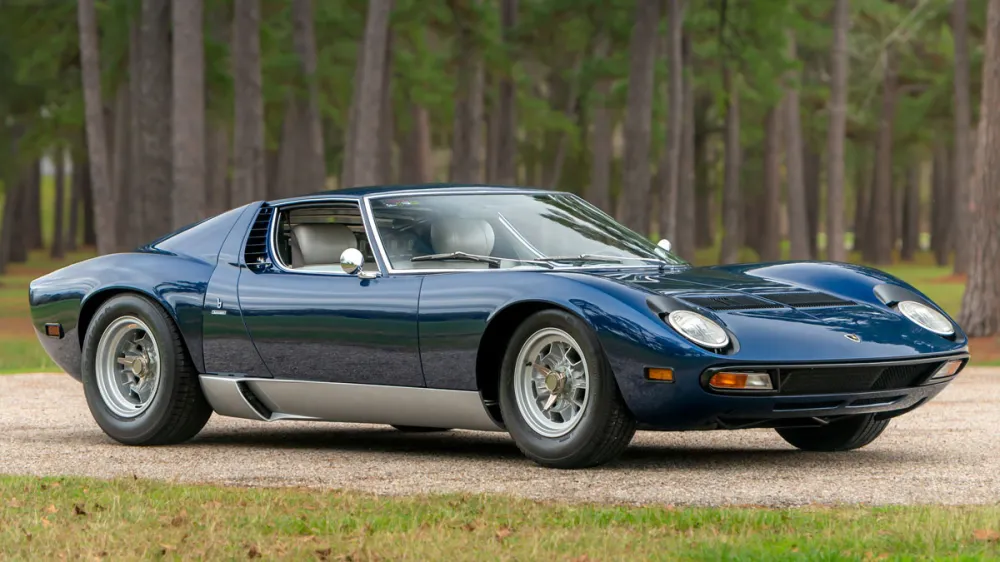
On October 11, Bonhams will open its Zoute Sale at the Zoute Grand Prix in Knokke-Heist with two headline lots that will draw plenty of attention: a 1970 Lamborghini Miura P400S estimated at €1.6 million to €2 million, and a 1989 Lamborghini Countach 25th Anniversary, both offered entirely at no reserve. It would be easy to write this up as another eye-catching estimate range attached to another famous nameplate. That would miss the actual story. These two cars, along with eight more Italian classics, come from a single Swiss family collection assembled by two brothers over decades, and the decision to sell all of it without a reserve says more about where the collector market stands today than any individual hammer price will say in October.
The cars belong to what Bonhams is calling the Keller Collection, put together by Christian Keller and his brother, who searched out cars across Switzerland and beyond not primarily for their rarity but for their character and the stories attached to them. Keller’s brother, who helped select, maintain, and drive every car in the collection, has since passed away, and Christian has described the sale not as a farewell but as “the passing on of the passion that brought the Collection into being.” That context matters. A collection built by two people who actually drove and lived with these cars for years tends to produce a different kind of documentation than one assembled purely as a store of value, and it shows in the paperwork accompanying each lot.
It also explains the no-reserve decision. Auction houses do not remove reserves lightly, especially not across an entire ten-car consignment that includes a seven-figure Miura. A no-reserve sale is a bet that transparent, well-documented ownership will draw enough serious bidders that the market sets a fair price without a safety net. It is the same dynamic driving a broader shift in how buyers value verified stewardship over anonymous rarity, a trend visible across recent sales of everything from race-proven Ferraris to celebrity-owned motorcycles.
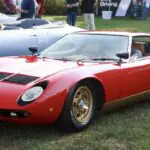
Chassis no. 4578 is the collection’s centerpiece for good reason. It is one of 114 late-production Miura P400S models built with ventilated disc brakes, a meaningful upgrade over the drum-and-solid-disc setups of earlier cars and a detail that matters to anyone planning to actually drive one hard rather than trailer it between shows. The car was delivered new to Switzerland in 1970 through Garage Foitek of Zurich and is believed to have first belonged to Emmanuel “Toulo” de Graffenried, the Swiss driver who won the 1949 British Grand Prix and remained one of his country’s best-known motorsport figures for decades afterward. It has stayed in Switzerland ever since, rarely shown publicly, and comes with a Valentino Balboni inspection report from December 2014, about as strong an authentication as a Miura can carry given Balboni’s decades overseeing quality control on Lamborghini’s V12 cars. One honest caveat worth noting: the car now wears Giallo Fly over its original black interior, having been repainted at some point from its factory color of Arancio Miura. That is not a small detail to a numbers-focused buyer, and it belongs in any serious evaluation of the estimate. Originality of color is not the same as originality of chassis, engine, and coachwork, and this Miura offers plenty of the latter even without the former.
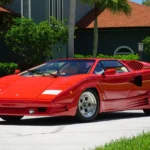
The 1989 Countach 25th Anniversary tells a related but different story. It is one of 657 built in the final specification of a model that had been in production, in one form or another, for eighteen years by the time this example rolled off the line, a car whose last major revision was overseen by Horacio Pagani, then working inside Lamborghini’s composites department, years before he founded his own marque. Finished in Rosso Siviglia over beige leather and showing just over 23,000 kilometers, this particular car has been part of the Keller Collection since 2014 and retains its original owners’ handbooks. Similar low-kilometer European-market 25th Anniversary cars have been drawing serious attention lately, and a 379-kilometer Euro-spec example that recently surfaced on Bring a Trailer made a similar case for the model. The pattern is consistent: buyers are increasingly treating the final Countach not as a compromised swan song but as the model’s most resolved and usable form.
The remaining eight cars in the Keller Collection round out a specific point of view rather than a checklist of blue-chip names. There is a 1973 Ferrari 365 GTC/4, a 1974 Ferrari Dino 246 GT, a 1977 512BB, and two 1977 308GTBs, alongside a 1966 Fiat Dino Spider and two Maserati Ghibli 4.7 coupes from 1967 and 1969. A 1992 Porsche 964 Carrera RS and a 2008 997 GT3 Cup S round things out. None of these individually rewrites a record book, and that is rather the point. This is a collection built by two people who wanted cars they found genuinely compelling to own and drive, spanning three marques and three decades, rather than a portfolio engineered to a formula. That is a different kind of collecting than the market usually rewards with headlines, and it is worth paying attention to precisely because it is not chasing them.
Offered separately from the Keller cars, a 1965 AC Cobra 289 provides the sharpest illustration of the sale’s real theme. It is one of only 45 COB-numbered leaf-spring Cobras built to right-hand-drive UK specification, delivered new in Vineyard Green over beige before a later owner converted it to left-hand drive and repainted it red for export to California, where it was driven coast to coast on at least two occasions. What sets it apart in a market saturated with re-bodied, re-numbered, and continuation Cobras is that its chassis, body, and engine have never been modified or swapped, and its complete ownership history from 1965 to today is documented and verified through both the AC Owners Club and Shelby American Automobile Club registries. At an estimate of €700,000 to €900,000, this Cobra is not the rarest or the most powerful car in the sale. It may be the most honest one, and in a market this mature, that increasingly counts for more.
None of this is to say estimates do not matter. They do, and October’s results at Zoute will say plenty about appetite for European sports cars heading into the winter auction season. But the number worth watching is not the hammer price on the Miura. It is whether a fully documented, single-family collection sold at no reserve draws the kind of depth and conviction in bidding that anonymous consignments increasingly struggle to attract. Documented stewardship compounds in the collector market much like interest compounds in finance. It looks unremarkable year to year, and then one day a family sells a decade of careful ownership and the whole market takes notice.
The collector car market, every weekday morning.
Auction results, price moves and what’s crossing the block, read in four minutes. Free, from Modern Car Collector.
No spam, unsubscribe in one click. Or read more about the Brief.

 Shawn Henry
  Kyle Matthews
  Eve Nowell