
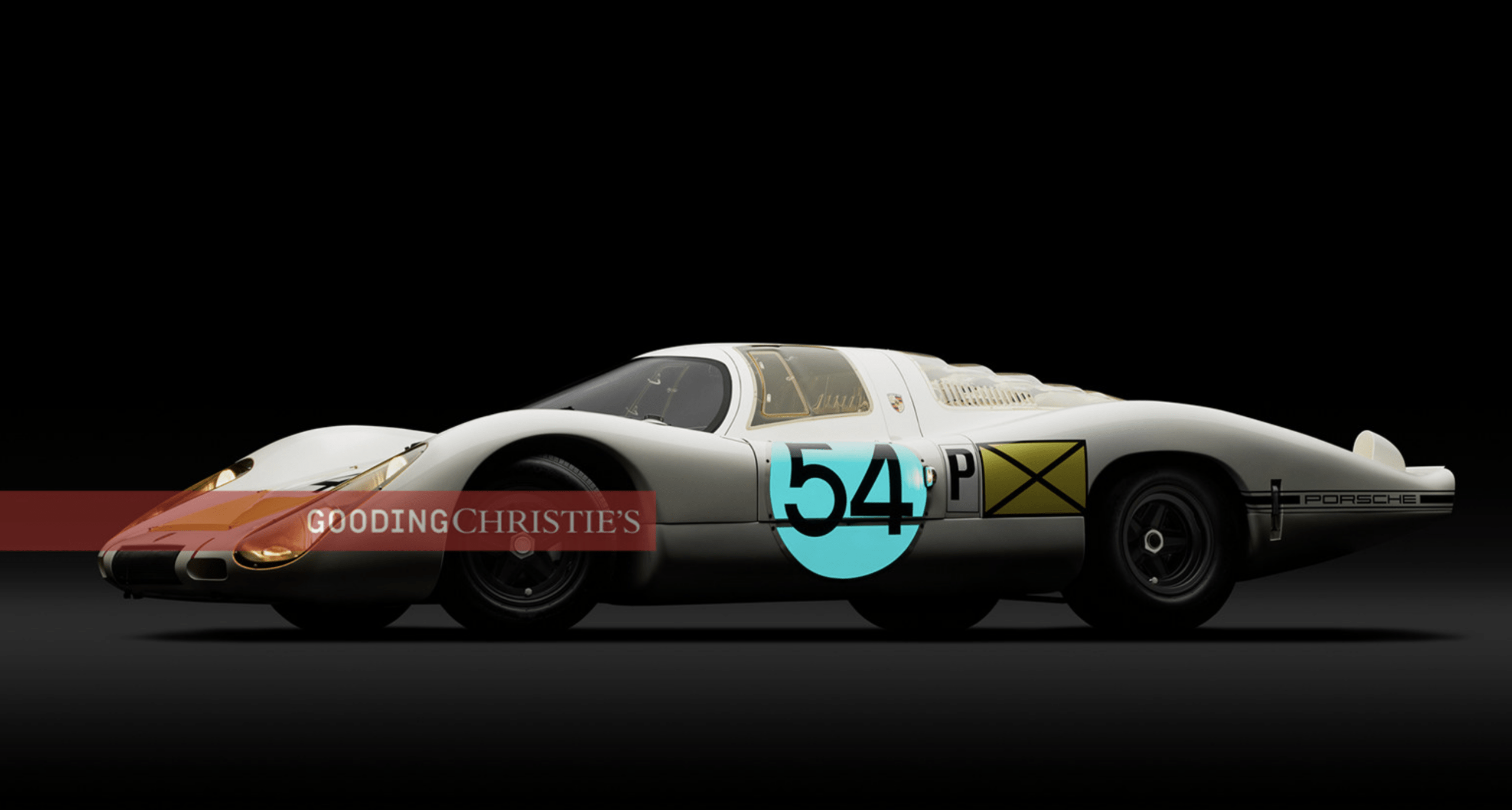
On the entry list for Gooding & Company’s Pebble Beach sale this August, Lot 44 runs long on detail: a chassis number, a rebuilt Type 771 flat-eight, a decade of restoration invoices, an aerodynamic drag figure precise to the hundredth. What the catalog does not include is a name. The seller is identified only as “the current owner,” part of “a significant private collection,” according to the lot’s official catalog description. That omission isn’t an error. It’s standard practice for a certain class of consignment. In this case, though, the anonymous seller has already told the car’s story himself — just not to Gooding’s bidders.
The car is chassis 907-005, a 1968 Porsche 907 Langheck, and the man who has spent the better part of a decade returning it to its original Daytona-winning specification is, by his own account on a recent podcast, Jerry Seinfeld. Separating what Gooding has documented from what Seinfeld has said publicly is the more useful way to understand why this particular Porsche matters — and why, ironically, the missing name changes nothing about its importance.
A Piëch-Era Milestone, Not a Footnote
The Type 907 emerged in 1967 under Ferdinand Piëch’s engineering direction, at the moment Porsche’s factory racing program stopped settling for class wins against bigger-displacement rivals and started building cars designed to win outright. The Langheck, or long-tail, body was shaped in the wind tunnel specifically for the high-speed circuits of Daytona, Monza, and Le Mans, cutting drag by roughly 25 percent versus the preceding 910 and reaching a 0.27 drag coefficient — the lowest Porsche had recorded for a full-size competition car. Beneath that fiberglass shell sat the Type 771, a 2.2-liter four-cam flat-eight descended from Porsche’s short-lived Formula 1 program, tuned to roughly 270 horsepower at close to 9,000 rpm.
Chassis 907-005 proved the concept at Daytona in February 1968. Driven through the race by Vic Elford, Jochen Neerpasch, and Rolf Stommelen, with Jo Siffert and Hans Herrmann sharing duties late, the car completed 673 laps to win outright — Porsche’s first overall victory in a 24-hour endurance race, anchoring a 1-2-3 factory sweep. Porsche historian Karl Ludvigsen later wrote that the 907 enjoyed “a splendid career all its own” beyond its role as a stepping stone to the 908 and 917. 907-005 followed Daytona with a second overall at the Monza 1000 Km and a retirement at Le Mans that September after an oil leak and camshaft failure — a full, well-documented season rather than a single flattering result.
Two Survivors, One Traceable Chain
What makes 907-005 collectible isn’t simply that it won a famous race. Most 907 Langhecks didn’t survive in their original long-tail configuration. Several were converted to short-tail Spyder bodywork for later privateer racing, a common fate for cars built for one specific purpose and then repurposed for whatever competition came next. 907-005 suffered exactly that during German ownership in the mid-1970s, along with a period running non-original six-cylinder power in later vintage events. Today, only two Langheck long-tail chassis are known to survive — which means the car’s rarity isn’t an abstract production number. It reflects a specific, documented history of near-loss and eventual correction.
That correction took decades. Swedish collector Sten Hillgard began reassembling original long-tail components in 1989. American racer and SVRA founder Henry E. Payne III bought the car in 1994 and returned it to vintage competition. In 2010, the chassis entered a major private collection and was reunited with a correct Type 771 engine and transaxle — the detail that matters most to anyone evaluating matching-numbers integrity. The current owner acquired it in 2014 and commissioned marque specialist Joe Cavaglieri, whose credits include restorations for the Miles Collier collection and Porsche’s own factory holdings, to return the car to its precise 1968 Daytona configuration. Ed Pink Racing Engines rebuilt the flat-eight. The project took more than ten years.
The Owner Gooding Won’t Name
Anonymized consignments aren’t unusual in this market. Auction houses routinely shield high-profile sellers — celebrities, family offices, collectors negotiating around other holdings — behind generic language, for reasons ranging from personal security to simple negotiating leverage. It lets the object, rather than the owner’s fame, carry the estimate.
In this case, the seller has removed his own anonymity elsewhere. On a recent episode of Spike’s Car Radio, the podcast hosted by longtime friend and collaborator Spike Feresten, Jerry Seinfeld discussed acquiring a 1968 Porsche 907 in 2014 and spending roughly a decade returning it to its exact Daytona specification, according to details of the episode reported by Man of Many. He described the car’s 1,320-pound curb weight, its rebuilt flat-eight, and driving impressions he found more compelling than those of his own Porsche 917K — itself tied to Steve McQueen, whose own provenance-driven market makes for a useful comparison. Every detail Seinfeld gave lines up with Gooding’s chassis history for 907-005: the 2014 acquisition date, the roughly ten-year restoration window, the Cavaglieri and Ed Pink Racing Engines credits. None of that appears under Seinfeld’s name anywhere in the Gooding catalog. It didn’t need to.
Why the Anonymity Is the Point
Modern Car Collector has made this argument before, whether the subject was a Packard once valued for who owned it, a Steve McQueen motorcycle offered at a fraction of this car’s estimate, or the provenance dispute wrapped around a modestly priced Mercedes: a car’s importance shouldn’t be measured by whose name attaches to it, and it shouldn’t evaporate when that name is withheld either. The Bernstein Mercedes taught a similar lesson at a far lower price point — documentation, not celebrity, is what actually holds up under scrutiny. So does Angelina Jolie’s own Ferrari 250 GT, a car whose market strength came from its factory history and rarity rather than its most famous logbook entry.
Run the Modern Car Collector test on 907-005: strip away the Seinfeld connection entirely, and does the car still matter? Unquestionably. It remains the first Porsche to win a 24-hour race outright, one of only two surviving long-tail 907s, and a chassis with a continuous, factory-to-podium-to-restoration-bench paper trail that few prototype racers from this era can match. The celebrity detail is a footnote to an already complete story, not the reason the story exists.
What Should Actually Matter to Collectors
Buyers evaluating Lot 44 should focus on the fundamentals Gooding has actually documented rather than the name it hasn’t: a matching-numbers correct engine and transaxle reunited in 2010, a restoration executed by a specialist with factory-collection credentials, an unbroken ownership chain traceable to the factory’s own 1969 fire-suppression testing program, and a concours record — Amelia Island, Salon Privé, Rennsport Reunion VII — that has already validated the restoration’s accuracy to outside experts, not just to its owner. The $4.5 million to $5.5 million estimate sits within a Pebble Beach week that includes several other race-winning cars crossing the same auction block and a notable run of classic-era Alfa Romeos anchoring the same Gooding & Christie’s sale, part of a broader pattern of blue-chip consignments that has followed Christie’s 2024 acquisition of Gooding & Company.
Anonymity in an auction catalog, like paint or upholstery, can be added and removed without touching what’s underneath. Documentation cannot be manufactured after the fact — it either exists in period photographs, factory records, and chassis logs, or it doesn’t. That distinction, not the estimate and not the consignor’s name, is what actually separates a car with a good story from a car with a provable one. Chassis 907-005 is unmistakably the latter, whoever ultimately signs the bill of sale.
The collector car market, every weekday morning.
Auction results, price moves and what’s crossing the block, read in four minutes. Free, from Modern Car Collector.
No spam, unsubscribe in one click. Or read more about the Brief.