
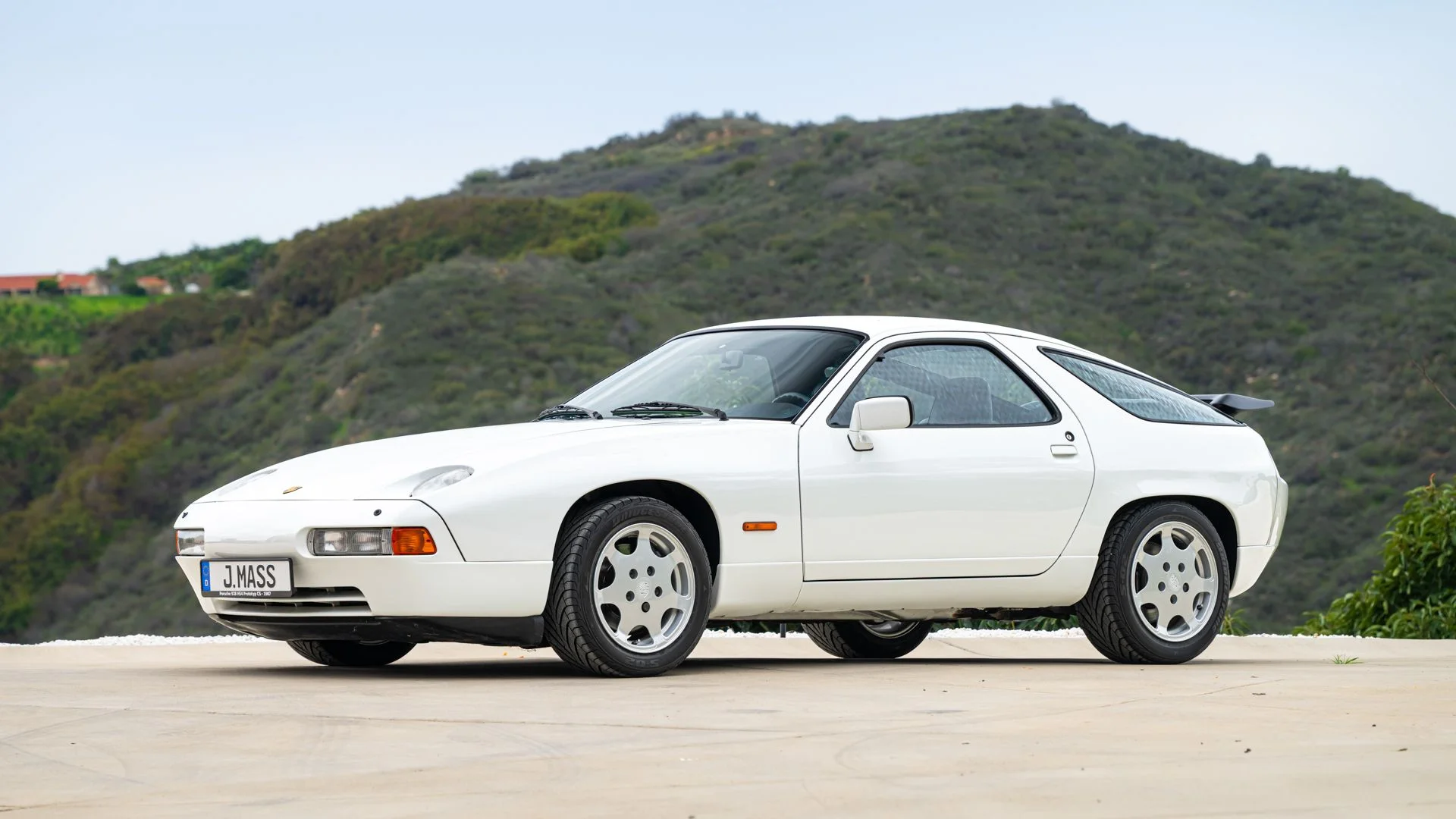
When Broad Arrow rolls a 1987 Porsche 928 Clubsport prototype across the block at The Quail this August, the catalog will lead with the obvious hook: a Formula 1 race winner’s personal car, one of only four ever built, fresh to public sale after nearly four decades in a tight chain of ownership. That’s a fine story. It just isn’t the real one. The more revealing document in the file isn’t Jochen Mass’s signature in the service book. It’s a request Porsche filed with the West German Kraftfahrt-Bundesamt, the federal motor transport authority, asking permission to register the car on special Böblingen plates and insisting the approval paperwork stay inside the car at all times. That’s not how a company hands a driver a thank-you gift. That’s how a company controls a test asset.
Internally numbered H54, this Grand Prix White coupe was the first of four lightweight, pre-production 928 Clubsport prototypes, built roughly a year before Porsche brought the Clubsport package to market. Compared with the standard 928, the specification is deliberate and specific: a lighter five-speed dog-leg manual transaxle in place of the usual automatic, revised engine calibration, stiffened suspension, and comfort equipment stripped throughout the cabin, all in pursuit of a reported 300-pound weight reduction. Each of the four cars was finished identically, in Grand Prix White over Marine Blue leather, and each went to a different Rothmans Porsche factory driver: Mass, Derek Bell, Hans-Joachim Stuck, and Bob Wollek.
Were these gifts, company cars, or contractual perks? The documentation argues for something closer to a controlled loan that only later became personal property. Porsche’s own paperwork shows the car initially registered to the factory, with Mass’s ownership details added afterward, correction fluid and all, in the service book. It wasn’t until the early 1990s that the Clubsport was reregistered independently, on Rhein-Neckar-Kreis plates, under the name of Mass’s wife, Bettina Dunne. Whatever informal understanding existed between Porsche and its four works drivers, the paper trail describes a factory asset transitioning to private ownership over time, not a handshake gift made at the factory gate.
That the four cars were built to identical specification, rather than four subtly different experiments, is itself informative. Porsche wasn’t testing four variations of an idea. It was putting one idea in front of four very different drivers, sending Mass’s smooth consistency, Bell’s endurance-honed patience, Stuck’s aggression, and Wollek’s precision against the same hardware under the same real-world conditions: long, high-speed drives across Europe between Group C races. If you want honest feedback on a lightweight manual grand tourer, you don’t ask an engineer to lap a test track. You hand identical cars to four men who will drive them flat-out to Le Mans, Spa, and the Nürburgring, then compare notes.
That feedback loop mattered. The lightened dog-leg manual, the firmer chassis, and the pared-back cabin all surfaced in the production 928 S4 Clubsport that reached European customers shortly after, part of a broader push within Porsche during the late 1980s to reassert its driver-focused identity across a range that critics felt was drifting toward luxury cruising. The 911 Clubsport arrived the same year with a similar philosophy: strip weight, sharpen response, remind buyers that the sports car and the luxury coupe were not the same thing. Judged against that backdrop, H54 isn’t a footnote to the production 928 Clubsport. It’s the engineering argument that preceded it.
Porsche built four of these prototypes, and by all public accounts, only H54 has surfaced with a documented, continuous ownership history. Where the other three sit today, if they still exist at all, isn’t publicly known, which makes the completeness of this car’s file more valuable than its production number. Rarity alone rarely creates value; documentation that proves the rarity does. And on that point, the 109,321 kilometers on H54’s odometer, the majority of them logged by Mass himself commuting to Group C races, function as evidence rather than deduction. On most collector cars, mileage is subtracted from value. On this one, it’s what supplies the value: verifiable proof the car did exactly the job Porsche built it to do, driven by exactly the man Porsche built it for.
Would an ultra-low-mileage survivor, untouched and unraced, be worth more? Probably not, and that’s the point worth sitting with. A pristine, low-mile 928 Clubsport would be a curiosity, proof only that Porsche built something interesting. H54 is proof that the plan worked, backed by a government registration document, a signed service book, a Fahrzeugbrief, and a factory driver who, two years after handing the car back, co-drove a Sauber-Mercedes C9 to outright victory at the 1989 24 Hours of Le Mans. GMMG’s Dick Harrell tribute Camaro program made a similar case from the muscle car side of the market: a paper trail earns more trust than a spotless odometer ever will. Rarity explains why only four of these cars exist. It doesn’t explain why this one matters. That comes down to paperwork, not scarcity.
Porsche’s market at auction has stayed active through 2026, from Ferrari, Porsche, and Pontiac highlights moving through the Medeiros Collection at Kissimmee to a fully documented 1954 Maserati Spyder Zagato crossing the block at the same Quail sale. What connects the strongest results across these sales isn’t marque or era. It’s buyers rewarding cars whose paperwork can withstand scrutiny, not just cars with a good story attached to them. An unreserved $250,000-to-$350,000 estimate on a genuine, one-of-four factory development prototype, with unbroken documentation back to the works driver who ran it, looks conservative by that standard.
For collectors evaluating cars in this category, factory development mules quietly placed with works drivers, the lesson extends well past one 928. Look for continuity: does the paperwork connect the factory build sheet to the driver to every subsequent owner, without gaps? Does the car’s actual use match the purpose it was built for, or does its history feel invented after the fact? As Modern Car Collector has argued elsewhere, significance rarely comes from being the fastest or the rarest example of anything. It comes from being able to prove, beyond reasonable doubt, exactly what a car is and why it was built that way. H54 can. That, far more than Jochen Mass’s name on the title, is what makes it worth serious attention at The Quail this August.
The collector car market, every weekday morning.
Auction results, price moves and what’s crossing the block, read in four minutes. Free, from Modern Car Collector.
No spam, unsubscribe in one click. Or read more about the Brief.
Related Posts:
- Low-Mile 1987 Chevrolet Monte Carlo SS Aerocoupe for…
- Weekly Roundup: Everything Modern Car Collector…
- Five Built, Three That Count: How to Read the MCA…
- Buick GNX #450 Has Traveled Four Miles in Two Years.…
- The Best Gifts for Car Collectors: Tools, Gear, and…
- Collector Car Market Brief: Sampras's BMW Z8, Two…
 Kyle Matthews