

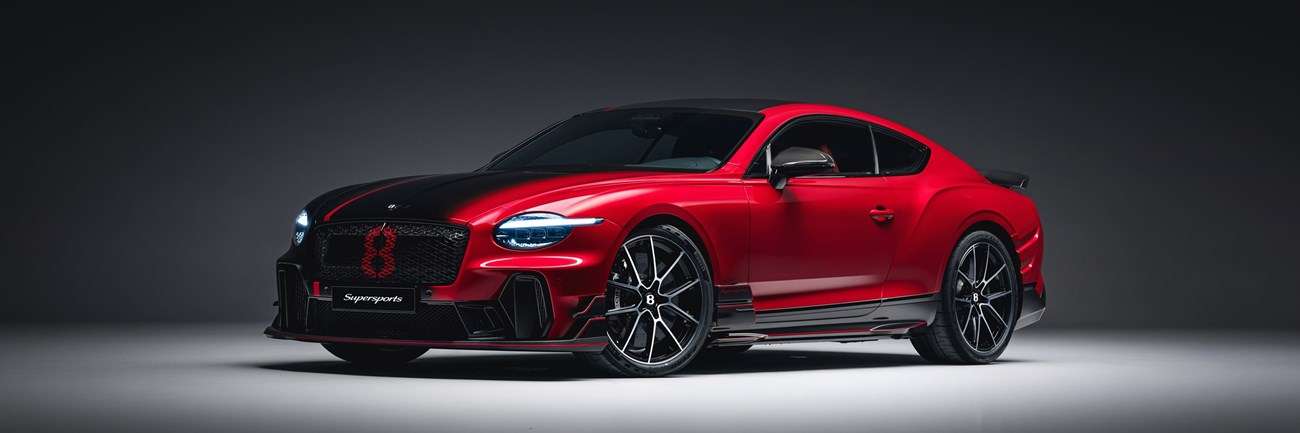
Bentley’s personalization arm, Mulliner, tends to operate in the realm of quiet good taste, the kind of car where the wow factor is a veneer sourced from a single tree or a clock face that took someone a week. So a Design Theme by Mulliner built entirely around a paint job that fades from one side of the car to the other is a genuine left turn for Crewe. This is Bentley being loud on purpose, and it’s reserved exclusively for the Supersports.
The headline trick is a lateral color gradient. Instead of the usual front-to-rear fade or a roofline two-tone split, the highlight color sits on the driver’s side and washes across the bodywork into a darker shade on the passenger side. There’s a single off-center stripe running nose to tail, deliberately lined up with the passenger seat rather than the centerline, plus a number eight on the grille and pinstripe accents on the carbon diffusers, fender blades, and sills. Bentley makes a point that the whole scheme reorients itself depending on drive-hand, so the bright side always lands on whoever’s steering. It’s asymmetry with a thesis.
Why nobody paints cars this way
Here’s the part the press release glosses over: a side-to-side fade is a paint-shop nightmare, and that’s exactly why you almost never see one from a factory.
A front-to-back gradient is comparatively civilized because it runs along the length of the car, roughly following panel gaps, and each panel transitions gradually into the next. A lateral fade has to travel across the width of the car, which means the color is changing as it crosses the hood, the roof, the trunk, and both fenders more or less simultaneously. Every one of those is a separate panel, some steel, some aluminum, and on the Supersports a carbon-fiber roof, and each material takes and reflects paint slightly differently. Getting a continuous, believable gradient to read as one uninterrupted sweep across all of them, with no visible banding or step at the shutlines, is painstaking hand work. You’re blending wet paint across a moving three-dimensional surface and hoping the eye never catches a seam. This is not something a robot arm bangs out.
Related Articles
- Best Microfiber Towels, Wash Mitts, and Detailing Kits Collectors Actually Use
- Market Movers: A Two-Speed Collector Car Market as the Top Sets Records and the Middle Cools
That difficulty is the whole flex. Mulliner is essentially advertising that it can do the thing most shops won’t quote you on.
The repair bill nobody mentions at the order desk
If you’re the sort of person who actually drives a car like this, factor in what a lateral fade does to bodywork repair. On a normal solid-color Bentley, a scuffed fender means the shop mixes the code, sprays that panel, and blends into the neighbors. Simple.
On a car where the color is different on every horizontal slice of the body, a single damaged panel can’t just be shot in “the color,” because there isn’t one color, there’s a specific value at that specific position in the gradient. Match it wrong and the fade develops a visible jog right where the new panel meets the old. In practice, a proper repair may force the shop to re-blend across several adjacent panels to keep the transition smooth, which multiplies labor and paint hours fast. The off-center stripe has to be re-registered to line up perfectly too.
For insurers, this is the kind of car that belongs on an agreed-value policy with a shop that specializes in coachbuilt finishes, because a standard body shop quoting a standard panel respray will get the gradient wrong, and a wrong repair on a bespoke Mulliner car tanks its value. Anyone speccing one of these should go in understanding that the paint is a permanent commitment, not a wrap you peel off when you get bored.
Three themes, and a reason it’s on this car
Buyers pick from three curated combinations: Dragon (Dragon Red into Black Crystal, Hotspur and Beluga cabin), Electric (Electric Blue into Dark Sapphire, with Klein Blue against Imperial Blue inside), and Brodgar (Pale Brodgar into Brodgar, with a Camel and Beluga interior). Want something else? That’s what Mulliner’s commissioning team is for. The two-tone logic carries inside, brighter shades wrapping the driver, darker reserved for the passenger, with Full Leather Specification, a Supersports-specific perforation pattern, and a contrast gear lever matched to the driver’s seat.
Related Articles
- 10 Garage Gadgets Every Car Collector Wishes They Bought Sooner
- 10 High-Value Upgrades Every Serious Car Collector Should Own
The driver-worship isn’t just decorative posturing, and this is where it connects to the actual machine. The current Supersports is the most single-minded Continental GT Bentley has ever built: a strict two-seater, sub-two-tonne, and the first road-going Continental to send its 666 PS twin-turbo V8 exclusively to the rear wheels. It’s a non-hybrid holdout in a lineup that otherwise went plug-in, and it’s capped at 500 individually numbered cars. A livery that literally centers the whole car on the driver’s hip point is, for once, a design gimmick that matches the engineering brief underneath it.
The number eight on the grille reads, to me, like a nod to that cross-plane V8, though Bentley leaves you to draw your own conclusion. The Design Theme makes its public debut at the Goodwood Festival of Speed as one of three specially painted Mulliner cars on the stand, diagonally opposite Goodwood House. If you’ve got a Supersports allocation and a taste for being looked at, this is the box to tick. Just keep the number of your nearest coachbuilding-grade paint shop handy.
Images Via: Bentley
The collector car market, every weekday morning.
Auction results, price moves and what’s crossing the block, read in four minutes. Free, from Modern Car Collector.
No spam, unsubscribe in one click. Or read more about the Brief.





 John Lloyd