

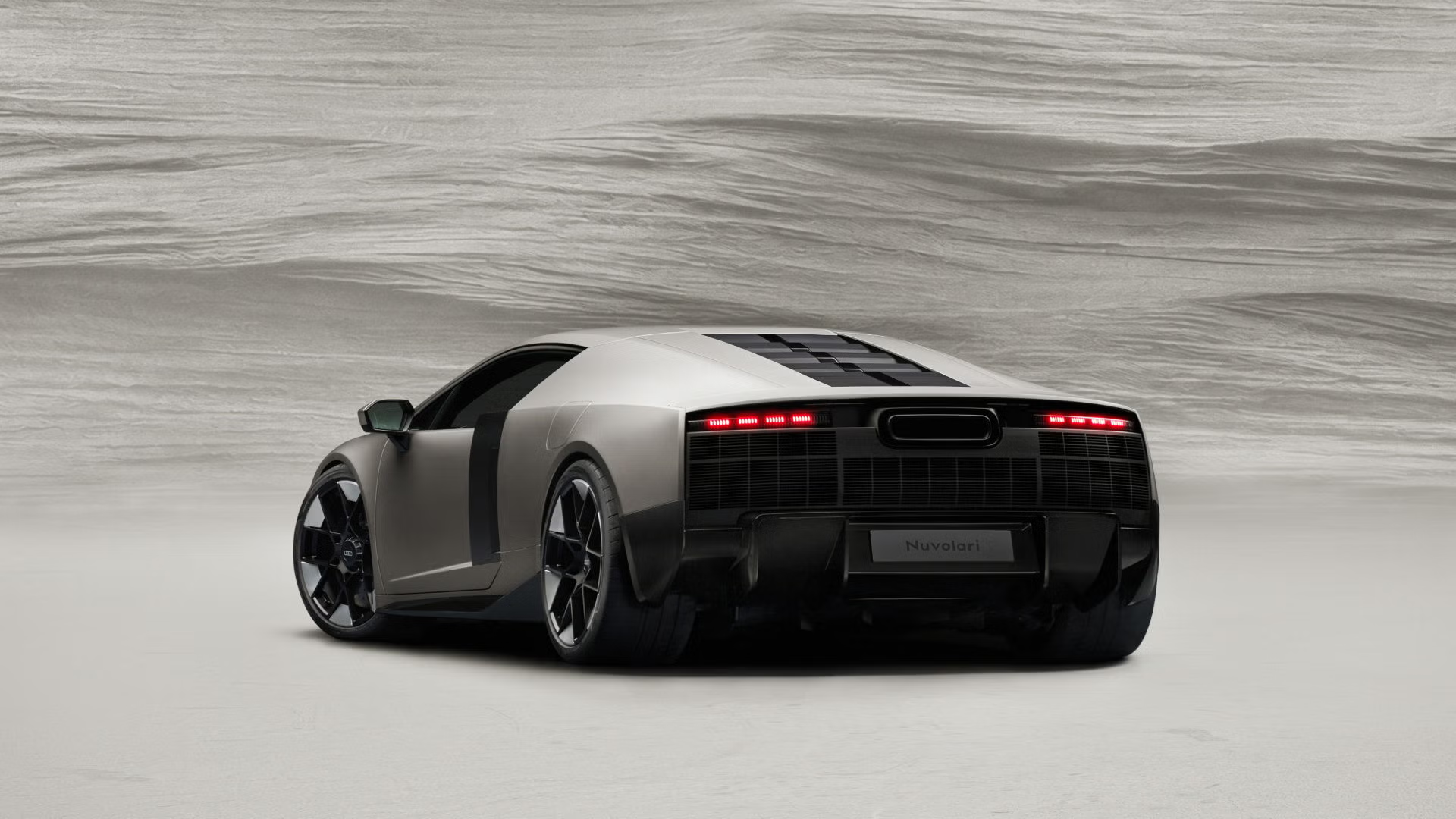
Tazio Nuvolari never drove for Audi. He drove for Auto Union — the pre-war racing consortium whose four interlocked rings became the badge Audi wears today. That distinction matters, because the name Nuvolari on a production car isn’t a marketing exercise. It is a direct line drawn between one of the most audacious racing drivers the world has ever produced and the company that now, after decades away from Formula 1, is putting itself back on the grid and reminding the automotive world what the four rings were built to represent.
The Audi Nuvolari made its United States debut at Monterey Car Week this week — first at The Quail, A Motorsports Gathering on August 14, then on the Concept Lawn at the Pebble Beach Concours d’Élégance. The choice of venues is deliberate. The Quail draws serious buyers. Pebble draws history. Audi wants both audiences, and with the Nuvolari, it has earned the right to address them.
The Man Behind the Name
Tazio Nuvolari was, by most serious assessments, the greatest racing driver of the pre-war era — and possibly of any era. Enzo Ferrari called him the greatest driver of the past, present, and future. Ferdinand Porsche described driving with him as watching a man defy the laws of physics. He was Italian, fiercely nationalistic, and wore a yellow jersey and blue trousers as his racing signature — colors that Audi’s F1 team revived this year in Monaco as a tribute before revealing the car that now bears his name.
Nuvolari joined Auto Union in 1938, already past what most considered his prime. He was 45 years old. He drove the fearsome mid-engined, supercharged Auto Union Type D — a car so powerful and so difficult that most factory drivers could barely manage it — and won anyway. His 1938 Italian Grand Prix victory at Monza in an Auto Union remains one of the most celebrated performances in motorsport history. He was, in the truest sense, a driver who made impossible machinery do things it had no right to do.
When Audi attaches that name to their most powerful production car in history, they are not being casual about it. The Nuvolari is meant to carry weight.
The First Audi Supercar Since the R8
The Audi R8 ended production in 2023 after nearly two decades as one of the most accessible and driver-satisfying supercars on the market. It was a genuinely excellent car — balanced, communicative, powered by one of the finest naturally-aspirated V10 engines ever fitted to a road car — and its discontinuation left a gap that many doubted Audi would fill. The Nuvolari fills it differently.
Where the R8 was democratic in spirit — a daily-driveable supercar that made its driver feel competent — the Nuvolari is a deliberate statement piece. Under the hood sits a twin-turbocharged 4.0-liter V8 paired with a plug-in hybrid system, combining for 987 horsepower delivered to all four wheels through an advanced Quattro Predictive Ride system. Top speed exceeds 217 mph. The Audi Space Frame architecture is all-new. Active aerodynamics are derived directly from Formula 1 engineering. The design draws from Audi’s Concept C show car, translating its dramatic proportions into production reality.
Production is capped at 499 units. Pricing starts at approximately $686,000, with well-optioned examples likely to exceed seven figures. It was revealed at the Monaco Grand Prix in June — a deliberate decision that placed it in the paddock of Audi’s inaugural Formula 1 season, underscoring the engineering lineage the company wants collectors to understand.
Why the F1 Connection Changes the Story
Audi’s return to Formula 1 is not simply a racing exercise. It is a brand repositioning, and the Nuvolari is its road car companion. The timing of the reveal — at Monaco, during the company’s first F1 season since Auto Union’s pre-war campaigns — is the kind of storytelling that sophisticated collectors and brand historians notice. Ferrari has always understood that Formula 1 is what makes a road car aspirational. Lamborghini built its identity on the Miura and the Countach. McLaren grounds everything in the F1. Audi is now, for the first time in the modern era, building a halo car with a genuine motorsport foundation beneath it.
That foundation is not manufactured. Auto Union won nine European Championship titles between 1934 and 1939. Nuvolari drove their cars in the twilight of that era and proved they were extraordinary. The four rings that appear on every Audi — representing the four companies that merged to form Auto Union in 1932 — carry a racing heritage that predates almost every other manufacturer’s claim to motorsport legitimacy. The Nuvolari supercar is the first road car that openly reaches back to that heritage rather than treating it as archival footnote.
A Collector’s Calculus
Four hundred and ninety-nine units is not rare in the way a Pagani Zonda R is rare. But it is rare enough to matter in the secondary market, particularly for a car from a manufacturer re-entering the supercar space after a meaningful absence. The relevant comparison is not the R8 — that car was produced in the thousands. The more instructive comparison is the Lamborghini Reventón (20 units), the BMW M1 (455 units), or even the original Porsche Carrera GT (1,270 units). Production numbers alone don’t determine collectibility, but they narrow the field considerably.
What serious collectors should watch is the narrative around the Nuvolari in five to ten years. If Audi’s F1 program produces meaningful results — and particularly if it produces a championship — the car revealed in the season it returned to Formula 1 takes on an entirely different significance. If the F1 program struggles, that context shifts. Provenance is always partly about the story still being written.
The hybrid powertrain is worth noting for long-term collectors. Plug-in hybrid supercars of this generation — the Porsche 918, the McLaren P1, the Ferrari LaFerrari — are now approaching the twenty-year horizon where questions of battery health and system maintenance begin to affect value. The Nuvolari will face those same questions eventually. Buyers who intend to hold rather than drive should engage Audi’s heritage and certification programs early and document everything from delivery.
The Monterey Debut in Context
There is no accident in the choice of Monterey Car Week for the North American debut. Audi’s head of US operations, Vito Paladino, described it plainly: “Once a year, the Monterey Peninsula becomes the pinnacle backdrop for premium and exclusive mobility.” The week draws the buyers Audi needs to reach — collectors who understand the difference between an expensive car and a significant one, and who will pay accordingly for the latter.
Placing the Nuvolari on the Concept Lawn at Pebble is the more interesting decision. That venue has historically been reserved for vehicles that represent something beyond their specification sheets — cars that stand for a moment in automotive history. Audi’s suggestion that the Nuvolari belongs in that company is either confident or audacious, possibly both. But the name on the car makes a reasonable argument for it.
What This Means
The Nuvolari is not a guaranteed future collectible. No new car is. But the conditions that create lasting collector significance are present in ways that most modern supercars cannot claim: a production cap that means scarcity, a name that carries genuine historical weight, a moment in the manufacturer’s history that is genuinely transitional, and a price of entry that selects for committed buyers rather than speculators.
Collectors rarely pay a premium for horsepower alone. They pay for moments in history — the year Ferrari introduced the mid-engine road car, the year Porsche turbocharged the 911, the year McLaren proved a road car could win Le Mans. Whether Audi’s return to Formula 1 becomes one of those moments remains to be seen. The Nuvolari was built on the assumption that it will. That is a bet worth understanding before the allocation window closes.
The collector car market, every weekday morning.
Auction results, price moves and what’s crossing the block, read in four minutes. Free, from Modern Car Collector.
No spam, unsubscribe in one click. Or read more about the Brief.



 Kyle Matthews
  John Lloyd
  Eve Nowell