

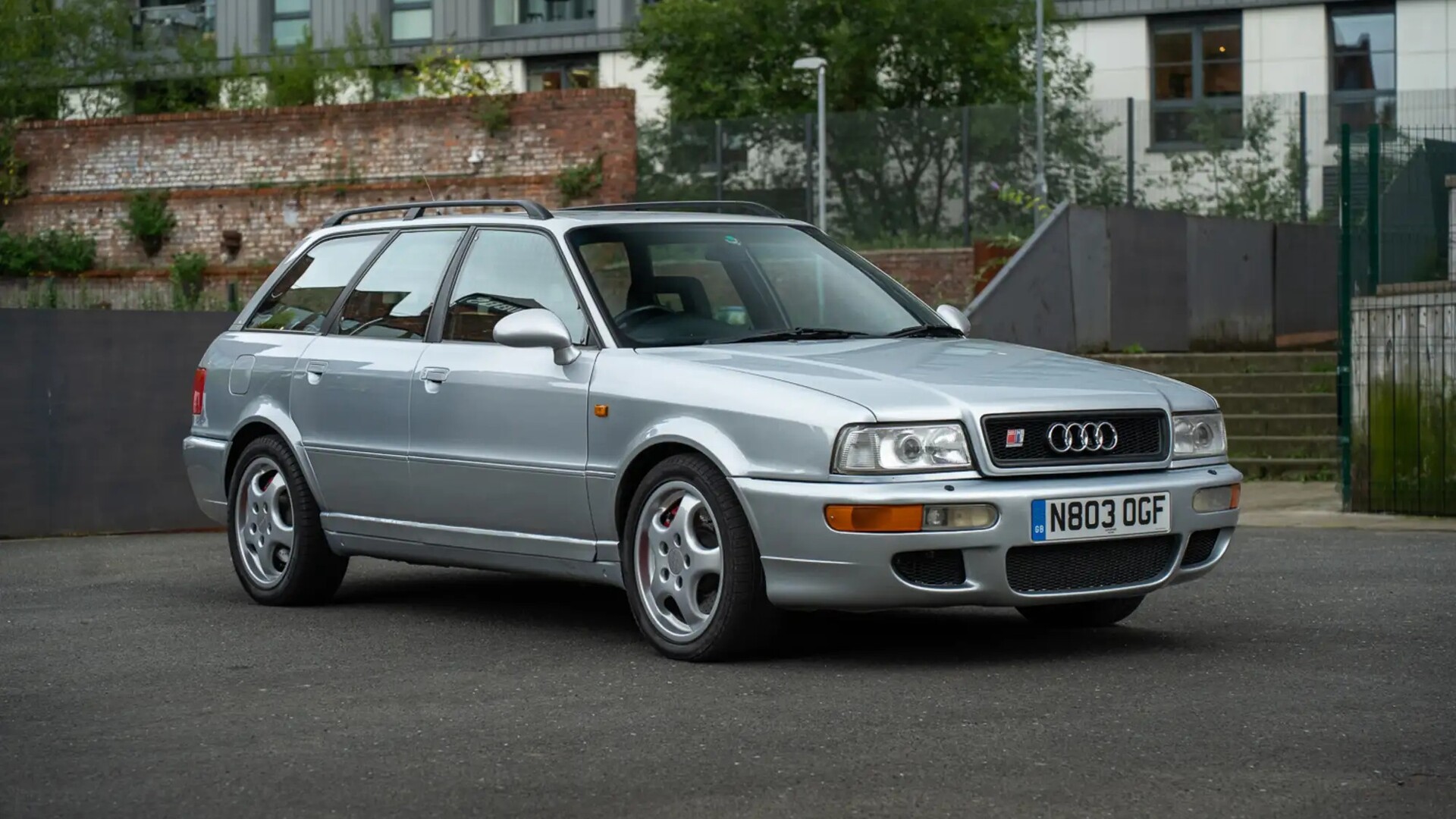
In March 1994 Audi showed a station wagon at Geneva that reached 60 mph in under five seconds, wore Porsche wheels and mirrors, carried the word “PORSCHE” on its tailgate, and cost £45,705 in Britain. Audi built 2,891 of them in about seventeen months. Thirty-two years later the RS2 Avant is the benchmark for the fast estate, and its market has settled into something more revealing than a single price: a spread. Sales since the start of 2025 have run from roughly £32,000 to more than £80,000, and the gap is explained almost entirely by mileage, originality and the availability of parts that only this car uses.
That spread is on display this month at the NEC in Birmingham, where Iconic Auctioneers is offering two right-hand-drive 1995 RS2s on consecutive days: a 38,500-mile Nogaro Blue car estimated at £75,000–£100,000 on 14 November, and the subject of this article, a 207,461-mile Polar Silver car estimated at £20,000–£25,000 on 15 November. The same model, the same venue and the same auctioneer, with estimates roughly four times apart. This deep dive explains why, and what it says about where the RS2 stands as an established collectible.
Why the RS2 Avant matters
The RS2 was the first car to wear Audi’s RS badge, and it was a collaboration in the full sense. Audi 80 Avant shells were built at Ingolstadt and sent to Porsche’s Rossle-Bau plant in Zuffenhausen, where Porsche carried out the conversion and final assembly (Octane; Wikipedia). Porsche reworked the engine, gearbox, brakes and suspension, and supplied hardware from its own parts bin. The formula it set — a family body, a turbocharged engine and an RS badge — is one Audi still follows; the Audi RS3 Competition Limited sits at the far end of that lineage.
For collectors the significance is practical rather than sentimental. The RS2 was a limited, Porsche-engineered performance car that an owner could use every day, which is why so many have covered 100,000 miles or more. That usability is also the central tension in the market: the cars that survive in the best condition are rare in absolute terms.
Production numbers
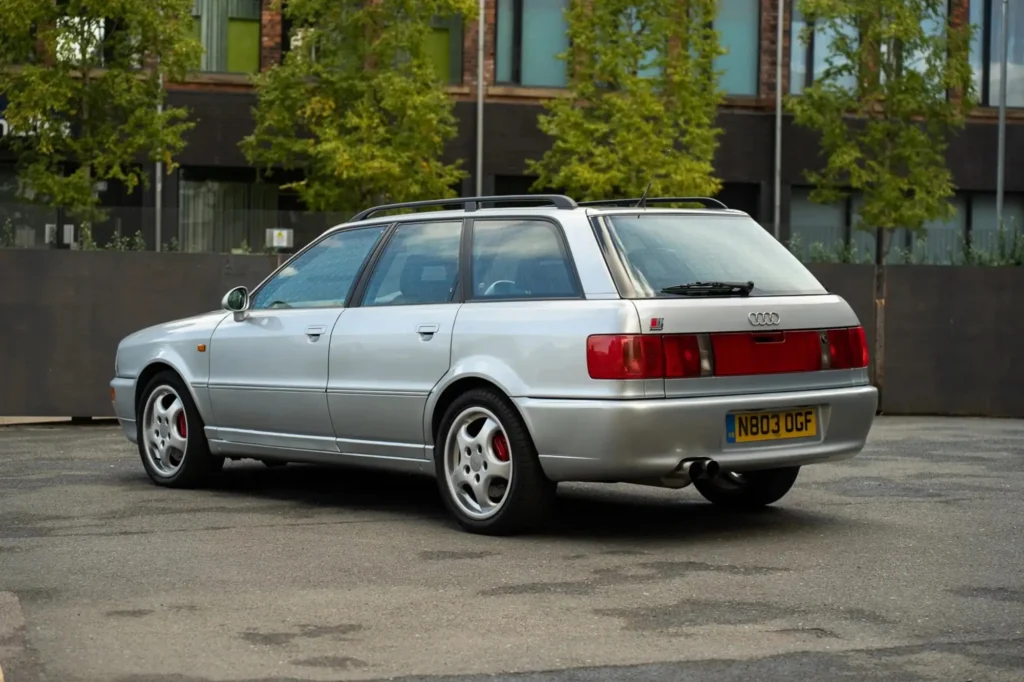
Audi planned about 2,200 cars. Demand pushed the total to 2,891, built between March 1994 and July 1995 (Classic & Sports Car; Wikipedia). About 180 were right-hand drive, shared among the UK, Hong Kong, New Zealand and South Africa, and four saloons were also built. Some sources quote lower totals; PistonHeads notes that 2,700 is commonly cited while 2,891 appears elsewhere. This article uses 2,891 because Classic & Sports Car, Octane and Wikipedia all give it.
The RS2 was never sold new in the United States, so American-market cars are imports. As of 2022 PistonHeads counted fewer than 130 cars still registered in the UK, of which roughly 40 were legally on the road. Treat those numbers as a snapshot rather than a census, but they help explain why right-hand-drive cars carry a premium in Britain (Octane).
Engine and drivetrain
The engine is the 2,226 cc, 20-valve, turbocharged inline-five (code ADU), with an iron block and aluminium head, already used in the Audi S2. Porsche added a larger KKK turbocharger running 1.4 bar against the S2’s 1.1 bar, high-lift camshafts, a larger intercooler, higher-flow injectors, a low-pressure exhaust manifold and a revised Bosch engine-management map. Output rose to 315 PS (311 bhp) at 6,500 rpm, with 410 N·m (302 lb-ft) at 3,000 rpm — about 85 bhp more than the S2 (PistonHeads; Classic & Sports Car).
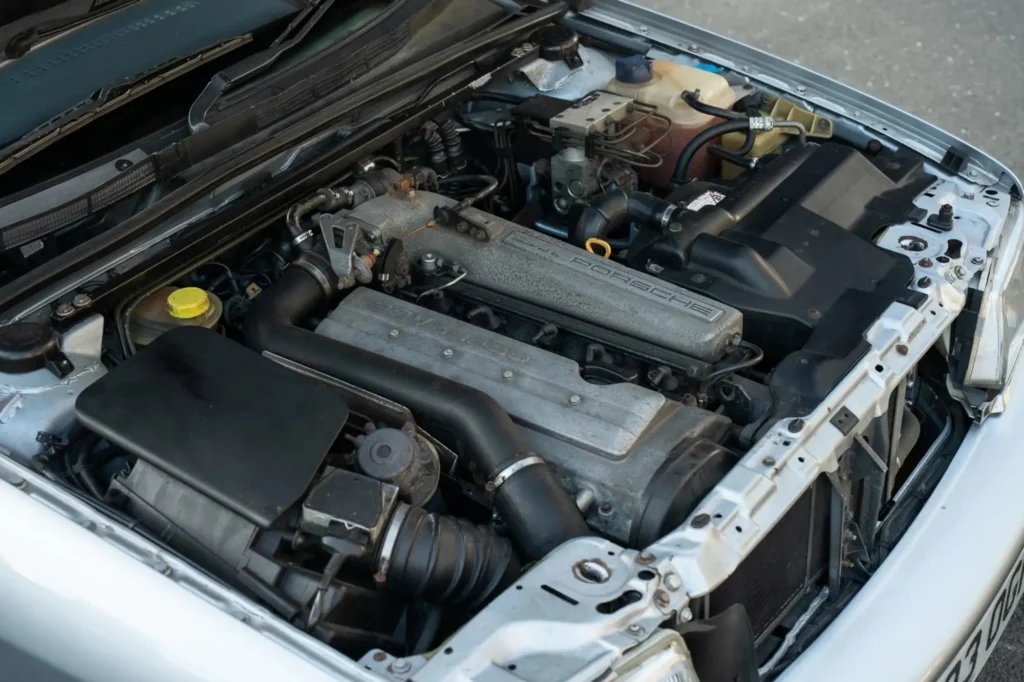
Power reaches all four wheels through a six-speed manual and Torsen-based quattro, with an electro-hydraulic lock on the rear differential. There was no automatic. Testers recorded 0–60 mph in 4.8 seconds, although PistonHeads gives Audi’s official 0–62 mph figure as 5.4 seconds, and top speed is quoted at about 163 mph from roughly 1,595 kg. The delivery matters as much as the numbers: a large turbo and a heavy flywheel mean noticeable lag followed by a hard surge above 3,000 rpm, which is a large part of the car’s character.
Mechanical uniqueness: the Porsche hardware
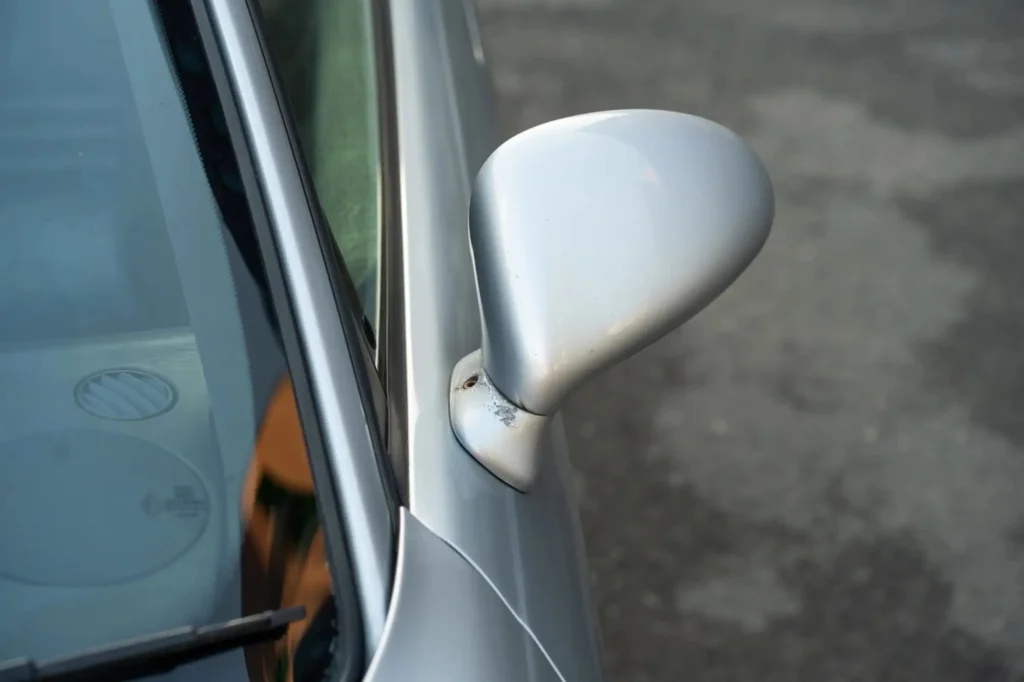
The RS2’s distinctiveness is mostly below the beltline. Porsche lowered the suspension by 40 mm and stiffened it, fitted four-piston Brembo calipers derived from the 968 Club Sport behind 304 mm front and 299 mm rear discs (322 mm fronts were optional), and specified 17-inch Cup-pattern wheels carrying 245/40 ZR17 Dunlops. Porsche 911 parts also appear in the details: the door mirrors, sidelights, front indicators and fuel pump all came from Zuffenhausen (Classic & Sports Car).
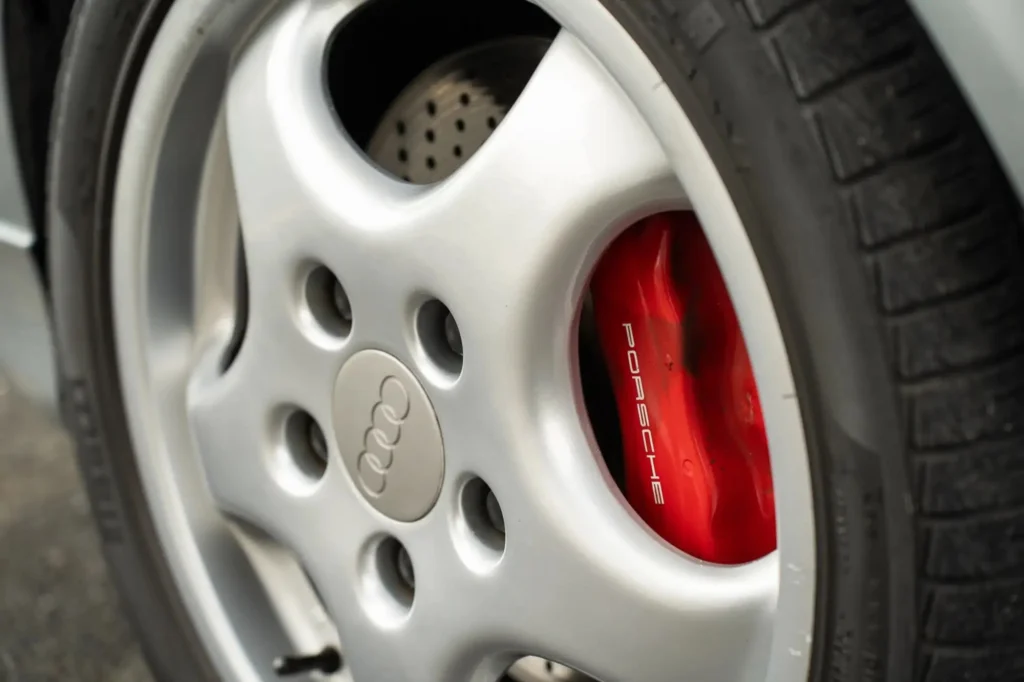
This hardware is the source of the car’s appeal and of its risk. The components that make an RS2 an RS2 are the ones that are hardest to replace today, a point developed in the ownership section below.
Factory options, colours and identifying details
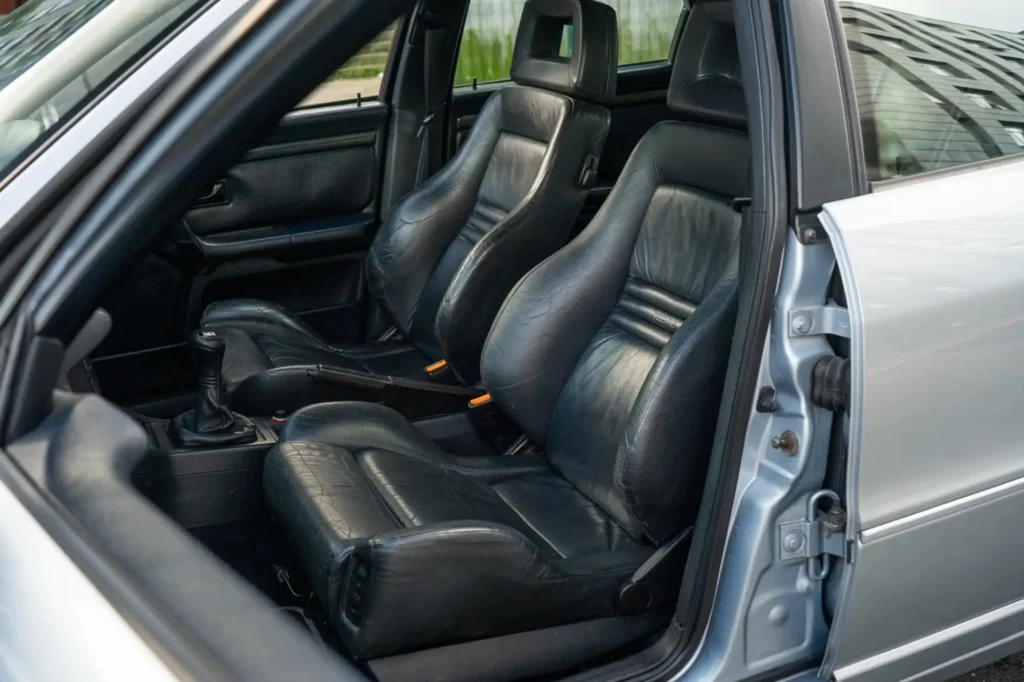
Options were mostly about trim. Interiors could be finished in full black Nappa leather or with silver or blue Alcantara inserts, with carbon-fibre or wood fillets on the dash and doors; Recaro seats and Kevlar or wood trim were specific to the model, and a sunroof was standard on right-hand-drive cars (Classic & Sports Car). Five exterior colours were offered in the UK, with blue the signature shade (Octane); the Lot 111 car is Nogaro Blue and the Lot 321 car is Polar Silver Metallic. Appearance alone proves little, because lesser Audi 80s and S2s can be dressed to resemble an RS2.
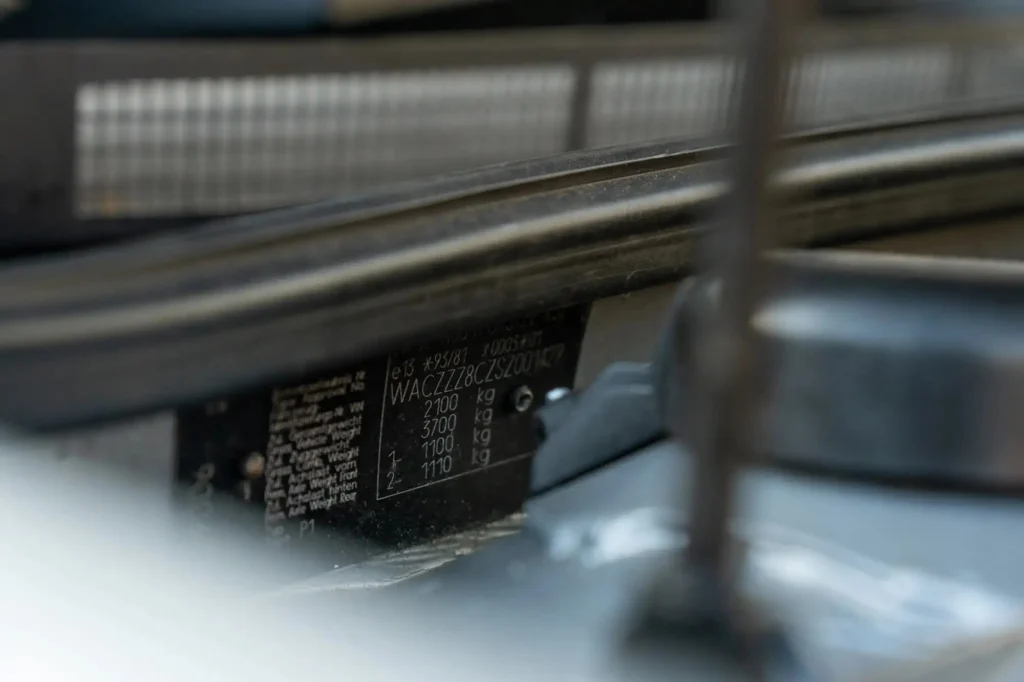
Verification starts with the chassis number. Every RS2 VIN in the public listings reviewed for this article begins WACZZZ8C, including the Lot 321 car (WACZZZ8CZSZ001429); that is a quick sanity check, not proof. Octane advises looking for an ARGE chassis plate, and buyers should ask for the build documents, service history and any evidence of the car’s Porsche-built origin before relying on appearance.
Current market values and comparable sales
Values have moved a long way. Octane records that RS2 prices dipped below £10,000 in the mid-2000s. By around 2016 PistonHeads reported a 127,000-mile UK car at £30,000, after values had doubled in three years; by about 2018 a good 100,000-mile car was £35,000–£40,000, with sub-50,000-mile cars near £75,000. In 2022 a 51,000-mile car was advertised at about £80,000 (PistonHeads).
The recent record is more mixed. The Classic Valuer, which converts results to pounds, shows 61 RS2 sales and an 87% sell-through rate, with a median of £46,948 since 2020, a low of £31,591 and a high of £86,838. Selected results are below; currencies, mileage and condition differ, and converted figures are the aggregator’s.
| Date | Venue | Car | Result |
|---|---|---|---|
| 29 Oct 2026 | Mathewsons (UK) | 1995 | £36,000 |
| 15 Oct 2026 | Collecting Cars (Germany) | 1995 | £51,879 |
| 30 Aug 2026 | Iconic Auctioneers (UK) | 1995 Avant | £50,625 |
| 24 Apr 2026 | Collecting Cars (Sweden) | 1994 | £32,851 |
| 13 Apr 2026 | Collecting Cars (Italy) | 1995 | £51,821 |
| 14 May 2025 | Collecting Cars (Spain) | 1995, 128,000 miles | €49,000 (£44,149) |
| 25 Apr 2025 | Bring a Trailer (US) | 1995 Avant | £81,165 |
| 27 Aug 2022 | Iconic Auctioneers, Silverstone | 1995 RHD, Nogaro Blue, 33,748 miles | £75,938 (Iconic) |
Hagerty’s valuation tool shows $68,000 for a good-condition (#3) 1995 car, a trend of −9.8% (the period is not stated), 16 public auction sales in three years with a low of $45,075 and a high of $108,000, and a latest sale of $69,509 on 15 February 2025 (Hagerty). Taken together, the evidence is that the market has not run away. Results for ordinary continental cars since early 2025 have clustered between about £32,000 and £55,000, and what separates cars within that band is mileage and condition; the cars above it are low-mileage or US-market sales.
The auction lot: what Lot 321 shows
The car is a 1995 RS2 Avant in Polar Silver Metallic with black leather and carbon-fibre trim, right-hand drive, registered N803 OGF and supplied new by Audi AFN Guildford. It crosses the block at 10:00 am on Sunday 15 November 2026 as Lot 321 in the Classic Sale at the NEC Classic Motor Show, with an estimate of £20,000–£25,000 and a buyer’s premium of 12.5% plus VAT, which Iconic gives as 15% including VAT (Iconic Auctioneers lot listing). If it sells inside the estimate, the all-in price is roughly £23,000 to £28,750 before transport and storage.
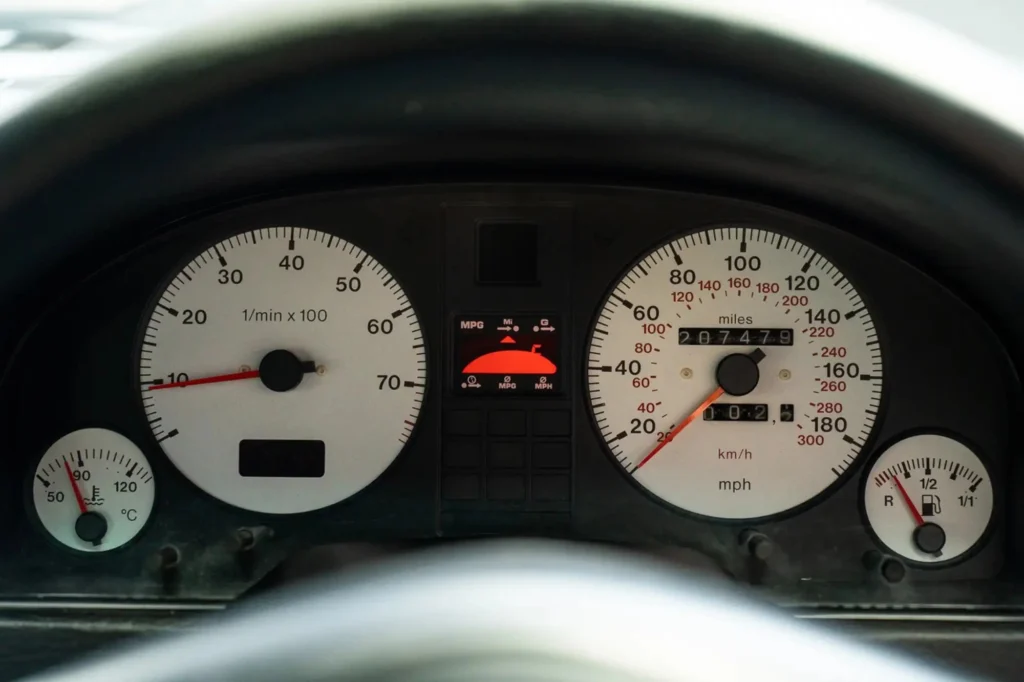
The catalogue lists 207,461 miles, a fully stamped service book, the original book pack and a substantial folder of Audi and specialist invoices, and says the car was last serviced by an Audi specialist in August 2026. That service entry is recorded at 207,476 miles, 15 more than the header figure, a small inconsistency a bidder should clear up with the auctioneer. The listing does not state the number of previous owners. Iconic’s seller rating is 81 out of 135, three stars (“Good”) in every category, and the page notes that the ratings come from the seller.
The estimate sits below every result in the table above and below the £31,591 low in The Classic Valuer’s data. The only high-mileage comparison in the data reviewed is the 128,000-mile Spanish car at €49,000; Lot 321 has roughly 80,000 more miles. The question for a bidder is whether a documented, right-hand-drive, 200,000-mile RS2 is a usable driver or a pending restoration, and the answer depends on the turbo, the gearbox and the cost of the parts discussed below. The neighbouring Lot 111 (38,500 miles, three former keepers, Nogaro Blue, £75,000–£100,000) shows what a seller is asking when those questions have already been answered. Estimates are not results, but the outcomes on 14 and 15 November will show how much of the price premium is for mileage and how much is for the car.
Ownership costs and known weaknesses
The engine is durable, but it depends on disciplined servicing. The cambelt is specific to the RS2 (it carries an extra tooth) and is due every 80,000 miles; PistonHeads priced the belt and water-pump kit at about £400 in 2022, with the tensioner and idler extra. Spark plugs are due every 20,000 miles, and fuel economy sits in the low twenties mpg. The recurring faults are consistent across the guides.
Engine and turbo. The wastegate can fail, causing stuttering performance; a failing mass-airflow sensor produces dark smoke and misfiring; coil packs and fuel pumps wear; and the turbo’s cooling water pump should be checked. Gearbox. Check second-gear synchros and first gear, which hard launches can damage, and expect linkage wear. The diff lock should work, but it should not be used much on tarmac. Brakes. Infrequent use seizes calipers and corrodes discs, especially at the rear, and slider plates and fixings corrode. Body and interior. The shell is not prone to rust, though wheelarches and sills deserve a look; window regulators fail; leather and door cards show age (PistonHeads; Classic & Sports Car).
Parts are the real constraint. RS2-specific items are scarce and costly: the Porsche mirrors, replacement bumpers, black plastic trim and gear knob are all hard to find, and PistonHeads reports that Audi Tradition does not list RS2 parts clearly; it names Quattro Corner and TPS Coventry as specialist sources. The original Dunlop SP Sport 8000 245/40 tyres are no longer available, and many cars run 235 or 225 sections instead (Classic & Sports Car).
Originality considerations
Many RS2s have been lowered, re-tuned or chipped, and Classic & Sports Car is clear that modifications rarely add value. The market has not always agreed: Classic.com records a modified 1995 car sold in Denver for $100,000 and a modified 20,000-mile car in Berlin at €59,250 in April 2024, though those prices probably reflect mileage and presentation rather than the modifications themselves. The conservative position for a collector is to prefer a stock car with its original wheels, mirrors, trim and documentation, because the Porsche-sourced details are the hardest and most expensive parts to rebuild. Look for crash repair, neglect and heavy modification, and confirm that those details are original.
Competing vehicles
Classic & Sports Car names two contemporary rivals: the Volvo 850 T-5R (243 bhp, 6,964 built in 1995–96, £10,000–£25,000 at the time of its guide) and the BMW M5 Touring (3.8-litre six, 340 bhp, 891 built, £25,000–£125,000). MCC has covered the Volvo in Is the Volvo 850 T-5R a Future Collector Car?; it also had Porsche involvement but sits at a fraction of the RS2’s price. On the Japanese side, the Nissan Stagea 260RS Autech is the nearest equivalent: a turbocharged AWD wagon with a performance-brand pedigree, in a market that has not yet settled on a price. The RS2 sits between the M5 Touring’s scarcity and the Volvo’s volume.
What separates exceptional examples from average ones
Mileage is the first filter, but not the only one. The best RS2s combine low mileage with a documented service history, an intact set of Porsche-specific parts, rust-free arches and sills, a working turbo cooling pump and wastegate, the correct tyre fitment and a recent cambelt. Classic & Sports Car priced show-condition cars at £80,000, average cars at £50,000 and restoration cars at £27,000 in November 2023; the 2025–2026 results above fit that structure loosely. As a rule, a high-mileage car with a complete history and original trim can be a sound purchase, while a high-mileage car without records, or with missing RS2 parts, is a project priced as a driver. The same pattern appeared in MCC’s Mustang SVO deep dive, where documentation explained more of the price range than mileage did.
Established value versus speculative potential
Established: the RS2 has a recognised place in automotive history, a documented production run, a Porsche connection that is visible in the car, a recovery from sub-£10,000 values in the mid-2000s, and a record of regular public sales. Low-mileage cars have sold above £75,000.
Speculative: whether the lower results since 2025 are a plateau or the start of a decline, whether very-high-mileage cars will form a stable lower tier or become hard to sell as parts run out, and whether the lowest-mileage cars will break £100,000. Lot 111’s result will test the last of these, though one result does not make a trend.
What could strengthen or weaken its desirability
Factors that could strengthen demand include the scarcity of low-mileage cars, continued US interest (Bring a Trailer results in 2025 ran from about £55,000 to £81,000 on The Classic Valuer’s figures), and the continuing success of the RS badge, which keeps the original in the conversation. Factors that could weaken it include the loss of parts supply (mirrors, trim and bumpers in particular), the age of the remaining cars, and rising specialist labour costs. None of this is a forecast; it is a list of the variables the price will follow.
The bottom line
The RS2 Avant is an established collectible whose market has stopped rising in a straight line and started sorting cars by mileage, originality and parts. The Iconic Auctioneers sale on 14–15 November will put two right-hand-drive cars with very different histories under one roof. If Lot 321 sells near its estimate, it will suggest a floor for a high-mileage, well-documented car; if Lot 111 meets its estimate, it will show what collectors pay for the opposite. Either way, buyers should price the parts risk first and the badge second. Auction estimates are not results, and nothing here is investment advice.
The collector car market, every weekday morning.
Auction results, price moves and what’s crossing the block, read in four minutes. Free, from Modern Car Collector.
No spam, unsubscribe in one click. Or read more about the Brief.
Related Posts:
- Is the Audi RS 3 Competition Limited a Future Collector Car?
- Is the Nissan Stagea 260RS Autech a Future Collector…
- Is the Volvo 850 T-5R a Future Collector Car? The…
- The Complete Guide to the Yenko Camaro

- Delta Integrale vs. Escort Cosworth vs. Celica…
- The Collector Car Market Paid Up for Certainty This…

 Shawn Henry
 Eve Nowell