

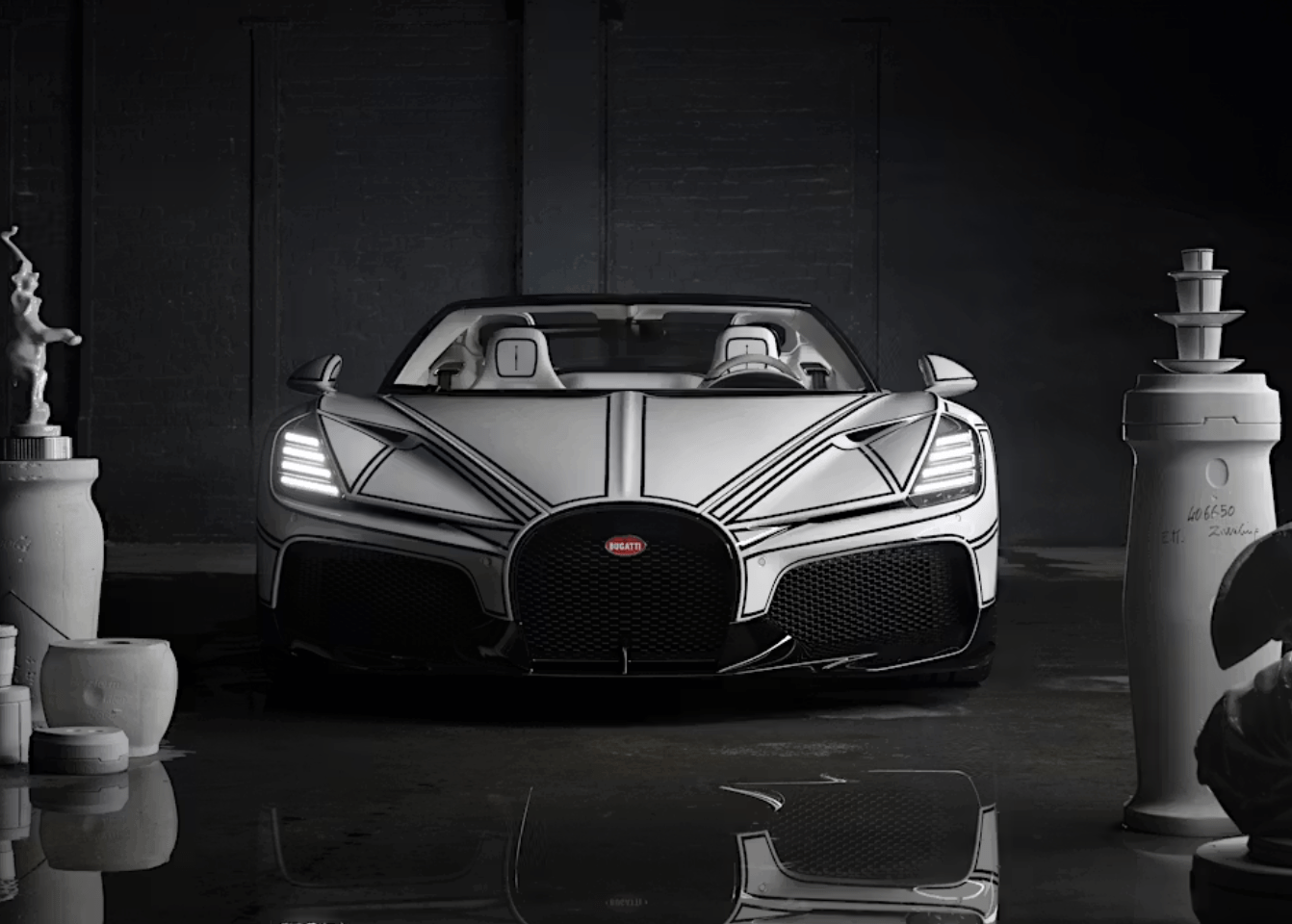
Bugatti has built its modern reputation on doing absurdly difficult things and then acting like they were easy. The W16 Mistral ‘Blanc Éternel’ is the latest one-off to come out of Molsheim’s Sur Mesure bespoke shop, and it manages to be simultaneously a design flex, an engineering headache, and a farewell card to the engine that defined the company for two decades. It’s a lot to hang on one roadster. Somehow it works.
Here’s the short version: it’s a single W16 Mistral finished in white, wearing a lattice of hand-painted black lines, trimmed with real porcelain, and built in partnership with Berlin’s centuries-old Königliche Porzellan-Manufaktur, better known as KPM. But the interesting part isn’t the “porcelain on a supercar” novelty. It’s what those black lines actually are.
You’re looking at the car’s own blueprint
Modern cars aren’t sculpted in clay anymore, and the Mistral never was. Bugatti says the roadster’s entire body was developed digitally, its surfaces built from a mesh of mathematically defined patches called NURBS, or Non-Uniform Rational B-Splines. If that sounds like alphabet soup, think of it this way: every smooth curve on a computer-modeled car is actually a quilt of individual surface panels stitched together, each one governed by control points that let designers bend and tension the shape with real precision. Normally that underlying grid is invisible on the finished car. It’s the scaffolding you’re not supposed to see.
Related Articles
- Win a 1-of-1 1970 ‘Cuda Convertible AND a 1,025-HP Demon 170 — And MCC Readers Get More Entries, Ends 7/9
- 10 Coolest Chevrolet Chevelles at Mecum Harrisburg 2026
For ‘Blanc Éternel,’ Bugatti took that hidden patch layout and painted it onto the outside of the car in black. So the livery isn’t decorative in the usual sense. It’s the geometric logic of the bodywork made visible, the digital seams that define the Mistral’s shape dragged out into daylight. It’s a car wearing its own construction diagram, which is either pretentious or brilliant depending on your mood, and I lean brilliant.
There’s a lineage here. Fifteen years ago Bugatti and KPM built the Veyron Grand Sport ‘L’Or Blanc,’ whose flowing blue-on-white lines were inspired by an Enzo Mari porcelain vase and by the “light lines” designers reflect across a body to hunt for surface imperfections. Frank Heyl, now Bugatti’s design director, hand-applied those lines himself back then. ‘Blanc Éternel’ is the sequel, except instead of celebrating reflections it exposes the digital skeleton, which is a neat way of saying “look how much the process has changed in fifteen years.”
The painting is where it gets masochistic
Digital origins or not, nothing about the execution is automated. Bugatti finishes the body in white, sands it, then hand-tapes every single black line into position before counter-masking the surrounding area, pulling the original tape to expose the channels, and spraying them black. That’s an enormous amount of masking for a livery that has to flow correctly across a compound-curved three-dimensional shape. Tape a line a couple millimeters off across a fender and the whole “surface geometry” conceit falls apart, because the line no longer follows the actual patch edge. This is genuinely fussy work.
The same graphic gets carried inside, hand-painted directly onto white leather, which forced Bugatti to develop a new process entirely, because paint on leather has to survive flexing, UV, body oils, and years of someone climbing in and out without cracking or transferring. That’s not a trivial materials problem.
Porcelain that you actually touch
The KPM porcelain isn’t just badge jewelry. Yes, it shows up outside on the EB emblem, the fuel and oil caps, and two engine-cover inlays stamped with KPM’s royal scepter. But inside, Bugatti made it functional: the gear-shifter shells, the window switches, the speaker cover, kneepad inlays, and the center-console armrest inlay are all real fired porcelain. You operate porcelain every time you select a gear or drop a window.
That’s a flex with consequences. Porcelain shrinks roughly 17% as it’s fired in the kiln, so every piece has to be modeled oversized with that shrinkage calculated in advance, or it won’t fit its mounting point when it comes out. Now put that brittle, precisely-sized ceramic into a roadster with no roof, subject to vibration, thermal cycling, and the occasional slammed door. Getting porcelain to live in that environment without cracking is the actual engineering story here, and it’s harder than the horsepower ever was.
Related Articles
- Jeremy Clarkson’s Personal 2006 Ford GT Is Coming Up for Sale
- One-of-a-Kind Ferrari Enzo Sets Record as Most Expensive Car Ever Sold Online
Which raises the practical question nobody in the press release wants to touch: what happens when you chip a porcelain window switch? On a normal car, that’s a parts-counter shrug. On a one-of-one collaboration between a hypercar maker and a 260-plus-year-old porcelain house, a replacement means going back to the artisans who fired the original, recalculating the shrinkage, and hoping the color and glaze match. For anyone insuring one of these, this is exactly the kind of car that lives on an agreed-value policy with a specialist underwriter, because there is no book value and no meaningful repair network. The livery has the same problem: a stone chip on the front clip isn’t a spot-repair, it’s a re-tape-and-respray of a mathematically precise pattern.
Why the name matters
‘Blanc Éternel’ is doing double duty. It nods to the timeless white of porcelain, but it’s also a headstone for the W16. Bugatti is blunt that the Mistral is the final road-going car to carry the quad-turbo 8.0-liter sixteen, the engine the original Veyron used to turn Bugatti from a historical footnote back into the benchmark. The Veyron made the W16 an icon; the Mistral is its last roadster. What comes next in Molsheim is a completely different animal, a hybridized naturally aspirated V16, so this really is the end of the turbocharged-sixteen bloodline rather than marketing sentiment dressed up as an occasion.
For the collector market, that context is the whole ballgame. One-offs from Sur Mesure already occupy the rarefied air where cars are bought as appreciating assets rather than transport, and a documented “last of the W16 lineage” provenance is precisely the sort of story that auction catalogs are built around a couple of decades from now. It’s worth noting the original ‘L’Or Blanc’ it descends from remains a coveted piece for exactly the same reason.
If you want a consolation prize, there’s a matching KPM porcelain collection, the To-Drive Cup and the Aviator Cup in two sizes, capped at 1,000 handmade pieces. It is, as far as I can tell, the only part of this project you have any realistic chance of owning. The car itself already belongs to someone with taste, patience, and a frankly heroic tolerance for fragile trim.
The collector car market, every weekday morning.
Auction results, price moves and what’s crossing the block, read in four minutes. Free, from Modern Car Collector.
No spam, unsubscribe in one click. Or read more about the Brief.



 John Lloyd
  Kyle Matthews