

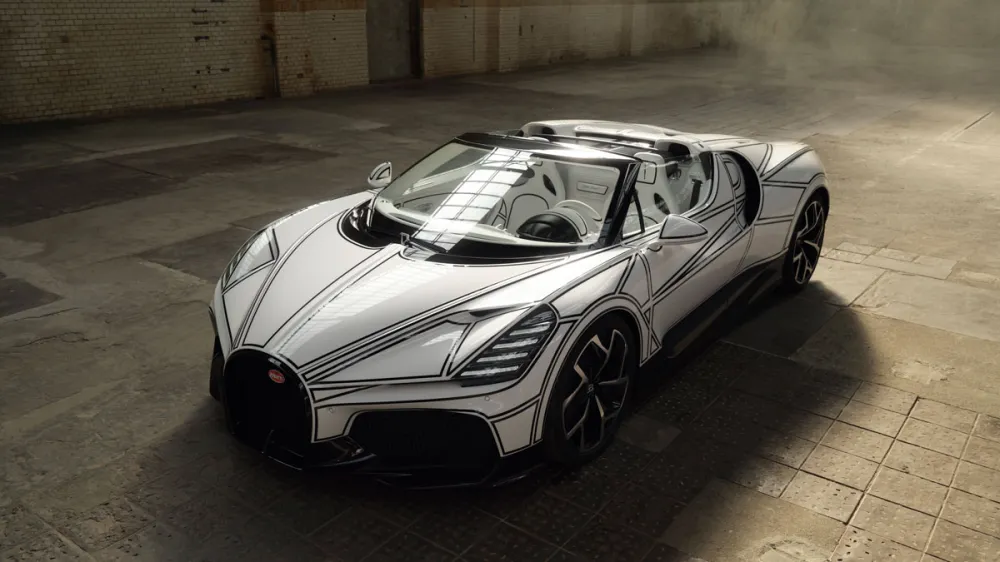
Bugatti’s latest one-off is a hypercar wearing its own CAD wireframe, trimmed with porcelain you actually shift gears through. That sentence sounds like a fever dream, but the W16 Mistral “Blanc Éternel” is a real, single-example roadster from Bugatti’s Sur Mesure personalization arm, and the story behind it is more interesting than the usual “we painted it a special color” one-off.
Start with the paint job, because it’s the cleverest part and everyone will misread it as decoration. Those crisp black lines threading across the white bodywork aren’t a random pattern. According to Bugatti, they trace the Mistral’s NURBS patch layout—the network of Non-Uniform Rational B-Spline surfaces that designers use to build a car’s shape digitally. Every curved panel on a modern car is a quilt of mathematically-defined surface patches stitched together, and the boundaries between those patches are normally invisible on the finished product. Bugatti made them visible. In effect, the car is showing you the engineering scaffolding underneath its own skin. If you’ve ever heard surface designers talk about “lines of light” or zebra analysis—reflected stripes they use to hunt for imperfections in a surface—this is the same idea turned into art. The earlier L’Or Blanc Veyron from 2011, Bugatti’s first collaboration with Berlin porcelain house KPM, used those reflection lines; this one exposes the digital mesh beneath. It’s a genuinely smart evolution of the concept rather than a rerun.
And it’s paint, not a wrap. Bugatti says the white body was laid down first, then every black line was positioned by hand with tape, counter-masked, and sprayed—the same laborious multi-stage masking repeated on white leather inside, which required developing a new leather-finishing process so the painted lines wouldn’t crack or wear. That distinction matters if you care about these things: sprayed-and-masked graphics have depth and durability a vinyl wrap can’t touch, and on a car like this they’re part of why it’s a one-off and not a configurator option.
Related Articles
- Joe Burrow Custom Ford Bronco Sells for $90,000 to Benefit His Foundation
- Maserati Reportedly Weighs Manual Transmission, V6 for Future Supercar
Now the porcelain, which is where the skeptic in me perks up. KPM has been firing porcelain since 1763, and here it’s not confined to a display cabinet—it’s on the EB emblem, the fuel and oil caps, and inlays in the engine cover outside, and inside it forms the speaker cover, kneepad inlays, gear-shifter shells, the center-console armrest, and the window-lifter buttons. In other words, the brittle material lives exactly where your hands go, in a car whose 8.0-liter quad-turbo W16 vibrates and whose performance is violent. The manufacturing detail Bugatti volunteers is the good one: porcelain shrinks roughly 17 percent as it’s fired, so every piece has to be modeled substantially oversized to end up the correct dimension after the kiln. Get the math wrong and the part won’t seat. KPM’s creative director calls refining the material for this use “a remarkable achievement in craftsmanship,” and for once the PR line undersells the problem—putting fired porcelain where a driver grabs a gear selector at speed is either mad or magnificent, and Bugatti has decided it’s both.
Underneath the artwork sits a standard-issue Mistral, which is to say anything but standard. The official specs list the 7,993cc W16 with four turbochargers running Bugatti’s two-stage sequential boost and water-to-air intercooling, making 1,600 PS (1,578 hp) at 7,050 rpm and 1,600 Nm of torque, sent through a seven-speed dual-clutch to all four wheels. Zero to 100 km/h takes 2.4 seconds; the run to 300 km/h is done in a little over 12. Worth knowing if you ever meet one: the customer car’s top speed is electronically capped at 420 km/h (273 mph) in Top Speed mode. The famous 453.91 km/h (282 mph) open-top world record set at Papenburg in November 2024 was run by a separate one-off World Record Car on bespoke high-performance tires, with Le Mans winner Andy Wallace driving. That governor isn’t Bugatti being timid—it’s tire physics. Production rubber has a speed rating, and no manufacturer lets a customer chase a number the tires aren’t certified to survive.
The context that makes Blanc Éternel more than a rich person’s science project is timing. The Mistral is the final road-going car to use the W16, the engine that launched with the 2005 Veyron. Bugatti’s future is the Tourbillon and its new hybrid V16, which means every W16 Mistral is a closing-credits car for a 20-year engine era, and the market treats last-of-the-line hardware accordingly. A one-off within that already sold-out final roadster run is about as scarce as modern collector cars get, and scarcity plus documented uniqueness is exactly what drives the Sur Mesure and one-off segment—the apex of Bugatti’s business precisely because no two cars can be compared on price. To ride the collaboration further, KPM is also making a 1,000-piece porcelain set of cups themed to the car, which is the sort of thing that sounds silly until you notice how quickly Bugatti-adjacent collectibles vanish.
Related Articles
- Win This 1967 Porsche 911S in Martini Racing Livery — or Take $80,000 Cash
- Dream Giveaway Offers Upgraded 2025 Porsche 911 Turbo S to One Winner
A couple of honest ownership notes. Porcelain isn’t paint—you can’t buff out a chip. Damage a porcelain window button and you’re waiting on KPM to hand-make and re-fire a replacement, kiln shrinkage and all, which is a very different repair conversation than ordering a trim piece. Insure it on an agreed-value basis, because there’s no book price for a one-off, and understand that this is a car built to be looked at more than driven hard. One regulatory footnote for the road-legal purists: like every W16 Mistral, it carries a combined CO2 figure of 495 g/km and lands in efficiency class G, the worst rung on the EU scale—an amusingly honest reminder that no amount of porcelain makes a quad-turbo sixteen anything but thirsty.
That’s the real appeal here. Blanc Éternel isn’t a faster Mistral or a lighter one. It’s a farewell letter to an engine, written in the design language that engine was born from, and finished by hand in a material older than the automobile itself. Gimmick or masterpiece depends on your temperament—but it’s a smarter object than the porcelain-in-a-hypercar headline suggests.
Images Via: Bugatti Automobiles S.A.S.
The collector car market, every weekday morning.
Auction results, price moves and what’s crossing the block, read in four minutes. Free, from Modern Car Collector.
No spam, unsubscribe in one click. Or read more about the Brief.
Related Posts:
- Bugatti W16 Mistral 'Blanc Éternel' Marks the End of the W16

- Porcelain-Trimmed Bugatti W16 Mistral Hits Monaco…
- Everything Modern Car Collector Covered Last Week
- Bugatti Just Built the Final Road-Going W16 — What…

- Bugatti Sur Mesure Captures the Spirit of Jean…
- Record Ferraris, Rare Icons and 15,000 RPM: The Week…

 John Lloyd
  Kyle Matthews