

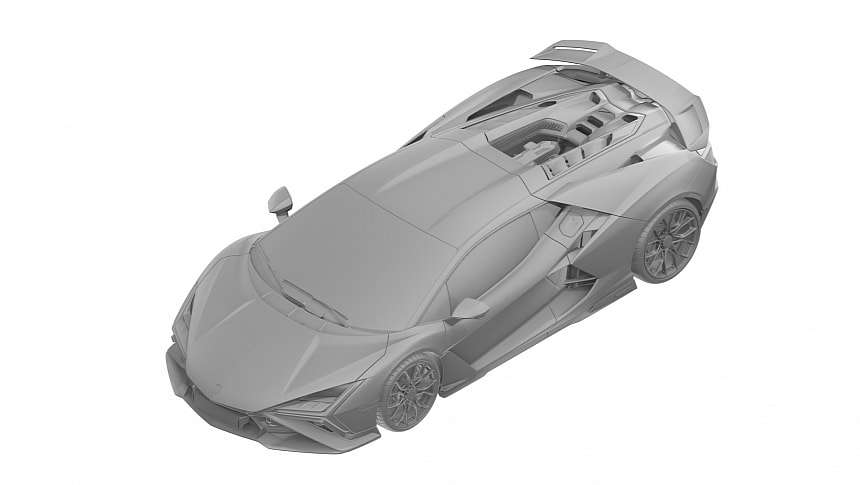
Three days before Lamborghini planned to peel back the covers at The Quail, the Revuelto SV’s design was already public record. Not through a spy shot, not through a dealer leak, but through the European Union Intellectual Property Office, where design number 015139658 was registered and fully published on August 11, 2026. The filing shows everything the teaser photos were built to obscure: the reworked front fascia, the centerlock wheels, the fixed rear wing that replaces the standard Revuelto’s active spoiler. Lamborghini has made a habit of staging its Monterey Car Week reveals with the choreography of a runway show. This time, a government database did the unveiling instead.
That is a mildly amusing footnote. It is not the story. The real story is what the Revuelto SV is now being asked to prove: that “Super Veloce” still means something on a car that begins life as a plug-in hybrid, and that a production number chosen for sentiment rather than scarcity can still move a collector market that has spent six decades pricing Lamborghinis on the opposite logic.
What the Patent Actually Shows
Design patents are appearance filings, not engineering disclosures, so treat the EUIPO drawings as a styling document rather than a spec sheet. Up front, the renderings detail a more aggressive fascia with larger intakes, aerodynamic blades, and a splitter pulled tighter to the road. The sides pick up chunkier skirts, revised cooling ducts for the radiators and electrical hardware, and a motorsport-style centerlock wheel setup already seen on test mules. At the rear, Lamborghini has abandoned the flush active spoiler for a fixed wing paired with a heavily reworked diffuser — a purely mechanical solution in place of an electronic one, which tends to be the detail serious collectors notice first.
None of that confirms output. The standard Revuelto’s V12-hybrid HPEV powertrain currently produces a combined 1,015 CV (1,001 horsepower) from a naturally aspirated 6.5-liter V12 and three electric motors. Rumors ahead of the August 14 reveal at The Quail point to something in the neighborhood of 1,065 to 1,080 metric horsepower for the SV, but that figure remains unconfirmed until Lamborghini says so on stage. The SV will share its Monterey Car Week billing with the U.S. debut of the Urus Performante and the global unveiling of the Revuelto Miura 60° Homage, a 99-unit tribute marking 55 years since the Miura SV — a pairing that is not a coincidence.
The Lineage the Badge Has to Live Up To
Lamborghini has attached the Super Veloce designation to a car only when it intended that car to be the final, most uncompromising statement of its generation. The Miura SV closed out the car widely credited as the first supercar. The Diablo SV and Murciélago SV each did the same for their platforms. The Aventador SVJ closed out twelve years of naturally aspirated V12 Aventadors, and it has aged into one of the most consistently sought-after modern Lamborghinis in the secondary market — not because it was fast, every Aventador was fast, but because it was factory-declared to be the last and best word on the platform.
Collectors have rarely paid a premium for the letters SV on their own. They have paid a premium for what Lamborghini historically attached to those letters: an ending, told at full volume. The Revuelto SV is the first car asked to carry that meaning into the hybrid era, and that is a genuinely open question rather than a marketing formality.
A Number With a History Behind It
The most-repeated rumor ahead of the reveal is a production cap of 1,963 units, a nod to 1963, the year Ferruccio Lamborghini founded the company. Lamborghini has run this play before, more literally: the Aventador SVJ 63 Roadster was built to exactly 63 units as a direct tribute to that same founding year. Scaling the homage from 63 cars to nearly 2,000 changes what it means. Sixty-three units was scarcity as theater — a number small enough to sell out through relationship managers before a press release went out. Nineteen sixty-three units, if the figure holds, is closer to a standard-sized run for a modern flagship halo car dressed up in a sentimental number rather than a genuinely scarce one.
That distinction matters more than most buyers realize at the time of purchase. A production number tied to a founding date makes a good story at delivery. It does not, by itself, create the kind of scarcity that holds a secondary-market premium twenty years out. What has historically done that for Lamborghini’s SV-badged cars is the combination of factory-declared finality, documented originality, and motorsport-adjacent engineering — not the digits on the build plaque.
Electrification’s Real Test
The V12-hybrid powertrain is the part of this story the collector market has not finished pricing. A 6.5-liter naturally aspirated V12 is still the mechanical heart of the car, which separates it meaningfully from Lamborghini’s more speculative all-electric design exercises — the kind of concept explored in Lamborghini’s own digital design studies for a future electric flagship. But three electric motors, an 8-speed dual-clutch gearbox making its debut on a twelve-cylinder Lamborghini, and a lithium-ion battery pack are new variables in a vehicle category collectors have historically valued for mechanical purity. Tightening emissions rules like Euro 7 make the combustion side of the equation harder to touch, which is precisely why Lamborghini’s power gains are expected to come from the electric side rather than the engine. Whether that engineering reality reads to future buyers as innovation or as compromise will do more to set the Revuelto SV’s long-term trajectory than any lap time at Hockenheimring.
Why Patent Filings Are Worth Watching
There is a broader lesson here for serious buyers beyond this one car. Design registries like the EUIPO’s are increasingly functioning as a pre-release verification tool — a way to confirm factory-specification details, body variants, and running changes before a car ever reaches a stage or a showroom. That matters later, when appraisers and marque specialists are asked to authenticate early production cars, resolve questions about factory-original equipment, or verify that a specific aerodynamic component was genuinely offered rather than added aftermarket. A public design filing is a primary-source document in a hobby that runs on documentation. It deserves the same attention collectors already give build sheets and factory build records.
Lamborghini will supply the horsepower figure and the price tag at The Quail on August 14, and those numbers will carry every headline that follows. They are not, in the end, what this car needs to prove. The real test, the one that will take years rather than a single Monterey Car Week to answer, is whether a name earned across sixty years of naturally aspirated V12s can survive its first hybrid application without losing the thing that made it worth chasing in the first place.
The collector car market, every weekday morning.
Auction results, price moves and what’s crossing the block, read in four minutes. Free, from Modern Car Collector.
No spam, unsubscribe in one click. Or read more about the Brief.




 John Lloyd
  Eve Nowell
  Shawn Henry