

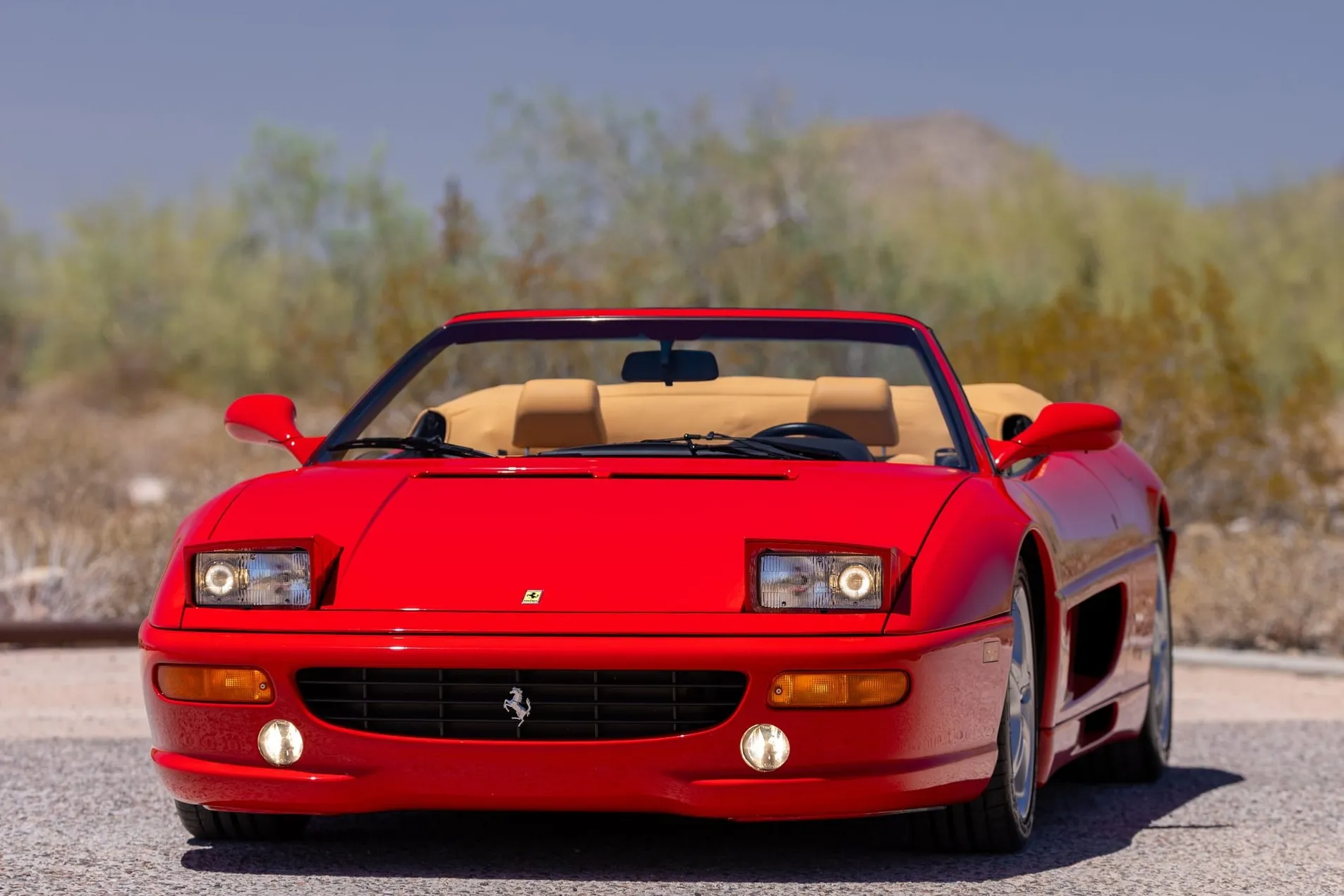
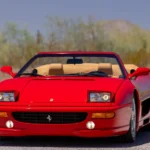
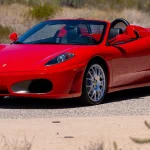
A 1996 Ferrari F355 Spider is currently sitting at $215,000 with no reserve on Bring a Trailer, two days from a hammer, chassis ZFFXR48A4T0104778 finished in Rosso Corsa over Tan Connolly leather. It is a good car, honestly presented, with 9,000 miles on the odometer and a fresh engine-out service behind it. None of that is the real story.
The real story is that this particular F355 was built before Ferrari ever offered a way around the clutch pedal. Every one of the roughly 11,000 F355s Ferrari built between 1994 and 1999 could be had with a conventional six-speed manual, but starting in 1997 buyers could also order the company’s first electrohydraulic paddle-shift gearbox, badged F1. A 1996 car like this one predates that choice entirely. It isn’t a case of manual-over-automated-manual preference. It’s a car from the last stretch of Ferrari history when a stick shift wasn’t an option at all, it was simply how the car came.
The Last Ferrari You Had to Learn
The F355 replaced the 348 in 1994 and carried Ferrari’s mid-engine V8 formula into a genuinely new era. The 3.5-liter engine used five valves per cylinder, a first for a Ferrari road car, and revved to a factory-rated 375 horsepower at a time when that figure from a naturally aspirated V8 still felt exotic rather than expected. Pininfarina’s body, the gated shifter, and the mechanical honesty of a cable-actuated clutch were the whole point. Learning to drive one well, heel-and-toeing through the gate and respecting the redline, took time. That friction was the product.
Why the Spider, Why Manual, Why Now
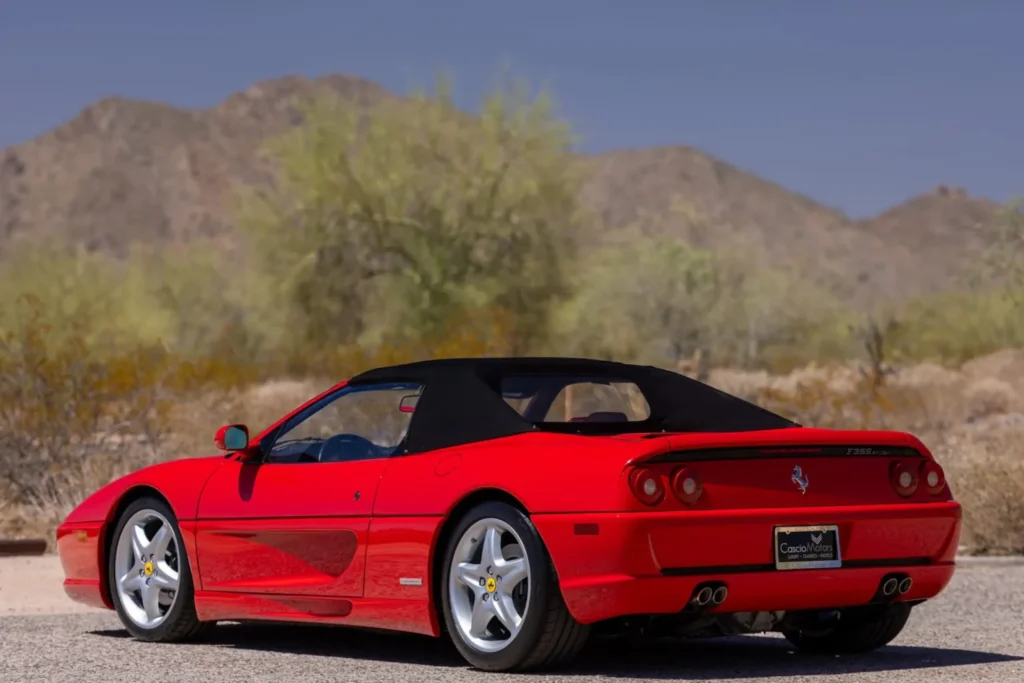
Ferrari built the F355 in three body styles: the Berlinetta coupe, the targa-topped GTS, and the fully open Spider, which used a power-folding soft top rather than a removable panel. Spiders were always the emotional choice over the Berlinetta, and a manual Spider now sits at the intersection of two things collectors increasingly chase at once, open-air theater and mechanical involvement. That combination matters more today than it did a decade ago, as a newer generation of buyers enters the market prioritizing how a car engages its driver over how many were built. We’ve written before about how Gen X and millennial buyers are reshaping the hobby, and this F355 is a textbook example of the kind of car that shift favors: analog, usable, and honest about what it is.
Reading This Particular Car
Specification matters more than sentiment with any F355, and this one reads well. Rosso Corsa over Tan Connolly leather is the combination most buyers picture when they close their eyes and think Ferrari, and it photographs as well in the metal as it does in a catalog. More important is the September 2024 engine-out service, which included new timing, auxiliary, alternator, and air-conditioning belts along with the exhaust manifolds, spark plugs, and valve covers. On a flat-plane Ferrari V8 of this generation, that service, not the paint, not the wheels, is the single line item that separates a car worth buying from a car worth walking away from. Belt failure on an interference engine is catastrophic, and the cost of doing the job properly is a meaningful fraction of the car’s value. A documented, recent engine-out service is worth real money to an informed buyer, arguably more than a few thousand extra miles on the clock.
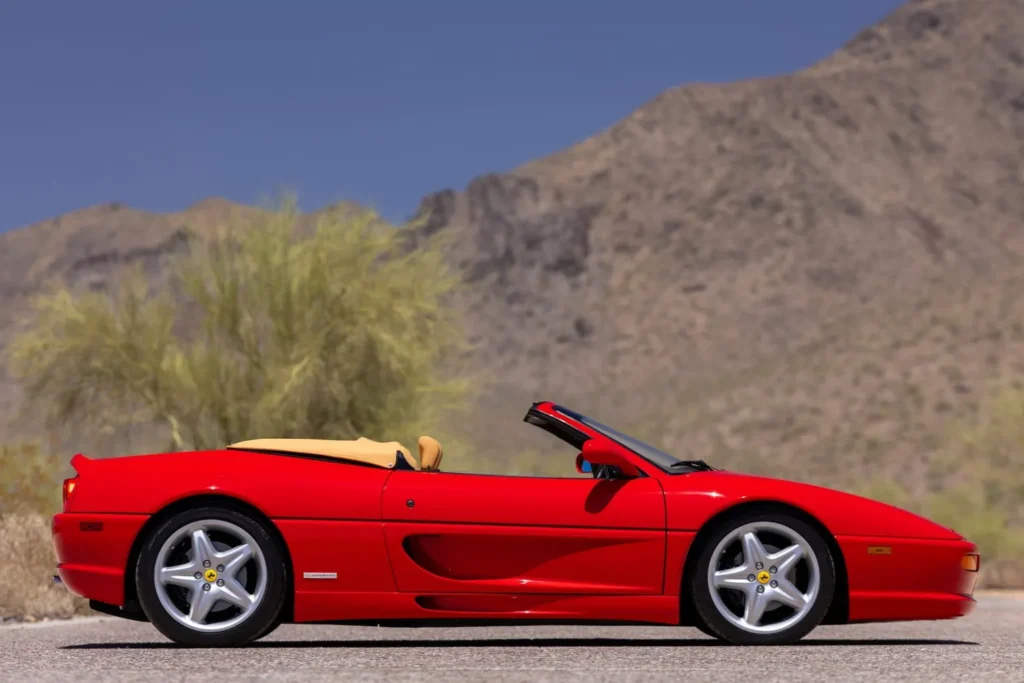
The odometer shows roughly 9,000 miles, with about 2,000 added under the current owner, and the Carfax report is otherwise free of accidents, with a single mileage-reporting inconsistency from a 2018 entry that the report itself attributes to likely clerical error rather than rollback. The car carries a clean Montana title, a registration structure common among exotics and not inherently a red flag, though buyers should understand the tax and titling implications before assuming it changes nothing at their home address. None of this is disqualifying. All of it is exactly what a disciplined buyer should be reading closely rather than skimming past on the way to the photos.
The collector car market, every weekday morning.
Auction results, price moves and what’s crossing the block, read in four minutes. Free, from Modern Car Collector.
No spam, unsubscribe in one click. Or read more about the Brief.
Related Posts:
- A White Six-Speed F355 With 34,943 Miles Is at…
- Serviced 1996 Ferrari F355 Spider Draws $215,000 Bid…
- Everything Modern Car Collector Covered Last Week
- Black 1996 Dodge Viper RT/10 Roadster With a Dyno…
- Acura's Zanardi Edition NSX Was Always a Tribute.…
- This No-Reserve, 12,000-Mile Ferrari F430 Spider on…
 Kyle Matthews