
At RM Sotheby’s Monterey sale this month, a 2023 Ferrari Daytona SP3 sold for $17,825,000, setting a new benchmark for a standard-production example of Ferrari’s Icona Series at public auction. As a headline, that is a striking number for a car that left the factory less than three years ago. As a data point, it is something more useful: confirmation that the Daytona SP3 has already stopped behaving like a depreciating supercar and started behaving like an established modern classic.
That distinction is worth making carefully, because it says something about how auction results should be read. In August 2025, at the same Monterey sale a year earlier, a second Daytona SP3 — serial number “599+1,” a one-off Tailor Made commission built beyond the model’s regular 599-car production run — sold for $26,000,000. Every dollar of that sale benefited the Ferrari Foundation, a registered charity, and Ferrari waived the buyer’s premium entirely. It was an extraordinary result, but not a conventional market result: a buyer at a charity auction is purchasing a car and making a donation in the same gesture, and the hammer price reflects both. The $17,825,000 paid this month for chassis 297567 — no foundation, no waived premium, no unrepeatable livery — is the more honest figure for collectors trying to understand what a standard Daytona SP3 is actually worth to a private buyer on the open market. Keeping that distinction straight matters more than the headline number itself.
The Car Behind the Number
The car earns its result honestly. Chassis 297567 was completed at Maranello in July 2023 and configured through Ferrari’s Atelier bespoke program in Giallo Triplo Strato, a deep, tri-layer yellow, with Nero racing stripes, an Italian flag motif, and a Nero cabin trimmed with Giallo accents. The options list reads like a study in what the Atelier program was designed to enable: a carbon-fiber roof panel, lower bodywork and mirror caps, matte black wheels paired with gloss black brake calipers, airbrushed Scuderia Ferrari shields, and an adjustable front suspension lifter for everyday usability. None of that is rare in the way a matching-numbers competition chassis is rare. But in the modern-car market, specification quality functions as its own form of provenance, and a thoughtfully optioned example that reads as a considered statement, rather than a default configuration ticked off a list, tends to command a meaningfully wider bidding audience.
More persuasive still is the ownership record. The SP3 was delivered new in January 2024 through Wide World of Cars in Spring Valley, New York, to its first owner in Florida, returned twice to the selling dealer for factory-scheduled service, and sold into the consigning collection in October 2025 showing roughly 220 miles. By the time it crossed the block this month, the odometer read 227 miles. Two owners and seven miles of use across ten months describe a car that has spent essentially its entire life being cared for rather than driven. On a modern hypercar, mileage this low is not a curiosity; it is the clearest available proxy for how a car has actually been treated, and treatment is what eventually separates a blue-chip modern Ferrari from a merely expensive used one.
An Icona Built on 1960s History
Context matters here, because the Daytona SP3 did not appear in a vacuum. It is the third model in Ferrari’s Icona Series, a program launched in 2018 to give the marque’s most committed clients modern engineering wrapped in coachwork that reinterprets its own racing history. The Monza SP1 and SP2 opened the series by referencing Ferrari’s open-cockpit barchettas of the 1950s. The Daytona SP3, unveiled in 2021, moved the series into closed-body territory, drawing its proportions from the mid-engined prototypes that carried Ferrari through the 1960s, most directly the 330 P3/4. The name itself commemorates Ferrari’s podium sweep at the 1967 24 Hours of Daytona, where the 330 P3/4, 330 P4, and a NART-entered 412P finished side by side, a calculated response to Ford’s win at Le Mans the year before. Every Icona car is, in effect, applied automotive history: buyers are not simply purchasing a shape, they are purchasing Ferrari’s own curated retelling of its most consequential racing seasons.
The Last Naturally Aspirated Flagship V-12?
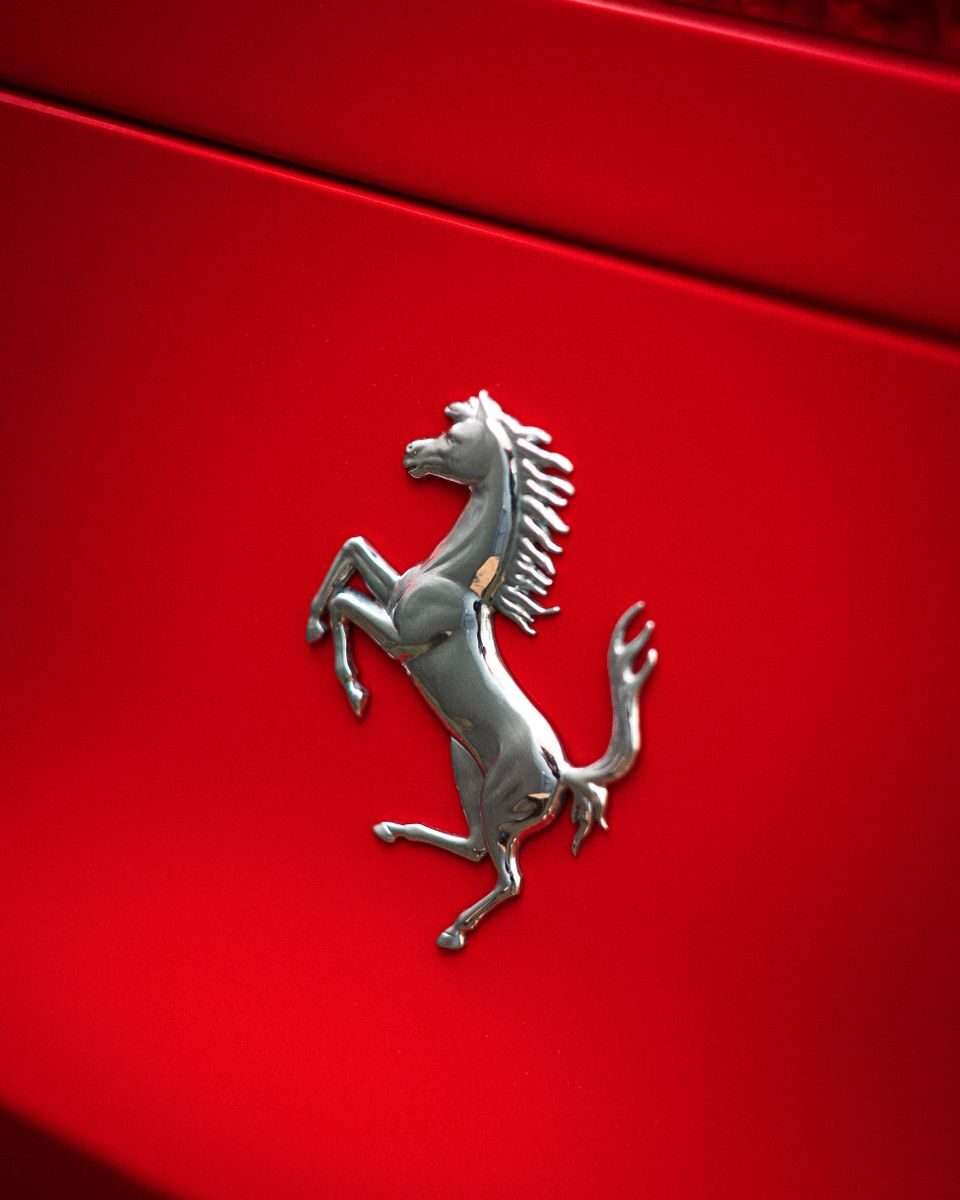
The more consequential detail sits beneath the rear clamshell. The Daytona SP3 is powered by a naturally aspirated, 6.5-liter version of the F140 V-12 — the same basic architecture found in the 812 Superfast and, in hybridized form, the LaFerrari — but here stripped of any electric assistance whatsoever. It produces 829 horsepower entirely on its own, sent through a seven-speed dual-clutch gearbox to the rear wheels alone, with no battery, no motor, and no torque-fill to soften the engine’s character. That is an increasingly rare engineering choice at Ferrari, and not because of the build number. Ferrari’s current flagship architecture runs through hybridized V-8s and V-12s, and its first series-production electric model arrived this year. Set against that trajectory, the Daytona SP3 looks less like a limited edition and more like a closing statement, quite possibly the last mid-engined, naturally aspirated, non-hybrid V-12 Ferrari the company will build. Collectors rarely pay a premium for horsepower alone. They pay for moments in history, and for the certainty that a particular kind of car will not be made again.
That trajectory was on full display at the very same Monterey sale, where Ferrari’s first electric model, the Luce, sold at a charity auction for $40 million the day before, a useful reminder that Ferrari is now actively building the future its most devoted collectors are simultaneously paying to preserve the past against. The rest of Monterey Car Week told a similar story from other angles: Mecum’s own docket a few miles away paired a Porsche Carrera GT and a McLaren P1 HDK with a vintage Mercedes-Benz 280 SE, underscoring how thoroughly the analog-versus-electrified divide now runs through every price bracket and every era of the collector market, not just Ferrari’s own lineup.
Why Allocation Changes the Math
There is a structural reason the SP3 already trades this confidently on the secondary market, and it has nothing to do with the auction itself. Ferrari builds cars like this to order for clients selected before the first chassis is welded together; there was never a showroom door through which a new buyer could simply walk in and order one. That allocation model means the only route to ownership for the overwhelming majority of interested collectors runs through the secondary market, whether at auction or by private treaty, and it is precisely why an SP3 with two careful owners and 227 miles draws serious competitive bidding rather than a shrug. Scarcity created by allocation behaves differently than scarcity created by low production alone. It guarantees unsatisfied demand exists on the very first day of ownership, long before the car has had any chance to earn a reputation on its own.
What This Means for Collectors
For buyers watching the next Icona-series result, the lesson from chassis 297567 is straightforward: condition and originality still set the ceiling, even inside a sold-out allocation. Mileage, documented service through an authorized Ferrari dealer, and a specification that reads as intentional rather than incidental all separated this result from a merely good one. A heavily driven, oddly specified SP3 would not have found $17.8 million at auction, however few were built. The production number gets a car onto a serious buyer’s shortlist. Everything else determines where it lands on it.
Strip the price away, as any honest reading of an auction result should, and what remains is a car that validates the entire premise of the Icona Series: that a modern, allocation-only Ferrari built around a farewell to naturally aspirated V-12 power can already behave, within three years of delivery, like a car with decades of established collector history behind it. That is the real headline from Monterey this year, not that a Daytona SP3 sold for $17.8 million, but that it already had to.
The collector car market, every weekday morning.
Auction results, price moves and what’s crossing the block, read in four minutes. Free, from Modern Car Collector.
No spam, unsubscribe in one click. Or read more about the Brief.
Related Posts:
- Ferrari Daytona SP3 Value Jumped 168% in Ten Months.…
- Record Ferraris, Rare Icons and 15,000 RPM: The Week…

- Ferrari Monza SP2 Value Nearly Doubled in Three…
- Ferrari F50 Value Nearly Tripled in Two Years.…
- The Collector Car Market Paid Up for Certainty This…

- The Porsche Carrera GT Doubled in 2026. The $6.7…
 Eve Nowell
  Shawn Henry
  Shawn Henry