

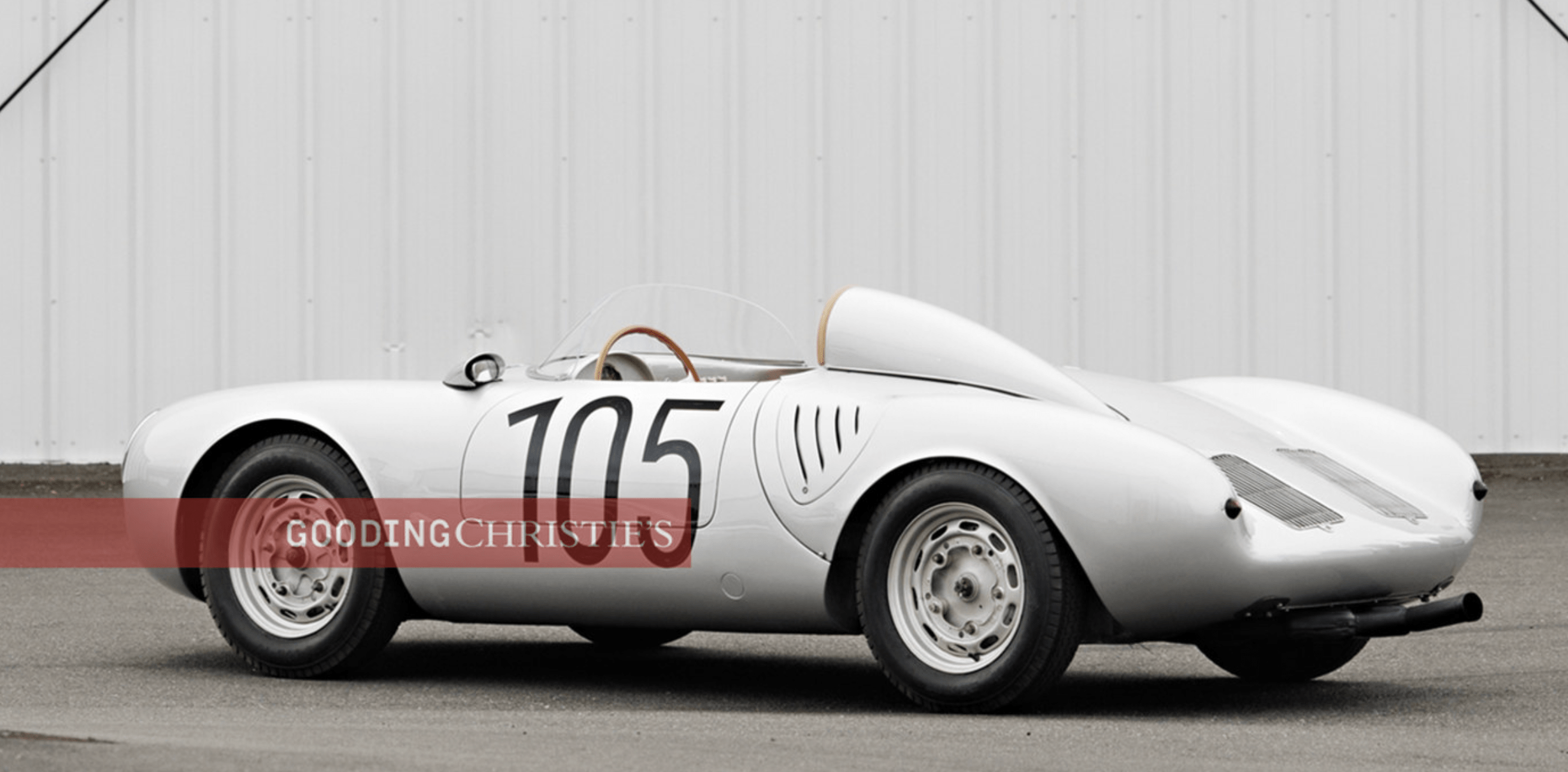
1958 Porsche 550A Spyder, Chassis 550A-0141: A Mirror-Polished Giant Killer Returns to the Block With Questions Worth Asking
There’s a specific kind of Porsche that sends four-cam obsessives into a quiet frenzy, and chassis 550A-0141 is one of them. It’s back on Mecum’s docket as a 1958 550A Spyder, listed with engine number P90-108 and the usual “check back closer to the auction” placeholder that means the full catalog write-up isn’t live yet. So before the glossy provenance copy lands, here’s what actually matters about this car — including the parts a listing tends to gloss over.
Start with what it is. The 550A was Porsche’s second act on its first serious race car. Where the original 550 rode on a welded steel ladder frame, the 550A (one of roughly 40 built) swapped in a proper tubular spaceframe, which is stiffer and lighter and a big part of why these cars handled like they were cheating physics. Chassis 0141 sits at the tail end of that short run — genuinely one of the last built — which is why you’ll occasionally see it described loosely as “one of the last 550s.” The chassis prefix settles the argument: it’s a 550A.
Related Articles
- 1963 Chevrolet Corvette Split-Window Coupe Crosses the Block at GAA
- This 1954 Kurtis 500S Is More Than the Sum of Its Replacement Parts
The heart of the thing is the Type 547 four-cam, the Fuhrmann engine, and it’s worth understanding why this motor is both the car’s soul and its liability. It’s a 1,498cc air-cooled flat-four with four camshafts driven not by chains or belts but by vertical “king shafts” turning through a nest of bevel gears — the reason enthusiasts call it the Königswelle engine. Add twin-plug ignition with two distributors, a dry sump, and a Hirth roller-bearing crankshaft that arrives as a kit of parts you assemble by hand. In pushrod form the same-displacement Porsche four made under 80 horsepower; the four-cam roughly doubled that. The catch is service. A skilled mechanic needed on the order of 120 hours to build one of these, with timing alone eating a full day or more. There is no “quick valve adjustment” on a 547. This is a specialists-only powerplant, and that reality follows the car forever.
Which brings me to the engine number. The listing hangs P90-108 on the car and, in past Mecum copy, called the engine authentic and built to factory racing specification — notably not the words “matching numbers.” That’s not a knock, it’s a flag. Cars like this lived hard in period and got their engines swapped the way you and I change oil. A well-documented chassis history isn’t the same as a numbers-matching drivetrain, and on a seven-figure four-cam the difference between “correct-type period engine” and “the engine it left Stuttgart with” is worth real money. Ask for the paperwork.
The in-period story is the good part. Chassis 0141 went to Austria in 1958 and was campaigned by Ernst Vogel — a concert pianist and composer who also happened to be quick. He won the Opatija Grand Prix in Yugoslavia, took class wins at the Zeltweg and Innsbruck airfield races, and closed out the year on a stretch of Salzburg autobahn setting a batch of national and absolute speed records, averaging 135.27 mph over a flying kilometer. The car later crossed to the U.S. and passed through Connecticut racer Harry Blanchard before disappearing into the decades. You can trace the outline in the public chassis registry.
That mirror-polished bare-aluminum body is a restoration statement, not history. These cars raced painted, with numbers and livery, not looking like a chrome bumper. The finish is stunning and photographs like jewelry, but a purist should file it under “aesthetic choice” rather than “as-raced authenticity.” Same goes for the sensible safety updates you’ll find on cars prepped for FIA historic events — a fuel bladder, sleeved brake calipers — which are great for actually driving the thing and mildly annoying to the originality police. You can’t have both; know which buyer you are.
Related Articles
- No. 9 of 30: The GMMG Dick Harrell Camaro and the Case for Modern Tribute Cars as Real Collectibles
- Frame-Off 1968 Chevrolet Chevelle SS Custom Bound for Harrisburg Auction
Now the uncomfortable market part. This exact car was offered at Mecum Monterey in 2018 with a $4.5–5 million ambition and walked away unsold, the high bid stalling at $2 million. That’s not a small gap. For context, the 550A’s auction high-water mark was set the same year, when a Le Mans-class-winning sister car made a $5.17 million record at Bonhams Scottsdale — but that car had works-team Le Mans results this one simply doesn’t. The top of the vintage market has cooled since 2018, and re-offering 0141 now tests whether bidders have moved toward, or further from, that $2 million ceiling.
Practical takeaways if you’re the type who could actually raise a paddle. Budget for agreed-value insurance and a relationship with a four-cam specialist before you buy, not after. Verify engine originality and gearbox type against the documentation rather than the listing adjectives. Treat the FIA-friendly upgrades and the show-finish paint as reversible-in-value questions. And read the sale terms — cars of this vintage frequently transfer on a bill of sale, with a pre-1968 build that sidesteps most modern federal emissions and safety hurdles for registration.
It’s a beautiful, fast, historically real thing. Just buy the history, not the shine.
Images Via: Goodingco
The collector car market, every weekday morning.
Auction results, price moves and what’s crossing the block, read in four minutes. Free, from Modern Car Collector.
No spam, unsubscribe in one click. Or read more about the Brief.
Related Posts:
- Record Ferraris, Rare Icons and 15,000 RPM: The Week…

- Here's Your Chance to Buy George Strait's Signet Red…
- A 240Z Owned Since 1975 Proves the Odometer Is the…
- On a Boss 429 Mustang, the KK Number Is the…
- Cadillac's Junkyard Dream Car Returns to Auction.…
- Everything Modern Car Collector Covered Last Week
 John Lloyd
  Shawn Henry