

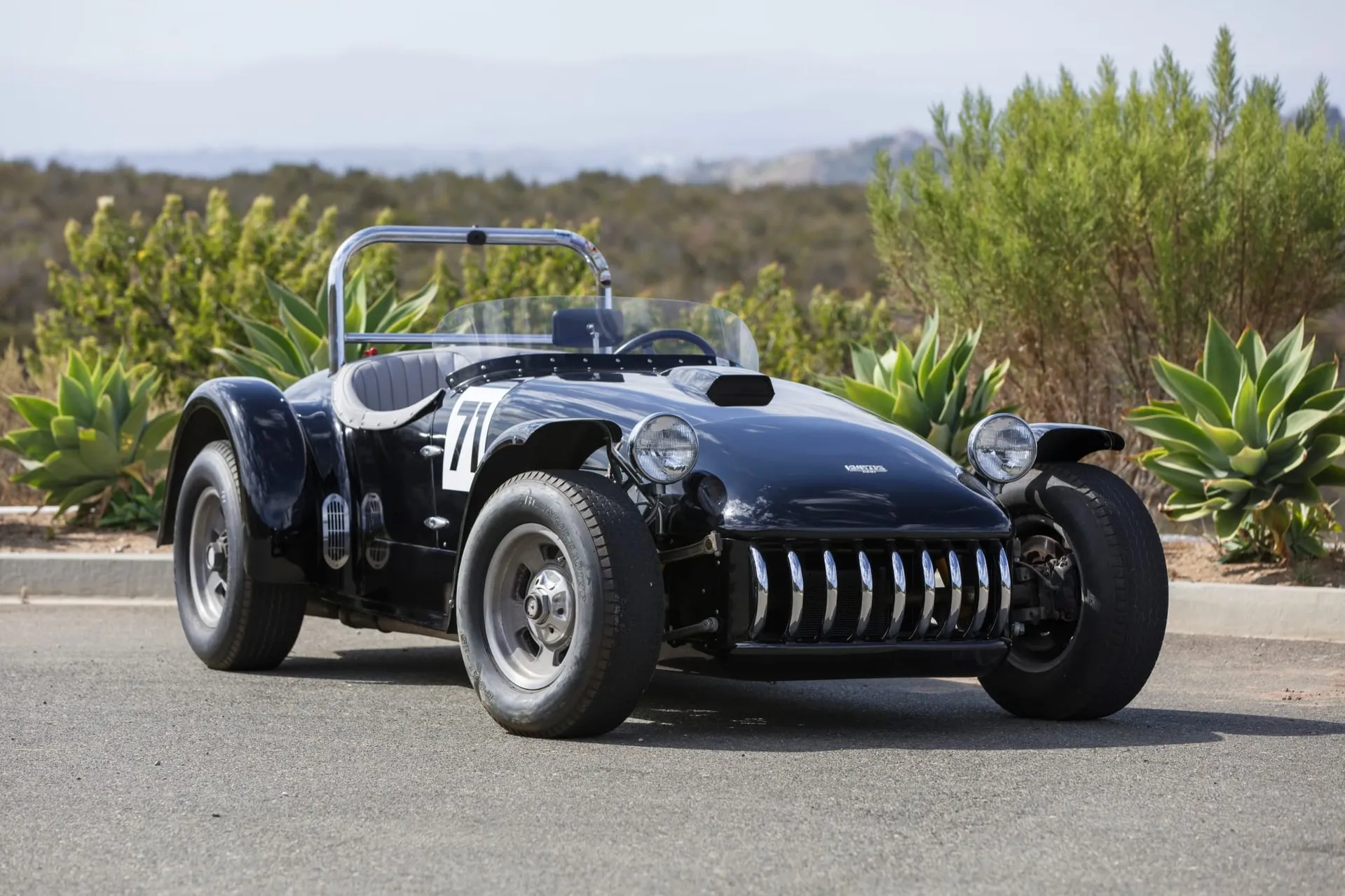
A collector judging this 1954 Kurtis 500S now offered on Bring a Trailer by the usual standards of originality will quickly find reasons to hesitate. Its fiberglass body is a replacement. Its 331-cubic-inch Cadillac V8 was assembled from two engines. A Tremec five-speed has replaced the Jaguar four-speed fitted when the car was completed, while AutoMeter instruments, front disc brakes, a fuel cell, and a widened cockpit make no claim to untouched 1954 specification.
Yet that is not the most useful way to read chassis KK51. The more consequential fact is that Arlen Kurtis—the son of company founder Frank Kurtis—helped source the components and personally carried out the restoration and assembly with the owner. This car is not an archaeological artifact. It is a usable vintage racer whose provenance runs through the family that created the type. For the right collector, that chain of authorship matters more than a false appearance of purity.
The Kurtis name carries real racing authority
Frank Kurtis began building competition cars in the late 1930s, and his designs became fixtures at Indianapolis after World War II. Kurtis machinery won five of the six Indianapolis 500s held from 1950 through 1955, an achievement that makes the 500S more than an attractive American special. Introduced in 1953, the sports-racing model translated lessons from Kurtis’s open-wheel cars into a low, light two-seater built around a tubular chassis, simple suspension, and whatever serious American power its owner chose.
That flexibility is central to the model’s identity. A Kurtis 500S was never a standardized grand tourer produced in the manner of a Jaguar XK120 or Mercedes-Benz 300SL. These were small-volume competition machines, and variation was part of the program. Cadillac, Chrysler, Buick, and other engines appeared in Kurtis sports cars, so the Cadillac V8 in KK51 is philosophically correct even if this particular unit is not a matching-numbers talisman.
Collectors rarely pay a premium for horsepower alone. They pay for a credible connection to a moment in history. Here, that moment is the early American road-racing culture in which resourceful builders combined European proportions with domestic torque and went racing.
Arlen Kurtis is the provenance
The current owner acquired KK51 in the early 1990s as a bare chassis and collection of parts with help from Duncan Emmons and Arlen Kurtis. According to the listing, Arlen used original Kurtis components from his own inventory wherever possible and completed the work at his home in collaboration with the owner. The replacement body was sourced through him, then modified with a larger cockpit; the hood is aluminum, while the remaining bodywork is predominantly fiberglass.
That history does not turn replacement components into original ones. It does, however, distinguish this car from a later evocation assembled by a shop with no direct connection to Kurtis. We have seen a similar distinction in the collector appeal of a painstakingly developed Porsche 356B Abarth tribute: authorship, research, and continuity can create a legitimate form of provenance without converting a tribute into a factory-built original.
It is also why KK51 should not be grouped casually with every historically styled special. A Superformance GT40 can deliver an exceptionally convincing period experience, but its collector thesis rests on licensed continuation production and modern assembly. The Kurtis rests on an old chassis, components gathered from the Kurtis orbit, and the hands-on participation of Arlen Kurtis. Those are different claims, and sophisticated buyers should value them differently.
A competition history that can be used
Since completion, the car has covered approximately 2,900 miles and has participated in events with the Vintage Auto Racing Association, Historic Motor Sports Association, and Sportscar Vintage Racing Association. Its résumé includes appearances at the Chrysler Classic Speed Festival and Coronado Speed Festival, along with track use at venues including Las Vegas and Buttonwillow.
The specification explains why it has been used rather than merely displayed. The Cadillac V8 breathes through an Edelbrock intake and three Holley 94 carburetors. Halibrand “kidney bean” wheels, transverse torsion bars, SPAX dampers, a brake-bias adjuster, and a roll hoop support the vintage-racing purpose. The Tremec gearbox makes the car easier to operate across modern events, even if the removed Jaguar four-speed will be essential to anyone considering a more period-faithful configuration.
This is the market niche: not a preservation-class object and not a disposable track toy, but a historic-platform racer that can still be driven hard. Online platforms have made such narrow-interest cars visible to far larger audiences—a shift reflected in Bring a Trailer’s growing influence on the collector market—but more bidders do not remove the need for expert inspection.
What serious bidders should verify
The first priority is the identity of chassis KK51. The number appears on the frame and on a firewall plate, while the California title describes the car as a 1954 “KURTS.” That spelling may be no more than an old administrative abbreviation, but the frame stamping, title history, restoration photographs, and any correspondence with Arlen Kurtis should be reviewed as a single provenance file.
Buyers should also establish exactly which major components are period Kurtis pieces, which were sourced from Arlen’s inventory, and which were fabricated or replaced during the build. The included spare engine, body panels, wheels, tires, literature, and removed Jaguar gearbox add meaningful value only when they are inventoried and their relationship to the car is documented. Eligibility is equally important: vintage-racing organizations differ in how they classify replacement bodies, modern transmissions, braking changes, and safety equipment.
Finally, the mechanical inspection should be approached as that of a competition car. Chassis condition, torsion-bar mounts, damper pick-up points, fuel-cell date, brake hardware, wheel integrity, cooling capacity, and the condition and age of the Dunlop tires all matter more than cosmetic perfection. The mixed-source Cadillac engine and triple-carburetor setup deserve leak-down, oil-pressure, cooling, and fuel-delivery checks under load.
The collector case
KK51 will not satisfy a buyer seeking an untouched example with an uninterrupted factory specification. It should not be represented as one. Its importance lies elsewhere: it preserves a Kurtis chassis, embodies the adaptable engineering that defined the 500S, and was brought back to life by Arlen Kurtis with an owner who then used it in the environment for which it was intended.
That makes the car collectible for a specific reason. The replacement parts reduce claims to originality, but the Kurtis family involvement strengthens the car’s historical continuity. In a market that often confuses visual correctness with authenticity, KK51 is a useful reminder that provenance is not only about what survived. Sometimes it is also about who put history back into motion.
Photography: Pawel Litwinski, courtesy of Bring a Trailer.
The collector car market, every weekday morning.
Auction results, price moves and what’s crossing the block, read in four minutes. Free, from Modern Car Collector.
No spam, unsubscribe in one click. Or read more about the Brief.

 John Lloyd
  Shawn Henry