

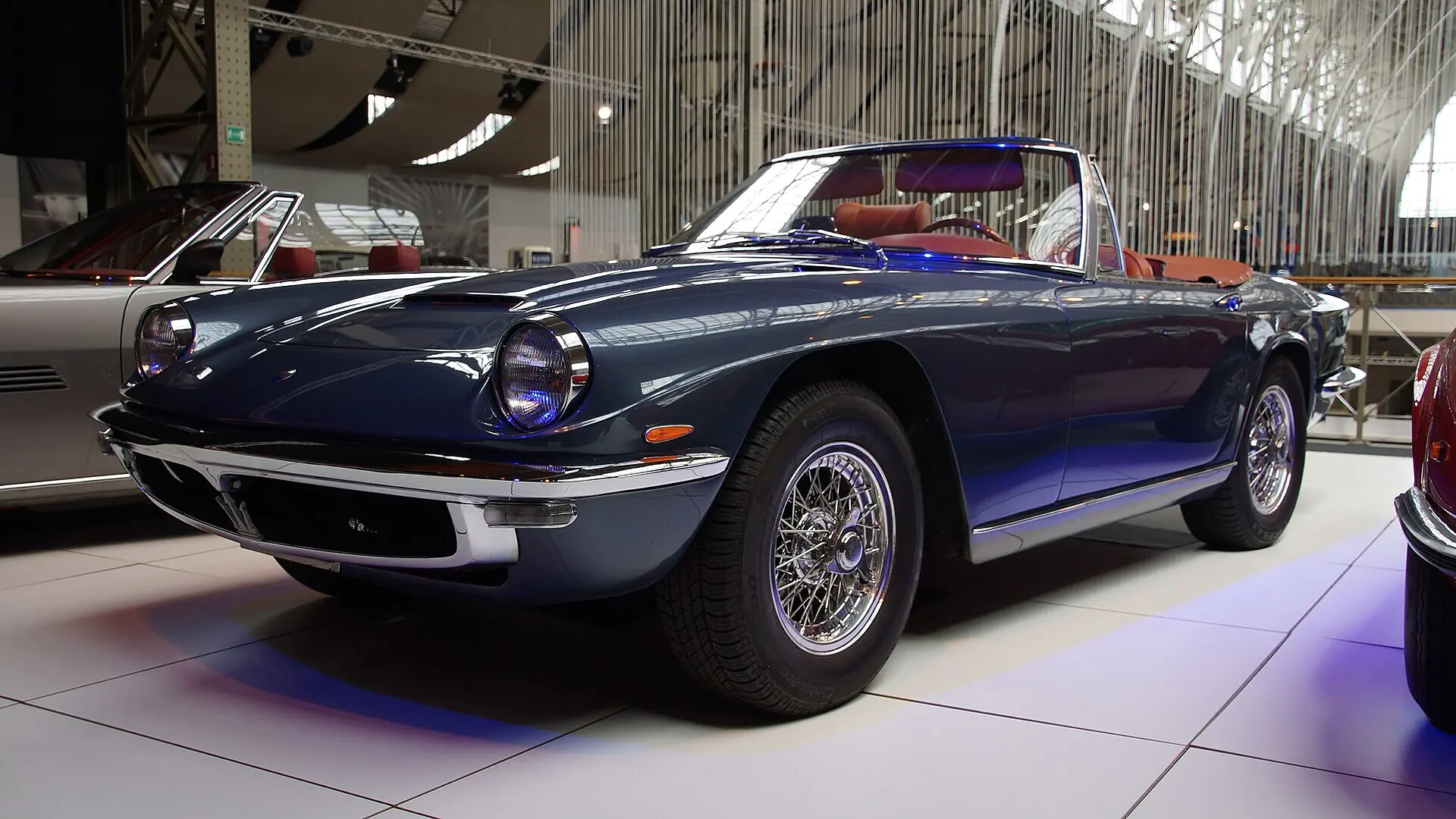
Three Maserati Mistral Spyder 3500s have crossed Bring a Trailer in under a month, all from the same North Salem, New York dealer, and they have priced like three different cars. The first sold on September 25 for $500,000. The second, the ex–Neil Peart car, closed October 13 with its reserve unmet at $351,000 and now shows as sold at $465,000. The third, a 1964 car, is at $170,000 with about four hours left.
Rarity does not explain that spread. Only 27 Mistral Spyders were built with the 3.5-liter engine, and all three cars share it. What separates them is history: a 1965 return to Modena after accident damage, a car that has worn three finishes, and an air-conditioning system that is no longer there, set against a factory-documented order and a rare original hardtop. This lot asks collectors how much of that history is a discount and how much is just a long life.
The lot at a glance
| Detail | Listing |
|---|---|
| Car | 1964 Maserati Mistral Spyder 3500, chassis AM109S033 |
| Venue | Bring a Trailer, Lot #269,435; dealer consignment from 1600veloce, North Salem, New York |
| Auction ends | Thursday, October 22, 2026, at 1:20 p.m. Eastern |
| Status | Live. Current bid $170,000 (8 bids, high bidder “Bernwood”) as of 9:20 a.m. Eastern. The listing is not marked No Reserve; BaT does not disclose a reserve amount. |
| Engine | 3,485cc DOHC inline-six, twin-plug ignition, Lucas mechanical fuel injection; 235 hp factory rating |
| Transmission | ZF five-speed manual, rear-wheel drive |
| Odometer | 74,000 km (about 46,000 miles) shown; roughly 20 miles added by the selling dealer |
| Finish and trim | Dark blue repaint; tan leather; Borrani wire wheels; black convertible top |
| Equipment | Removable color-matched aluminum hardtop, tip-up seats, passenger grab handle; air conditioning removed |
| Paperwork | Report from Maserati historian Dr. Adolfo Orsi with build sheets, shipping notes and invoices; Arizona title |
Why the 3.5 is the early, scarce Spyder
The Mistral coupe debuted in late 1963 with Pietro Frua’s styling, and the convertible followed at the Geneva Motor Show in March 1964. Maserati’s own Mistral Spyder heritage page counts 124 Spyders across three engines: 27 with the 3.5-liter six (1964–1966), 46 with the 3.7 and 51 with the 4.0. BaT’s listing uses a count of 125 for the model, a one-car difference between sources, though both agree on the 27 for the 3.5. Maserati rates the 3.5 at 235 hp at 5,800 rpm, with the 3.7 and 4.0 adding 10 and 30 hp respectively.
The engine is a descendant of the six used in Maserati’s 350S sports racer: aluminum block with cast-iron liners, hemispherical combustion chambers and twin spark plugs per cylinder. Suspension is a double-wishbone front end with a leaf-sprung live rear axle, and the car has four-wheel disc brakes with twin servos. Maserati lists a 255 km/h top speed and a 1,430 kg dry weight. The Mistral replaced the 3500 GTi as the company’s mainstream two-seat grand tourer. Collectors weighing Italian grand tourers of the era may also want to see how Maserati’s later Ghibli 4.7 Coupe is being treated at auction.
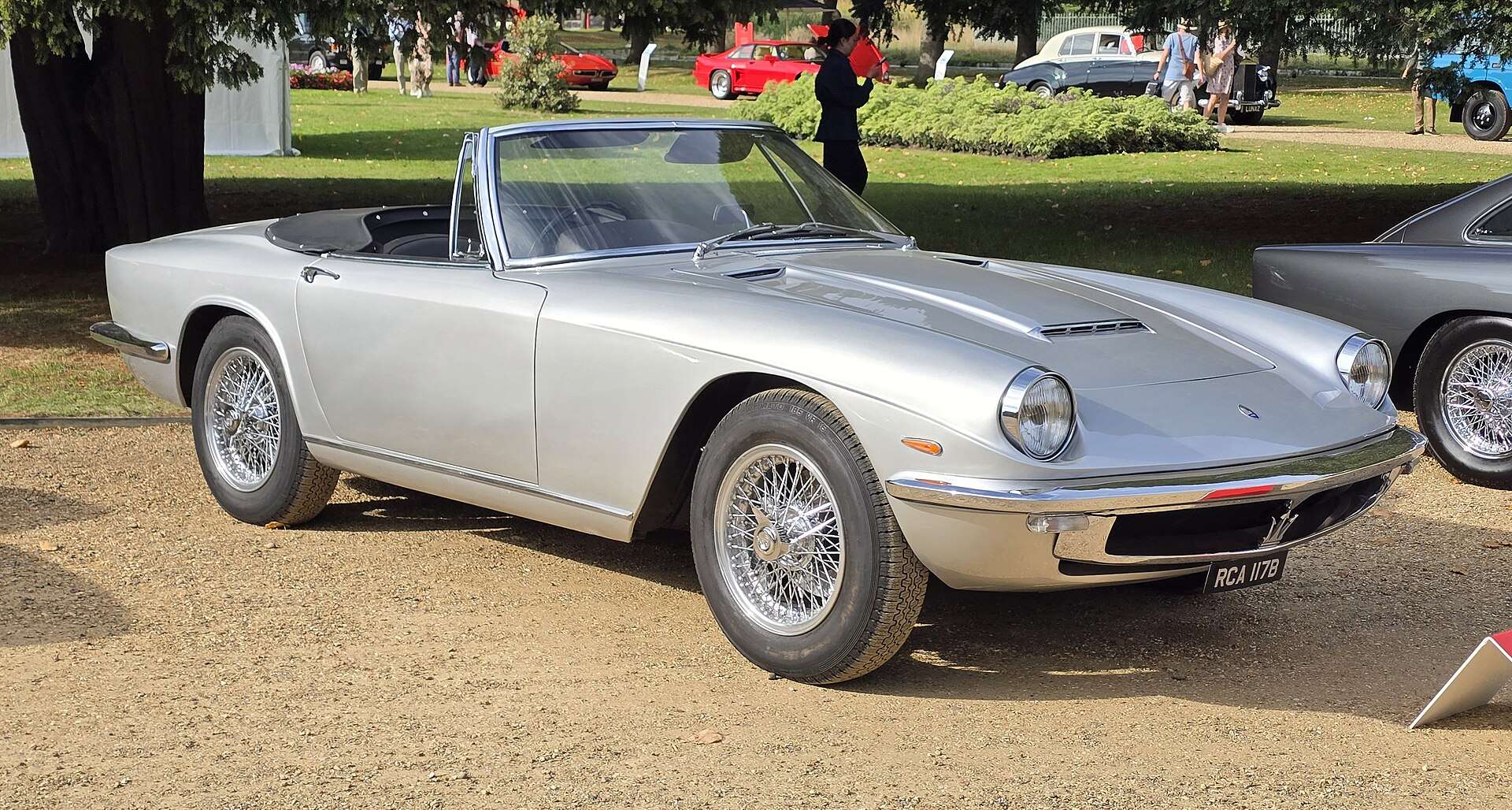
Chassis 033 left the factory in the specification a German collector would have wanted. It was ordered through Auto-Konig, Maserati’s importer for Germany, with the removable aluminum hardtop, air conditioning, tip-up rear seats and a passenger grab handle. Maserati calls the hardtop very rare, and the buttressed roof is the detail that most separates this car from a standard Spyder. It was delivered in December 1964 to Hubertus Liebrecht, a member of the shareholder family of the Boehringer Ingelheim pharmaceutical company.
Provenance: documented start, a long gap, a 2017 reset
Ownership passed on in the late 1960s, and the car eventually reached the United States, where the listing says it was stored for an unknown period before being sold at auction in 2017. It went to the United Kingdom later that year for refurbishment work that included a repaint in dark blue and the reinstallation of the Lucas mechanical fuel injection. The selling dealer acquired it recently and offers it with the Orsi report and an Arizona title.
That is a clear beginning and a clear recent chapter with roughly five decades in between that the listing describes only as unknown storage. For a car priced on documentation, those gaps are worth asking about directly.
Originality and condition
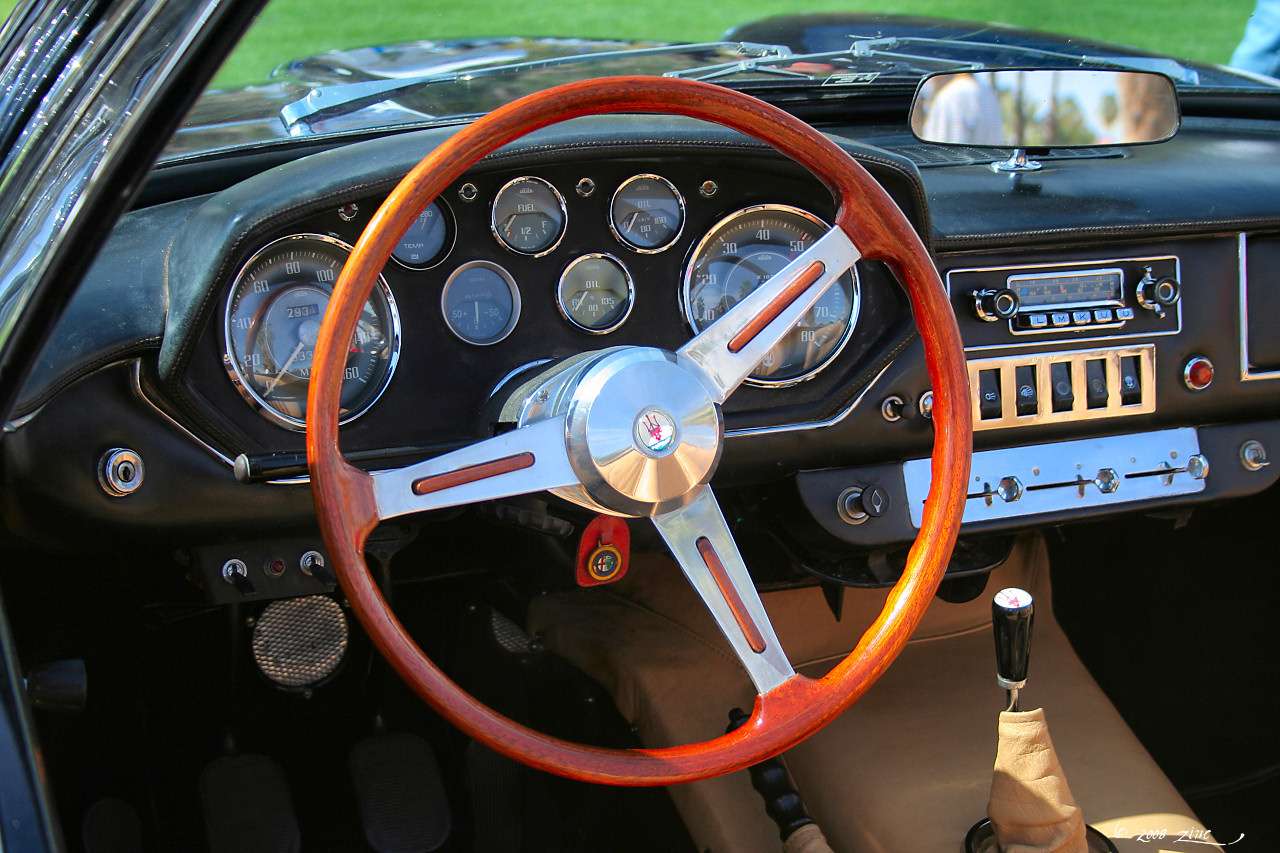
The listing is candid about the car’s state. In 1965 it was returned to Modena following accident damage, and a number of rear panels were replaced before the full car was repainted in its factory Bleu Sera. It was later red, then refinished blue after the post-2017 refurbishment. The listing notes finish flaws visible in close-up photos, tears along the upper dashboard trim, and that the optional air-conditioning system has been removed, with various components included in the sale. The five-digit odometer shows about 74,000 km.
Three things match the original order: the hardtop, the tip-up seats and the grab handle. Two do not: the paint color and the air conditioning. The car also keeps Lucas mechanical fuel injection, the system Maserati fitted to the 3.5, rather than carburetors; the listing says the injection was reinstalled in 2017.
What the comparable sales say
Every one of these figures comes from a primary listing or auction record, and they are not like-for-like. BaT, RM Sotheby’s and private-sale structures differ in fees and in how results are reported, so read them as a range rather than a ladder.
| Date | Car | Venue | Result | What was different |
|---|---|---|---|---|
| Oct. 22, 2026 (live) | 1964 3500 Spyder, ch. 033 | BaT | $170,000 bid, ends 1:20 p.m. ET | Modena accident repair, three finishes, A/C removed |
| Oct. 13, 2026 | 1965 3500 Spyder, ch. 049 (ex–Neil Peart) | BaT | Reserve not met at $351,000; page shows sold $465,000 | Celebrity owner, silver repaint, replacement 3.5-liter engine |
| Sept. 25, 2026 | 1965 3500 Spyder, ch. 101 | BaT | Sold $500,000 | About 9,000 miles shown, 2021–2024 refurbishment, black hardtop |
| 2024 | 1965 3.5 Spyder, ch. 055 | RM Sotheby’s Monterey | Sold $395,500 | Maserati Classiche certified; engine enlarged to 3.7 with carburetors, injection parts included |
| Dec. 1, 2022 | 1964 3500 Spyder, ch. 027 | BaT | Bid to $522,222, no sale | Classiche documentation, triple Webers, hardtop |
Two observations follow. First, the Peart car is the closest test of how much history a 3500 Spyder can carry: it had a replacement engine and two repaints, yet it reached $351,000 at the close and $465,000 after. Second, the $522,222 high bid in 2022 that did not sell is a reminder that a number visible in a bid column is not a price until the owner agrees. The same pattern appeared on a Ferrari Dino that missed at $366,000 and sold for $442,000, and the bare-carbon Bugatti EB110 shows the limit of reading a record bid as a record sale.
Potential concerns
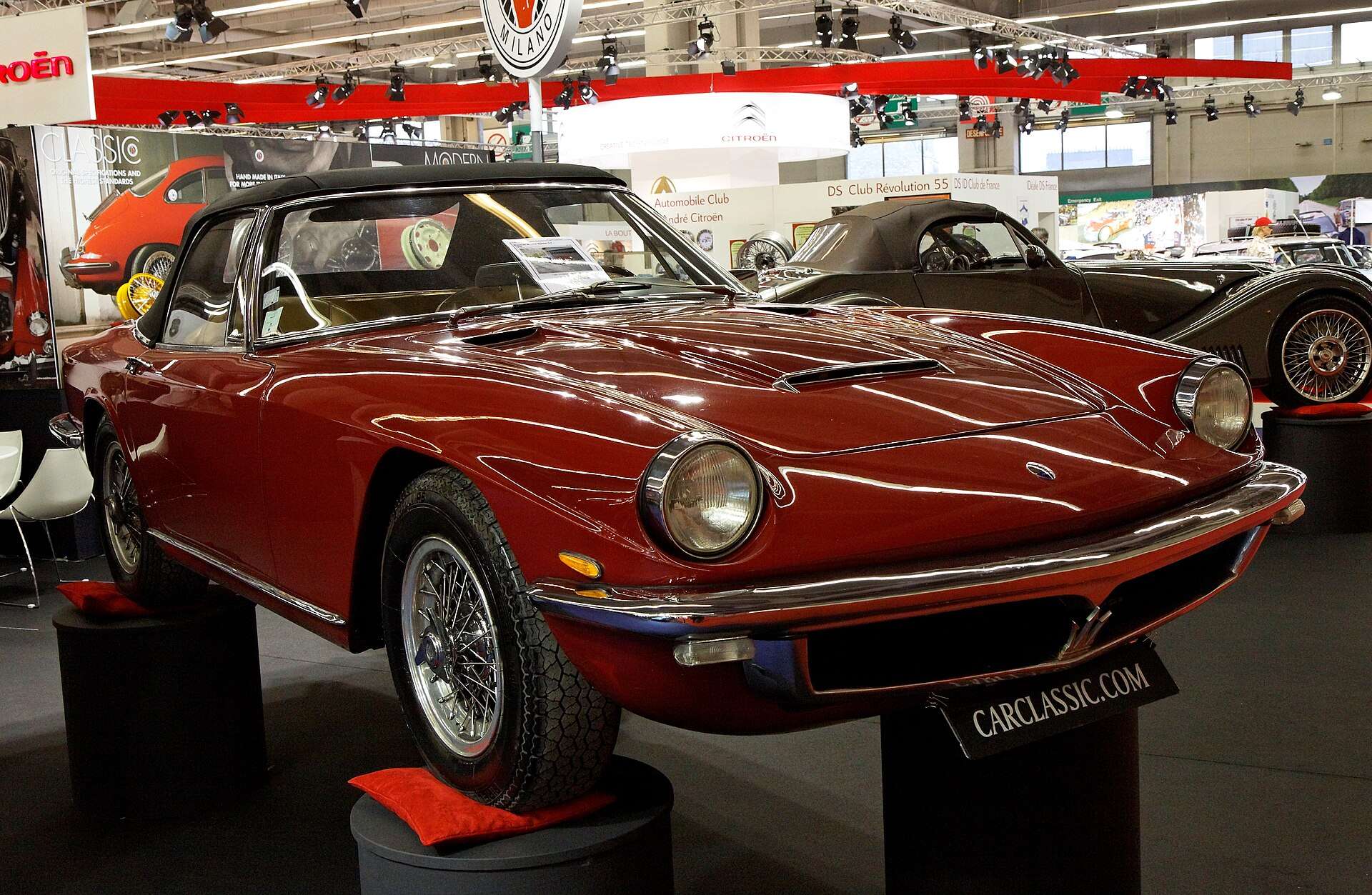
The accident repair is the main one. The listing says rear panels were replaced at Modena in 1965, but it does not say which panels, how severe the damage was, or whether the Orsi report’s invoices document the work. A factory repair carries a different weight from an unrecorded one, and bidders should ask for the specific entries.
Refinishing is the second. Bleu Sera to red to blue means the original finish is gone, and no photo can confirm what is underneath. The Lucas injection, reinstalled in 2017, is the third: it is the correct system, but a buyer needs to know who set it up and what it has done since. The 2024 RM car, by contrast, now runs carburetors, and the 2022 BaT car wore triple Webers, so a car that keeps its injection is the more original configuration and the one where a buyer most needs service records.
Finally, the missing air conditioning and torn dash trim are small costs but they are real, and the former was a factory option that the first owner paid for.
The factor that will set the price
The number likely to move this car from $170,000 toward the $351,000–$500,000 band of its sisters is how bidders read the 1965 Modena repair and the refinishing history against the Orsi report. If the paperwork shows a documented factory repair, the car begins to look like an early, correctly equipped Spyder with a story. If it does not, the same facts read as an accident car with a long gap in its record, and the sisters’ prices stop being a guide.
A second, quieter factor is the reserve. This is not a No Reserve auction, so it could end like the Peart car, with a high bid below the number and a second conversation afterward. Whatever the hammer shows at 1:20 p.m. Eastern should be treated as an opening position, not a verdict, until a sale is reported.
Sources
- Bring a Trailer: 1964 Maserati Mistral Spyder 3500, Lot #269,435
- Bring a Trailer: ex–Neil Peart 1965 Maserati Mistral 3500 Spyder
- Bring a Trailer: 1965 Maserati Mistral 3500 Spyder, sold September 25, 2026
- Bring a Trailer: 1964 Maserati Mistral Spyder 3500, December 2022 auction
- RM Sotheby’s: 1965 Maserati Mistral 3.5 Spyder
- Maserati Classic: Mistral Spyder
- Classic.com: Maserati Mistral 3.5 Spyder market data
Bid and timing figures reflect the Bring a Trailer listing as of 9:20 a.m. Eastern on October 22, 2026, and may have changed. Photos are representative Mistral Spyder examples, not the auction car.
The collector car market, every weekday morning.
Auction results, price moves and what’s crossing the block, read in four minutes. Free, from Modern Car Collector.
No spam, unsubscribe in one click. Or read more about the Brief.

 EL Puckett