

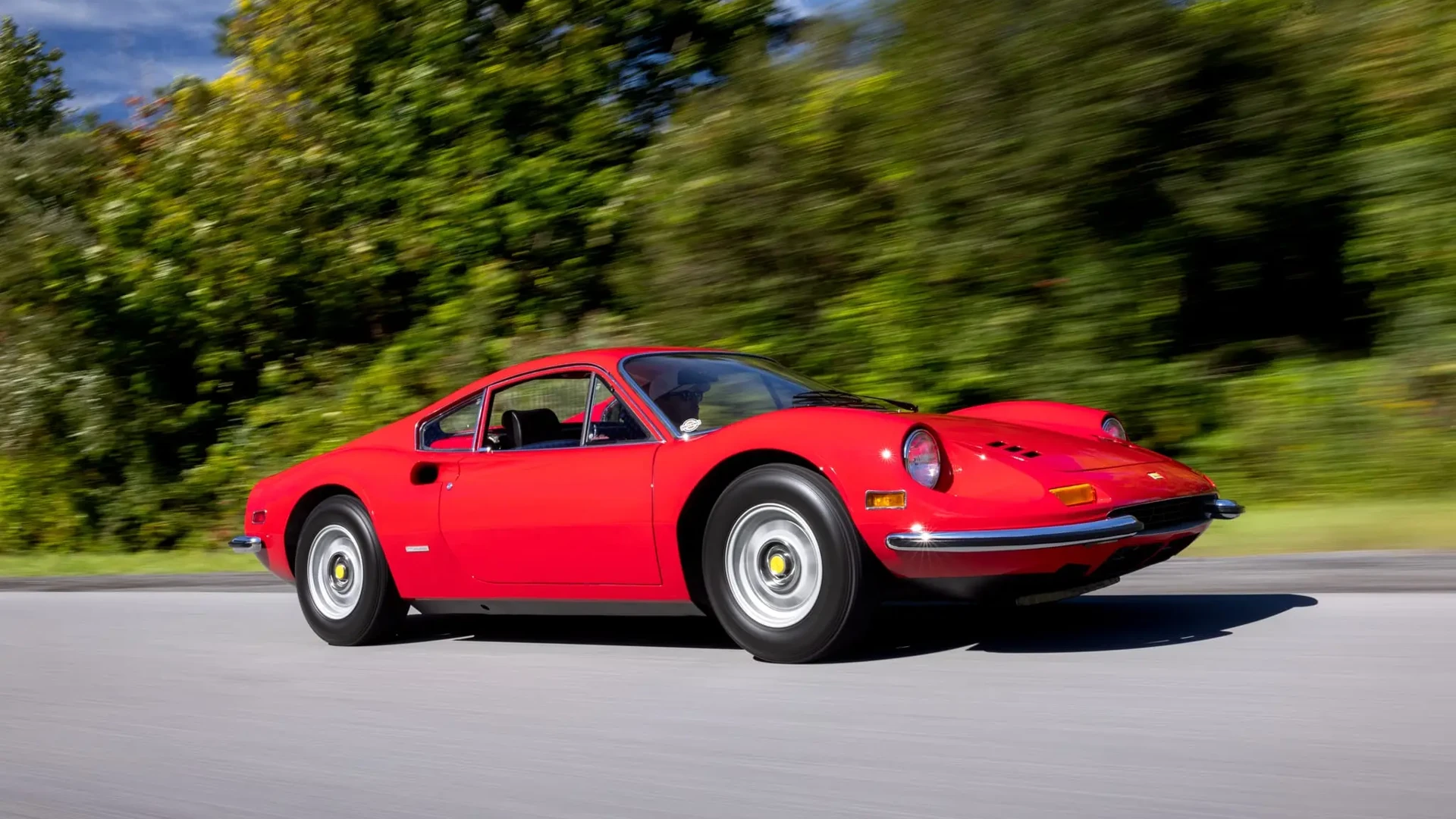
When Bring a Trailer closed its auction for a 1972 Ferrari Dino 246 GT on October 10, the high bid stood at $366,000 and the seller’s reserve had not been met. By conventional accounting, that is a no-sale. The car did not stay unsold for long. According to reports of the outcome, it changed hands afterward for $442,000, which is $76,000, or roughly 21 percent, above the last bid on the screen.
The detail that drew the attention is the underbidder. Ford CEO Jim Farley, a well-known enthusiast, was reported to have taken the bidding to $365,000 on the public listing. That makes for a good headline, but it is the least useful part of the story. The useful part is the gap.
A reserve is not a price. It is a seller’s opinion of the price, and on a Dino of this quality, the seller’s opinion proved closer to the market than the bidding did.
What was actually for sale
The car is chassis 03952, completed at Maranello on May 26, 1972, in Rosso Chiaro over Nero leather and delivered new through Bill Harrah’s Modern Classic Motors in Reno, Nevada. It spent roughly 1975 to 2023 in California, was recommissioned in 2020, and has since had a suspension overhaul (2024), modern air conditioning (2025) and, this year, a bare-metal repaint by Classic Rescue Coachwork of Oakdale, New York. The listing cites approximately 21,000 miles, a figure the listing itself does not verify, so it should be read as a claim rather than a fact. The documentation package reportedly includes service records and a Dino Compendium report.
That is a car with a clear chain of custody, a respectable but not concours-level presentation, and one open question, the odometer. Each of those matters to what follows.
Why the Dino still sets the entry point
Ferrari built 2,487 Dino 246 GT coupes and 1,274 GTS spyders between 1969 and 1974. The cars were sold under the Dino name, a tribute to Enzo Ferrari’s late son Alfredo, rather than as Ferraris, which is part of why they have always sat slightly apart from the V12 canon. The Pininfarina-styled, Scaglietti-built coupe was a mid-engine V6 car at a time when Maranello’s flagship was still a front-engine V12, and that design clarity is why the 246 has aged better than almost anything from its decade.
For collectors, the 246 GT is one of the few genuinely important Ferraris of its era that still trades below $500,000 with regularity. That is also why it attracts a particular kind of bidder: the buyer with the means to chase more expensive cars who simply wants this one.
What the comparables say
Aggregator data from Classic.com show how wide the 2026 range has been. Two earlier Bring a Trailer sales brought $301,000 in April and $305,000 in May. At Monterey in August, Broad Arrow sold a Dino for $401,000 and Bonhams for $417,500, while Gooding’s two Dinos reached $555,000 and $643,000. The spread is a statement about condition, provenance and presentation, not about the market’s direction.
Against that field, $442,000 sits above the earlier Bring a Trailer results and above the Broad Arrow and Bonhams Monterey cars, but well below Gooding’s. For a freshly refinished, well-documented car with unverified mileage, that is a plausible place to land. It also suggests that the seller’s reserve was not an aspiration but a read of where good Dinos now clear. Readers following our earlier coverage of a restored 1972 Dino 246 GT, the ex-Cher 1972 246 GTS and Bob Seger’s 1973 246 GTS will recognize the pattern: provenance and presentation account for most of the difference between one Dino and the next. At the other end, we noted a fire-damaged 1972 Dino listed at $129,500, a reminder of how far a car can fall below this range, and a more recent 1974 246 GTS headed to the Saratoga Motorcar Auction shows the spyder side of the market.
What a bare-metal repaint tells a buyer
The 2026 repaint deserves more attention than it has received. Stripping a Dino to bare metal is as much a disclosure as a refinement: it exposes any rust, filler or prior accident repair, and a documented strip can reduce uncertainty rather than add to it. What it cannot do is preserve original paint, and in the collector market originality compounds the way interest does. A buyer paying for a refinished car is paying for the quality of the work and the honesty of the documentation, not for the factory finish.
Serious buyers should ask to see photographs taken during the strip, confirm that chassis, engine and gearbox numbers match the Dino Compendium report, check panel fit and door shut lines, and verify mileage against the service records and title history rather than the odometer alone.
The takeaway
The public auction established what the room would pay. The private deal established what the seller needed. That the two differed by $76,000 on a car of this caliber is not a failure of the auction format; it is the point of a reserve, and a reminder that the last bid on a screen is often a floor rather than a result. The sale price has been reported but neither the buyer nor the terms of the post-auction deal have been disclosed, so the figure should be treated as indicative rather than final.
The presence of a high-profile underbidder confirms the Dino’s appeal. It does not, by itself, explain the price. Collectors who watch only the first number will keep being surprised by the second.
The collector car market, every weekday morning.
Auction results, price moves and what’s crossing the block, read in four minutes. Free, from Modern Car Collector.
No spam, unsubscribe in one click. Or read more about the Brief.
Related Posts:
- Record Ferraris, Rare Icons and 15,000 RPM: The Week…

- Original-Paint 1972 Chevrolet Corvette Convertible…
- Everything Modern Car Collector Covered Last Week
- The 8 Most Expensive Cars for Sale at Bonhams Right Now
- This Dodge Dart Demon 340 Tribute Rolls Into…
- Collector Car Market Brief: A Belgian Record at…
 Shawn Henry
  Shawn Henry