

Reno has heard the name Harrah before. For more than half a century, Bill Harrah’s collection of automobiles — built on a casino fortune and an obsession with mechanical originality — stood as one of the most significant private gatherings of cars in America, and pieces of it still anchor the National Automobile Museum a few miles from where this sale will take place. So when a 123-lot auction titled “Estate of John Harrah” appears on the Reno calendar for August 15, it is worth saying plainly, before anything else: nothing in the catalog ties this collection to that family or that legacy. What it actually represents turns out to be more useful to understand, because it is a far more common kind of estate than the one the name might suggest — and a more instructive one.
Stremmel Auctions, the Reno house handling the sale, is offering the inventory of a working car builder rather than a static trophy collection. Read the 123 lots in order and a portrait forms that has little to do with matching-numbers documentation or auction-house estimates and everything to do with how a serious enthusiast actually spends his time and money. That portrait is the real story here, and it says more about contemporary car culture than any single vehicle crossing the block.
Not That Harrah Collection
It bears repeating because the confusion is understandable. Bill Harrah’s automobile collection, assembled from the 1950s through his death in 1978, once numbered more than 1,400 cars and set the standard for what an obsessive, historically literate collection could look like, with engines and interiors preserved rather than modernized and provenance chased down to the build sheet. Nothing in Stremmel’s listing or public auction materials connects John Harrah’s estate to that collection or that family. Readers searching for an echo of Harrah’s National Collection in this sale won’t find one, and serious buyers should approach the catalog on its own terms rather than any borrowed cachet from the name.
The Shop Tells the Real Story
Scroll deep enough into the 123 lots and the vehicles thin out, replaced by the equipment of an actual fabrication shop: a manual metal lathe, a vertical knee mill, CNC routers, plasma cutters, a motorized bead roller, a rolling metal-shaping station, heavy steel welding and fixture tables, and a wide-format vinyl printer and cutter suited to producing the kind of racing livery wraps worn by more than one car in the sale. This is not the equipment list of a collector who wrote checks for finished cars. It is the equipment list of someone who built them, or at minimum modified and wrapped them himself, in a shop capable of real structural and cosmetic work. Readers who followed our look at a Long Island estate built around a turnkey garage will recognize the pattern: the most revealing asset in an enthusiast’s estate is often not a car at all.
Three Resto-Mods, One Sensibility
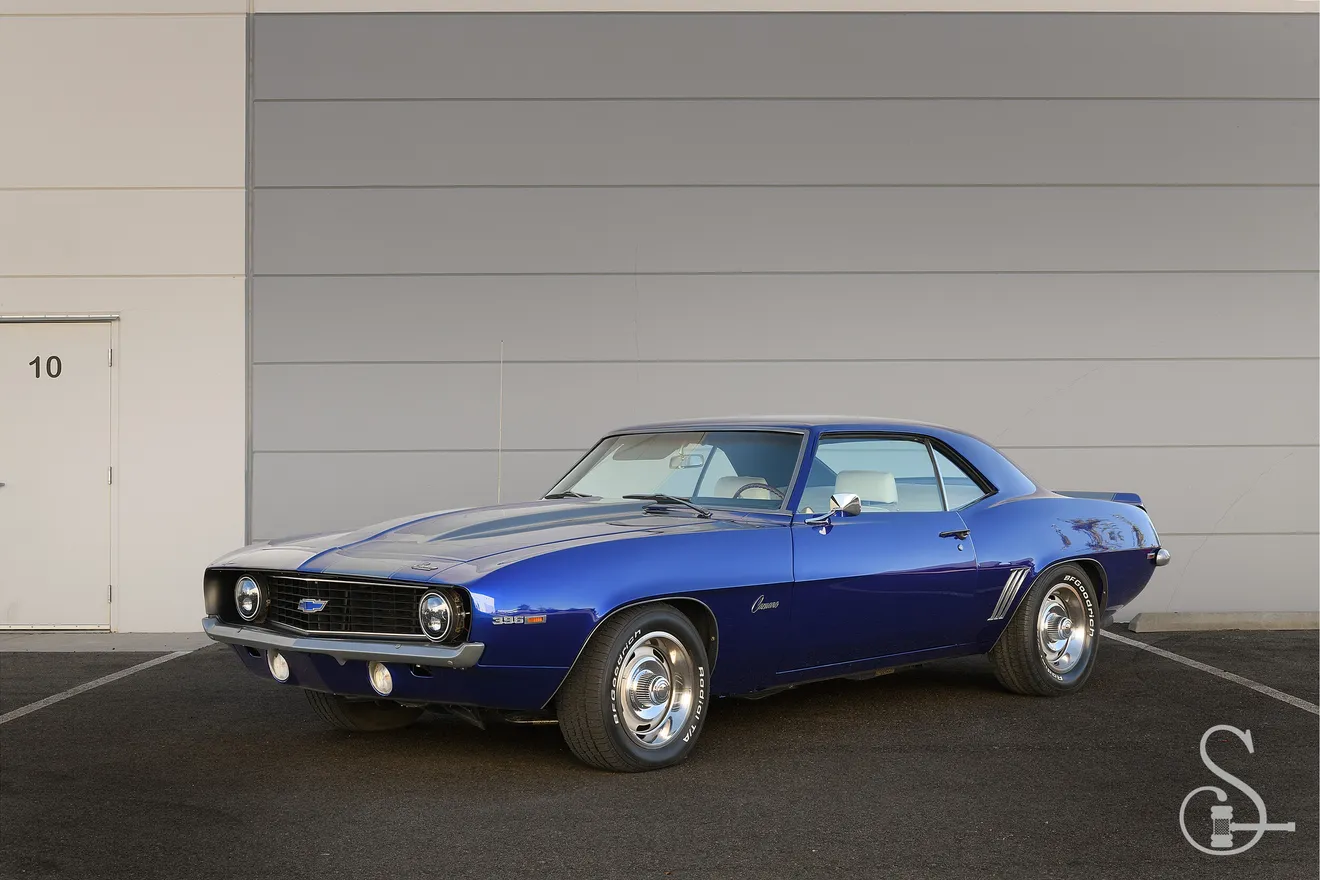
The three most distinctive vehicles in the sale confirm what the shop equipment implies. A 1969 Chevrolet Camaro carrying its factory 396 fender badging and a Hurst shifter, a Chevrolet Chevelle SS 396 rebuilt around Edelbrock and GM Performance Ram Jet components with a custom two-tone interior, and a 1933/1934 Ford three-window coupe reworked as a full restomod with Classic Instruments gauges and an automatic floor shifter — none of these are numbers-matching restorations chasing concours points, and none are pretending to be. They are driver-focused resto-mods built for someone who wanted performance and comfort over originality, a sensibility with its own healthy secondary market entirely separate from investment-grade collector cars. Readers who enjoyed our coverage of a 1967 Chevelle brought back from the dead ahead of SEMA 2025 will recognize the type: cars built to be driven hard and shown proudly, not cars built to be graded.
A SEMA Build in the Mix
The clearest evidence of showfield ambition is a modified BMW M2 listed as a SEMA show car, finished in a matte dark grey wrap with a full aerodynamic kit, HRE wheels, an Akrapovič carbon-fiber exhaust, and component branding from Öhlins, Brembo, CSF, and Agency Power laid out like a rolling parts-sponsor board. Cars built for the SEMA Show’s Las Vegas convention floor exist to demonstrate what the aftermarket can do to a platform, and they rarely reach public auction with the build’s full story intact, a pattern we’ve tracked before in covering a SEMA-built Corvette C8 headed to a Carlisle auction and a SEMA-exhibited 1979 GMC Jimmy sold at no reserve. Whether this M2 ever stood on a SEMA stage, or was simply built to that standard in a home shop equipped to do the work, is exactly the kind of provenance question a buyer should ask before bidding rather than after.
The Daily Drivers: Preserved, Not Displayed
Beneath the resto-mods and the show car sits a fleet of contemporary performance machinery that reads less like a collection and more like a rotation of cars actually used and enjoyed: a 2019 BMW M5 with 7,809 miles, a 2017 Audi RS7 with 5,295 miles, and a 2018 Porsche 718 Cayman GTS showing just 1,569 miles. None of these carry the kind of six-figure estimates that headline a Monterey sale, and none need to. Their value to a serious buyer lies in something simpler: low-mileage examples of platforms already earning enthusiast attention as future modern classics, sold without the depreciation baked into a car that has spent a decade as someone’s daily driver. It’s the same logic we outlined around a 2,000-mile 2023 Porsche 911 GT3 Touring sold at no reserve on Bring a Trailer: mileage this low doesn’t just preserve value, it preserves options for the next owner.
No Reserve, No Floor — and Why That Matters
Every one of the 123 lots in this sale, from the shop equipment to the Camaro to a miniature electric Porsche 550 Spyder built as a child’s ride-on car, opens bidding at five dollars and carries no reserve and no minimum. That is standard practice for estate and equipment liquidations handled by firms like Stremmel, which built its business on turnkey onsite and consignment sales rather than curated collector-car auctions, but it is worth explaining to readers more accustomed to houses like RM Sotheby’s or Gooding: a true no-reserve estate sale means every lot sells to whoever bids highest, full stop, with no floor protecting the consignor and no walk-away price. That structure produces the purest kind of price discovery the market offers, the number the room decides a thing is worth rather than a pre-set estimate. It’s the same dynamic we tracked in the no-reserve sale of Cher’s 1972 Ferrari Dino, and it applies just as much to a modified Camaro as it does to a celebrity Ferrari. Stremmel’s buyer’s premium structure reinforces the equipment-auction character of the sale: ten percent up to $25,000, five percent with a $2,500 minimum from $25,001 to $75,000, and a flat $3,750 above that, a declining effective rate as hammer prices climb that is more typical of an industrial and vehicle liquidation house than a collector-car specialist.
What Serious Collectors Should Take From This
The Modern Car Collector test we apply to every sale is simple: if the price disappeared from this story, would readers still learn something? Here, the answer is yes, and it has nothing to do with what any individual lot brings when bidding opens on August 15. This sale is a case study in the difference between a collection and an accumulation of things a genuine enthusiast used, built, and enjoyed — and in how the second category, though it will never headline a Monterey docket, moves through the market every week largely unremarked. Collectors chasing investment-grade metal will find little here. Collectors interested in what the next tier of car culture actually looks like, the shop-owning, wrap-installing, SEMA-adjacent builder who drives a low-mileage GTS on weekends and keeps a resto-mod Chevelle in the garage, will find the estate of John Harrah far more revealing than its name first suggests.
Stremmel has billed this event as “Part I,” which means at least one more tranche of this estate is still to come. The rarest thing in this particular catalog isn’t a car. It’s the complete portrait of how one enthusiast actually lived with the hobby, tool by tool and car by car, right up until the estate had to let it all go.
The collector car market, every weekday morning.
Auction results, price moves and what’s crossing the block, read in four minutes. Free, from Modern Car Collector.
No spam, unsubscribe in one click. Or read more about the Brief.




 Kyle Matthews
  John Lloyd
  Eve Nowell