

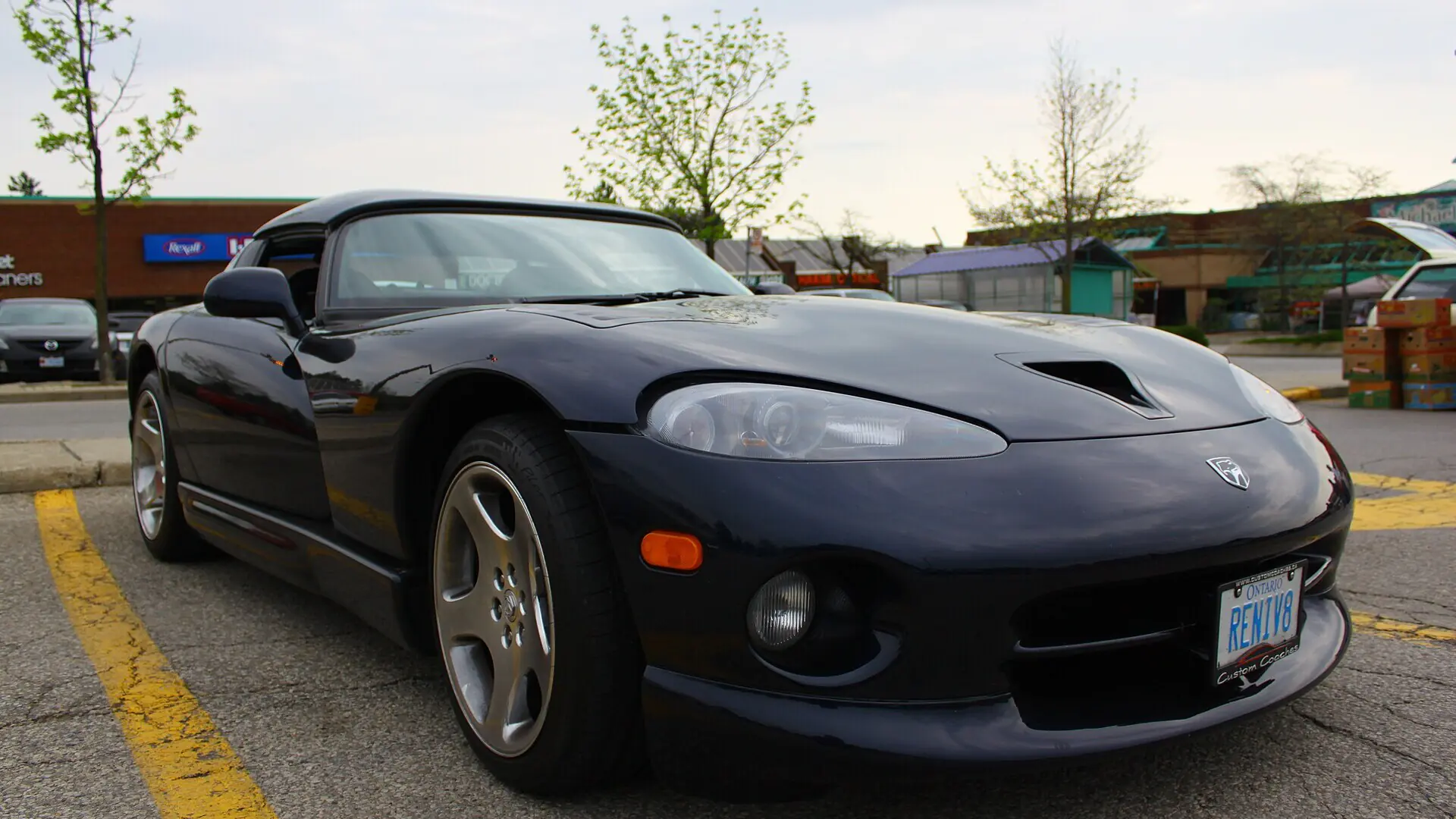
The first-generation Dodge Viper RT/10 is the rawest version of America’s most deliberate supercar: a tubular frame, a fiberglass body, an 8.0-liter V10 and, in the earliest cars, no roof worth the name, no door handles and no anti-lock brakes. It is also now one of the more accessible collector cars with real supercar credentials. Hagerty’s October 2026 guide puts a 1993 car in #3 (good) condition at $35,200. Below: the production numbers, the identifying details, the weak points and where values sit, so you can tell a good RT/10 from a tired one.
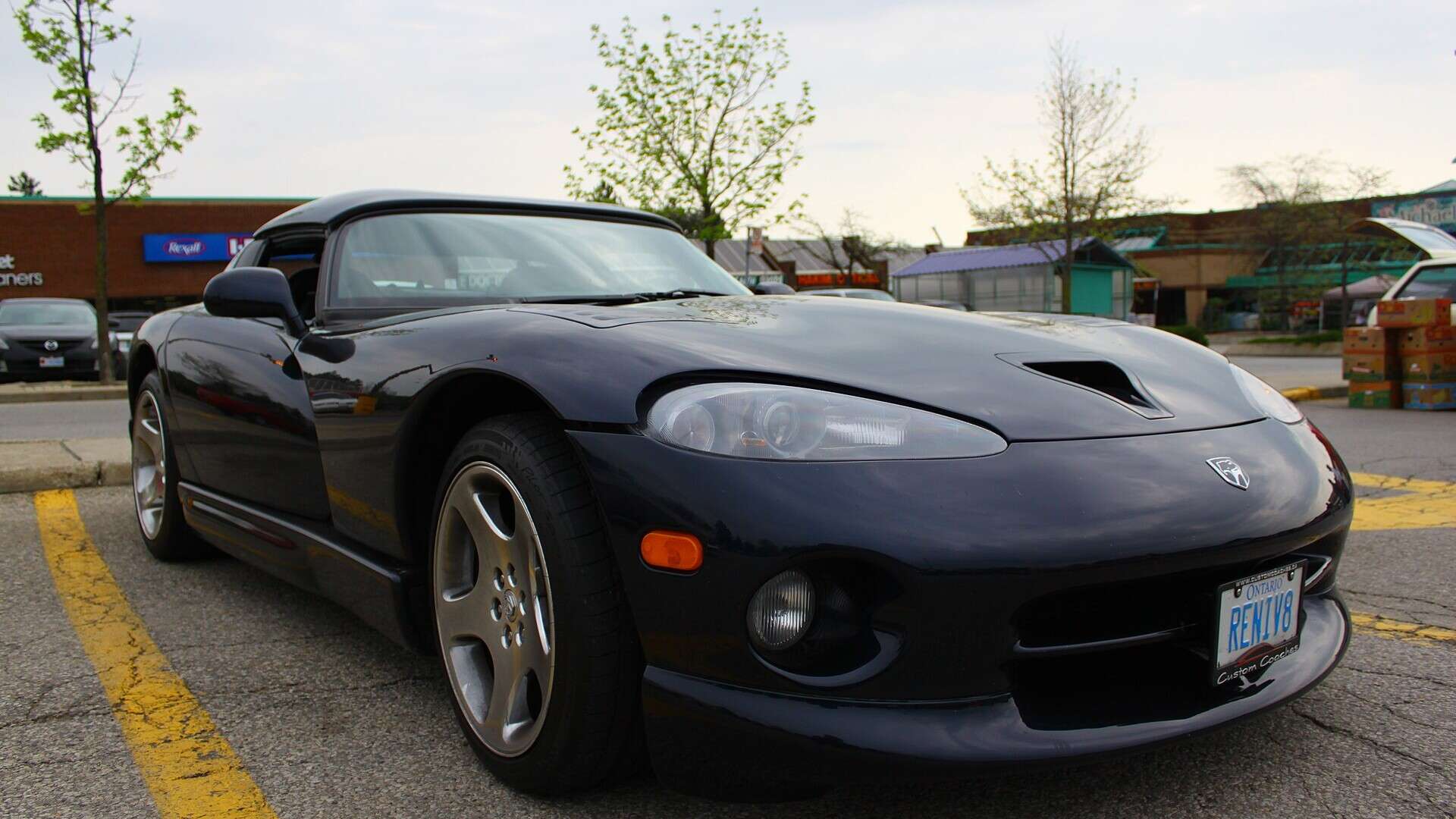
Dodge Viper RT/10 (1992–1995) at a glance
| Item | Detail |
|---|---|
| Model | Dodge Viper RT/10 roadster, first generation (SR I), 1992–1995 |
| Engine | 8.0-liter (488 cu in) V10, aluminum block and heads, two valves per cylinder, pushrod; developed with help from Lamborghini |
| Output | 400 hp; torque quoted as 450 lb-ft at 3,600 rpm (Hagerty and Wikipedia body text); one Wikipedia field lists 465 lb-ft |
| Transmission | Six-speed BorgWarner T56 manual; no automatic offered |
| Chassis | Tubular steel space frame with center spine; fiberglass body; unequal-length double-wishbone suspension with Koni coil-over shocks |
| Brakes and wheels | Four 13-inch vented discs; no ABS; 17-inch wheels |
| Weight | About 3,285 lb curb (Wikipedia); Hagerty lists 3,376 lb shipping weight |
| Performance | 0–60 mph in under five seconds; top speed originally about 164 mph (Hagerty) |
| Price new | About $50,000–$52,000 |
| Hagerty value, Oct. 2026 | 1993 RT/10, #3 condition: $35,200 (range $31,200–$38,333) |
Specifications from Hagerty’s valuation page and Wikipedia’s SR I article. Where they differ, we show both.
Production totals
Hagerty gives year-by-year production for the RT/10 era. The total is our sum of its figures.
| Model year | Built | Notes |
|---|---|---|
| 1992 | 285 | All red with gray interior |
| 1993 | 1,043 | More colors added; dealer-installed air conditioning |
| 1994 | 3,083 | Factory air conditioning option |
| 1995 | 1,577 | Factory one-piece hardtop became available |
| Total | 5,988 | First-generation roadsters, 1992–1995 |
The 1992 cars are the scarcest by a wide margin, and the 1994 model year accounts for roughly half of all first-generation production. A 1992 car is the one collectors chase; a 1994 or 1995 is the one that is usable.
Engine and drivetrain
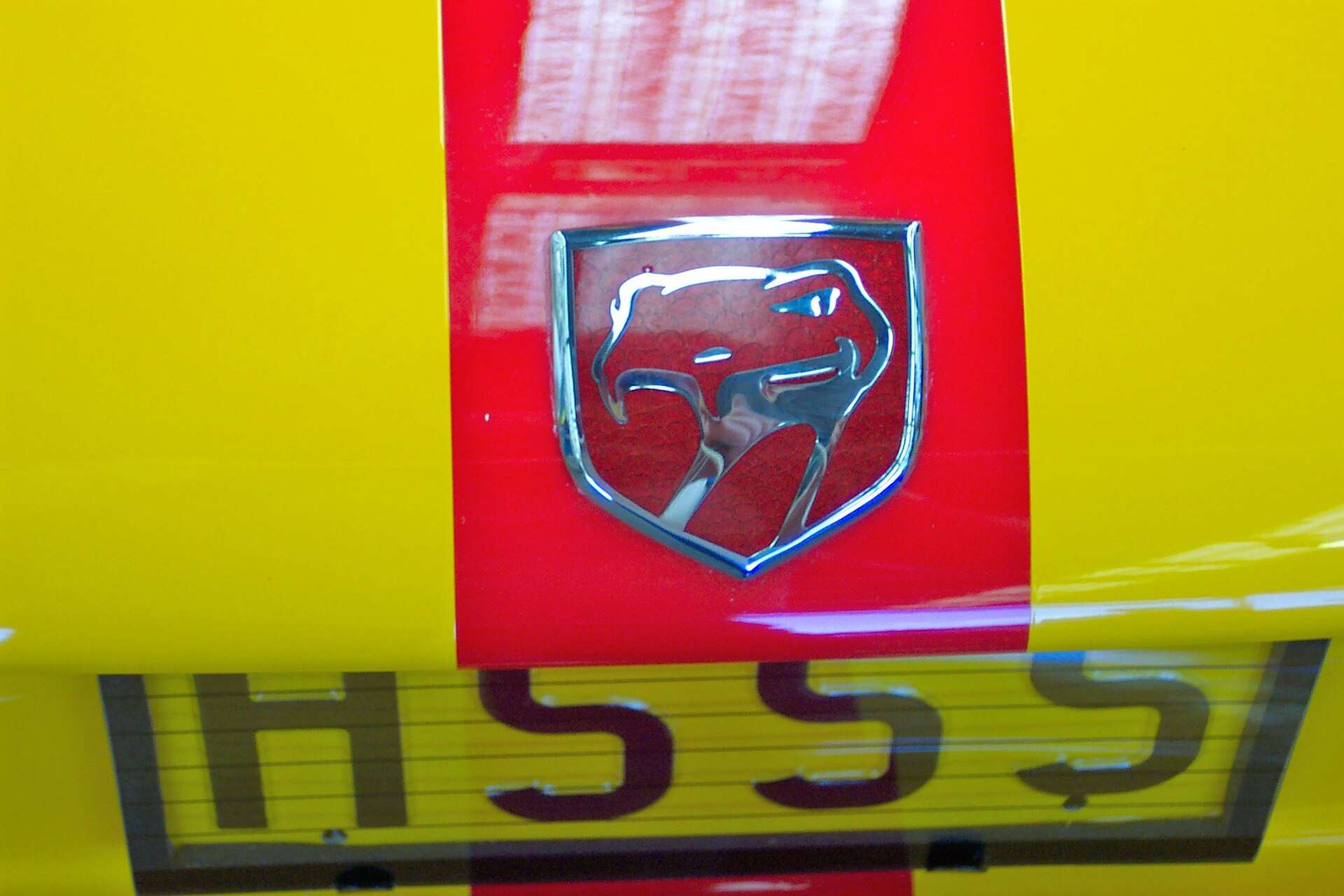
The V10 began as a Dodge truck engine concept before Chrysler asked Lamborghini to help design an aluminum block and heads, keeping the two-valve pushrod layout. It is rated at 400 horsepower with a 6,000-rpm redline, and it feeds the rear wheels through a BorgWarner T56 six-speed manual. Wikipedia notes a claimed 0.95 g in corners and EPA figures of 12 mpg city and 20 mpg highway, helped by tall gearing. A pre-production Viper paced the 1991 Indianapolis 500 with Carroll Shelby at the wheel, and production roadsters went on sale in January 1992.
Special options and equipment
- Air conditioning. A dealer-installed option in 1993 and a factory option in 1994 (Hagerty); Wikipedia says later 1994 cars.
- Adjustable suspension. Listed as an option by Wikipedia.
- Factory hardtop. A true single-piece removable hardtop arrived for 1995. Most cars from this generation came with only a canvas top with plastic side windows.
- Standard equipment. Manual leather sport seats, AM/FM cassette, power brakes and steering. The cars have no airbags, traction control or ABS, and none of the early cars has exterior door handles or key cylinders.
Identifying details
- Red paint with a gray interior identifies the 1992 model year, the only configuration Hagerty says was delivered that year.
- No exterior door handles or lock cylinders; entry is by reaching inside through the unzipped side window to the release.
- Side-exit exhaust pipes, whose heat is part of the car’s reputation.
- The one-piece factory hardtop signals a 1995 car or a later addition, so ask whether it is original to the car.
- The generation ends with the 1995 model year; the 1996 GTS coupe and later RT/10s belong to the SR II era.
Common weaknesses
Hagerty calls Viper ownership relatively low-cost and trouble-free next to other exotics, and lists the following points to check:
- Valvetrain wear. The engine can develop valvetrain issues with wear, or if it was not broken in properly.
- Hard or track use. Look for signs of it, and check the front valance and side pipes for curb damage or makeshift repairs.
- Interior exposure. Most cars lacked a tight-fitting top, which left the interior vulnerable to the elements, so Hagerty advises choosing a car stored in a dry, climate-controlled garage.
- Cabin heat. The side exhaust warms the cabin noticeably at low speeds and can scorch a leg when getting in.
- Driving manners. Near the limit, early cars bite back, with no ABS or stability control. That is a trait of the car, not a defect, but it matters to the buyer.
Current value range
Per Hagerty’s October 2026 price guide, a 1993 RT/10 in #3 (good) condition is worth about $35,200, with a high-low band of $31,200 to $38,333, a quarterly change of +2.9%, an annual change of −3.3% and a three-year change of −12.2%. Hagerty’s 12-month data for 1992–1995 Vipers shows 58 cars sold at an average of about $51,200, with sales volume up 14%. The three-year auction range for a 1993 car runs from $8,525 to $150,000, which tells you how much condition and provenance matter.
| Recent 1993 RT/10 sale | Price | Notes |
|---|---|---|
| Mecum, August 15, 2026 | $42,900 | Manual |
| Bring a Trailer, August 1, 2026 | $40,426 | 13,000 miles |
| Bring a Trailer, July 21, 2026 | $49,350 | 2,800 miles |
| Barrett-Jackson, June 27, 2026 | $70,400 | Manual |
The market has been correcting. In April, Hagerty reported that every 1992–2010 Viper fell in the guide, with the earliest RT/10s down 10% in the quarter and 21% from their late-2021 peak to a #2 (excellent) value of $44,600, not far above where they stood in early 2020. The October figures show the first-generation car stabilizing, with a small quarterly gain.
What separates a good RT/10 from an average one
- Mileage and use. The 2,800-mile car above brought roughly 20% more than the 13,000-mile car, and well-documented low-mile cars lead the top end of the range.
- Engine health. Evidence of a proper break-in, correct maintenance and a clean leak-down or compression test.
- Unmolested bodywork. An undamaged front valance, side pipes and fiberglass, with no track-day scars or repainted panels.
- Dry storage. A car that lived under cover, with an interior free of mold, sun damage and water stains.
- Correct year-specific features. A 1992 in red over gray is the collector’s pick; later cars should have documented air conditioning or a factory hardtop if the seller claims them.
- Originality. Factory wheels, exhaust and top, with any modifications disclosed.
For related Viper coverage, see a black 1996 RT/10 roadster at auction and the last open Viper with 9,000 miles. Other Mopar spec sheets include the 1970 Plymouth Superbird and the 1970 Dodge Challenger T/A, and a different kind of analog supercar is covered in our Ford GT spec sheet. For another Hagerty-driven price story, read the Jeep CJ-7 value drop.
Are you chasing the red-over-gray 1992, or is a usable 1994 the smarter way into a Viper?
Sources
- Hagerty Valuation Tools, 1993 Dodge Viper RT/10, October 2026 price guide, production figures and sales
- Hagerty Media, “Viper Prices Are Falling,” Andrew Newton, April 21, 2026
- Wikipedia, Dodge Viper (SR I)
Values are as of October 8, 2026. This is a reference article, not investment advice.
The collector car market, every weekday morning.
Auction results, price moves and what’s crossing the block, read in four minutes. Free, from Modern Car Collector.
No spam, unsubscribe in one click. Or read more about the Brief.
Related Posts:
- Depreciation and Market Comparison of the Pontiac…
- The Porsche Carrera GT Doubled in 2026. The $6.7…

- Black 1996 Dodge Viper RT/10 Roadster With a Dyno…
- First-Generation Acura NSX (1991–2005): Collector Spec Sheet
- The 10 Most Expensive Ford Broncos Ever Sold at Auction

- The 10 Most Expensive Toyota Supras Ever Sold at Auction

 Kyle Matthews