

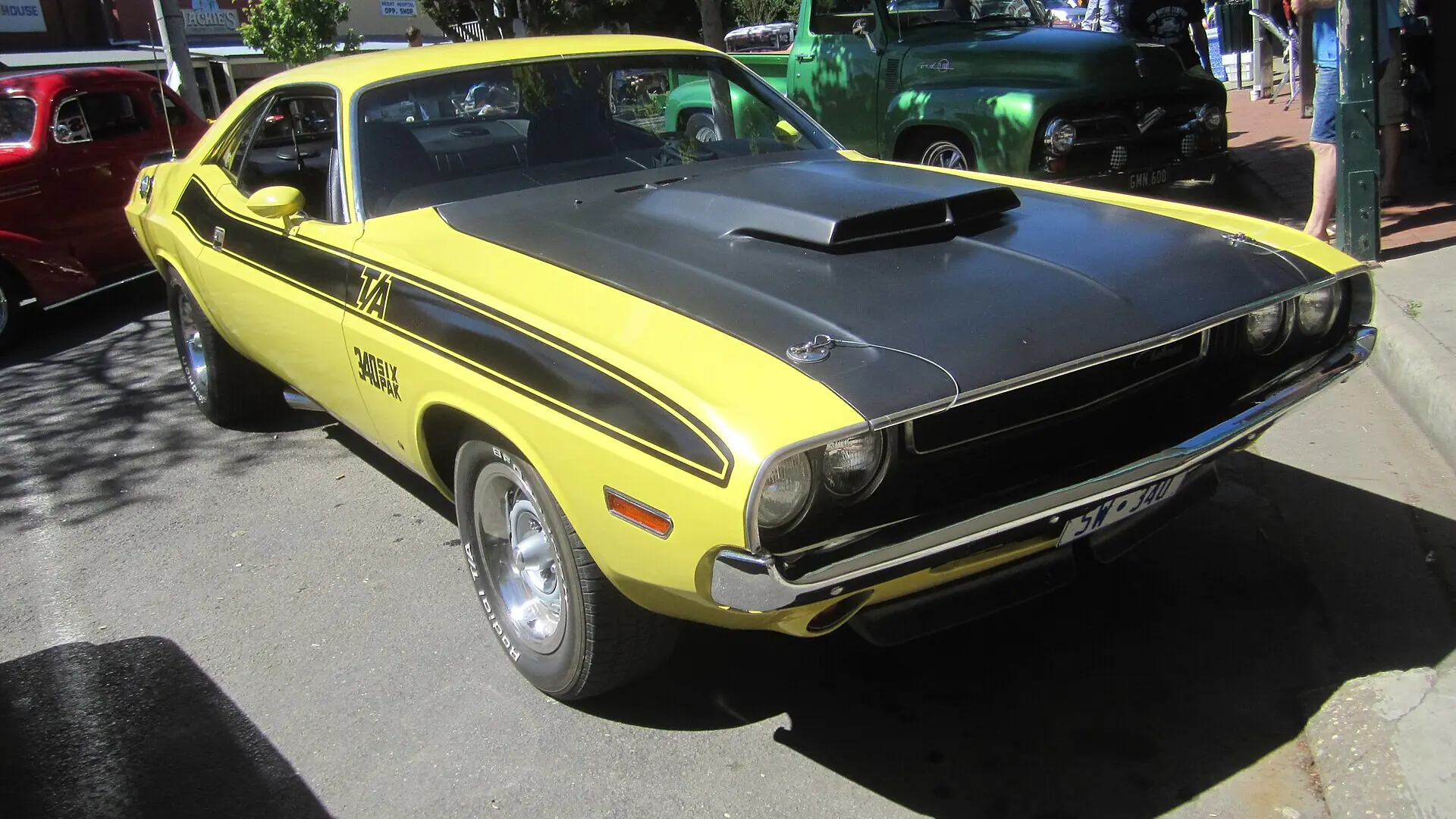
The 1970 Dodge Challenger T/A was built for one reason and sold for one year: to qualify a small-block coupe for SCCA Trans-Am racing. That homologation origin gives collectors a tidy spec sheet, a short list of identifying features and a long list of look-alikes. Below: the verifiable numbers, the places where sources contradict each other, and what separates a strong T/A from a clone with good stripes.
1970 Dodge Challenger T/A spec sheet at a glance
| Item | Detail |
| Production | 2,399 cars in one account, split 1,410 automatic and 989 manual (Muscle Cars Illustrated). Wikipedia’s text gives 2,399 while its production table shows 2,539, so totals vary by source. |
| Years | 1970 only; a homologation package for SCCA Trans-Am racing (Wikipedia). |
| Engine | 340 cu in V8 “Six Pack” (engine code J) with three two-barrel Holley carburetors on an aluminum intake manifold, four-bolt mains and dual exhaust. |
| Output | 290 hp at 5,000 rpm and 345 lb-ft at 3,400 rpm; 10.5:1 compression (Muscle Cars Illustrated). Rated 290 hp SAE gross, 15 hp above the standard 340 (Wikipedia). |
| Transmission | Hurst pistol-grip A-833 four-speed manual or heavy-duty three-speed TorqueFlite automatic. |
| Rear axle | Sure Grip 8¾-inch differential; 3.55:1 or 3.90:1 gearing (Wikipedia). |
| T/A package | $865.70, for a total sticker of roughly $4,100. Seven High Performance colors cost an extra $14.05 (Muscle Cars Illustrated). |
| Special equipment | Power front disc brakes, heavy-duty shocks and suspension with stiffer rear springs, fiberglass hood with fresh-air package, ducktail rear spoiler, left remote mirror, T/A tape stripe, collapsible spare, 15×7 steel wheels. Optional front spoiler and silver Rallye wheels. |
| Tires | Staggered: E60x15 Goodyear Polyglas in front and G60x15 in back, with raised white letters. |
| Not available | Air conditioning. |
Identifying details
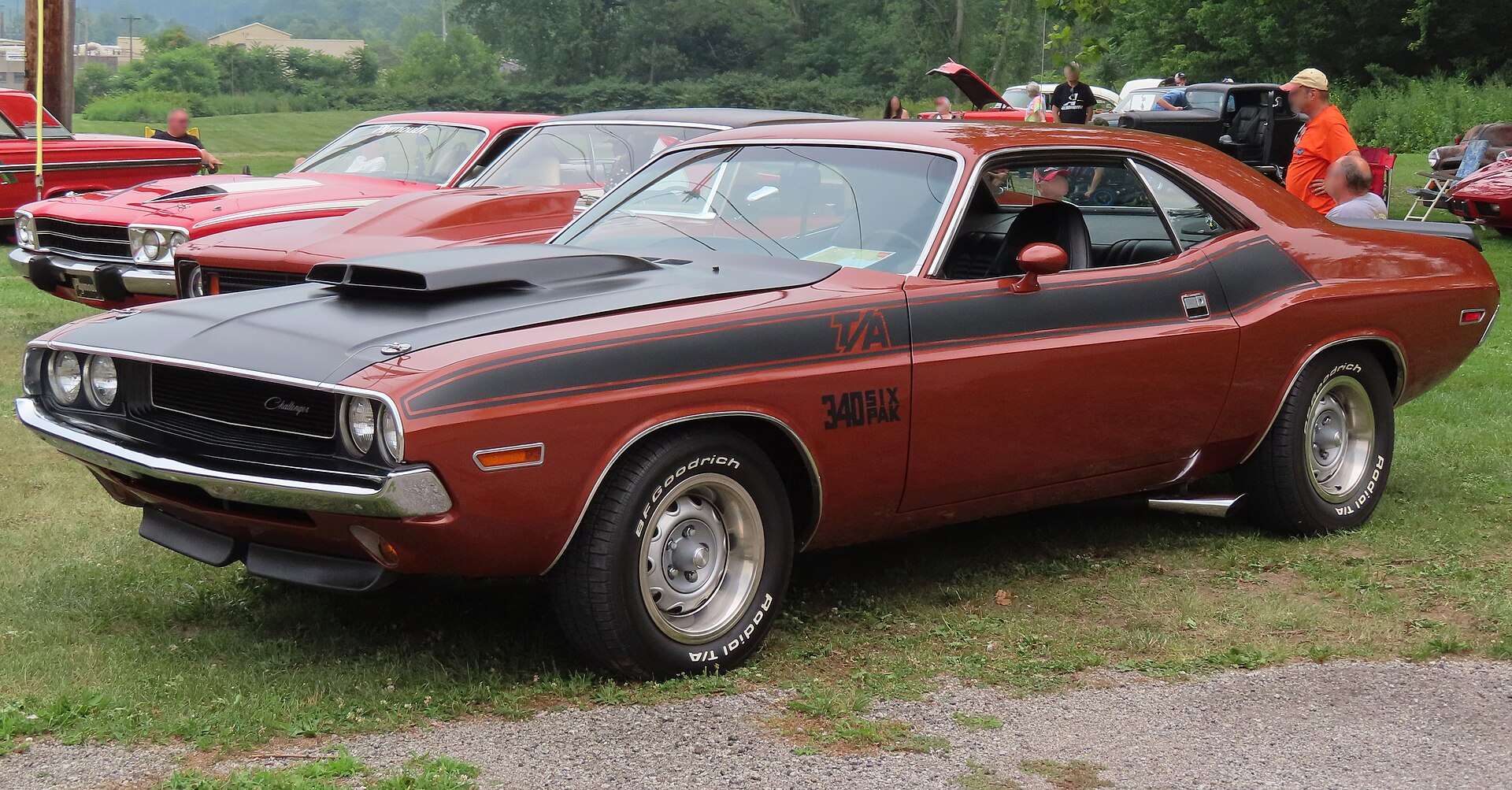
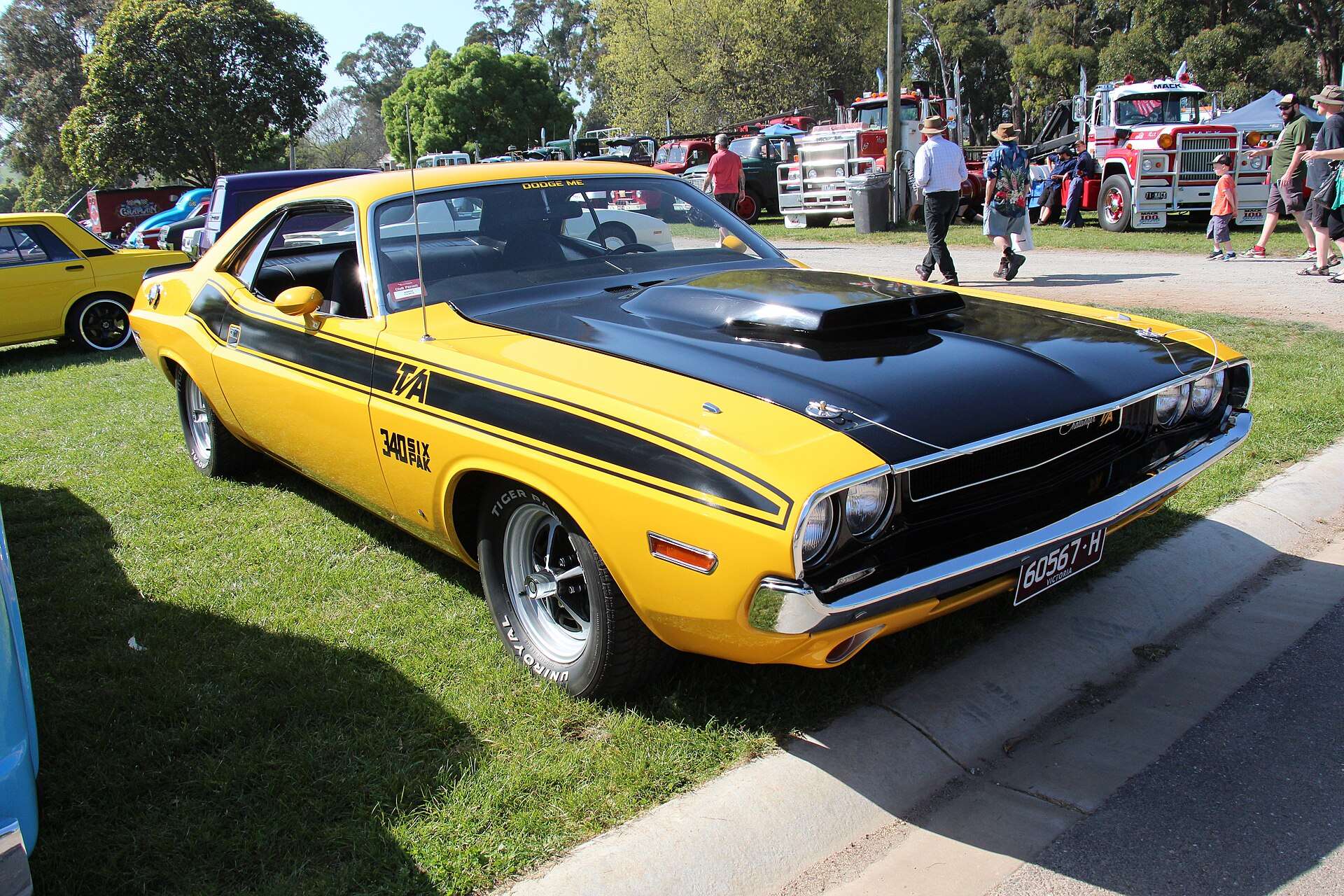
- A matte-black fiberglass “Scat Scoop” hood, hinged and held with hood pins.
- Side-exit exhaust with chrome-tipped outlets ahead of the rear wheels.
- Wide side stripes with “T/A” and “340 SIX PACK” callouts.
- The staggered tire sizes that give the car its raked stance, and dog-dish center caps.
- Engine code J in the VIN, per Wikipedia. Fast Lane Only advises cross-referencing the VIN, fender tag and drivetrain against known T/A specifications rather than relying on appearance.
Where the sources disagree
Production is the obvious conflict, with 2,399 and 2,539 both in print. Muscle Cars Illustrated also contradicts itself on the fuel-filler detail, describing a locking flip-top cap in one section and a snap-open cap in another, and calls the production run “just over 2,000” in a summary. None of this changes how a car is authenticated, but it is a reason to work from the fender tag and the VIN rather than from a figure in a listing.
Common weaknesses
The sources we reviewed do not catalog T/A-specific mechanical failure patterns, and we will not invent any. They do describe two risks. The first is handling: Wikipedia says the street car handled poorly in fast corners, which it attributes to the smaller front tires. That is a character trait of the package, not a defect. The second is authenticity. Fast Lane Only advises separating genuine cars from standard 1970 Challengers by checking for correct small-block hardware, Six Pack induction and T/A-specific body details, which is another way of saying clones exist.
Current value range
- Hagerty guide, as cited by Fast Lane Only: about $73,500 for a typical T/A in good condition with average specifications.
- Classic.com benchmark: $111,071 for the T/A market, which it cautions depends on each car’s condition.
- 2026 sales on Classic.com: nine results from $74,000 (Bring a Trailer, August 16) to $200,750 (Mecum Indianapolis, May 16). The others were $197,000 at GAA Greensboro, $156,750 and $151,250 at Mecum Harrisburg, $93,500 at Barrett-Jackson, $88,480 at Kruse, $85,930 on Bring a Trailer and $85,800 at Mecum Indianapolis. The median of those nine is $93,500, our calculation.
- Unsold bids: highest bids of $69,000 to $95,000 did not meet reserves.
The spread is the finding. Prices span nearly three times from low to high in one year, and Classic.com does not tell us why each car sold where it did. Our reading is that serious buyers should expect roughly the mid-$80,000s to the mid-$90,000s for a sound, documented driver and well above $150,000 for the best cars. That is our synthesis of public sales, not an appraisal.
What separates a good example from an average one
- Authenticity first. Fast Lane Only puts verification ahead of cosmetics. A car with matching VIN, fender tag and drivetrain is a different asset from one that only looks right.
- Documentation and originality. Both sources name documented, original cars as the strongest, and projects or heavily altered cars as the weakest.
- Color and option combinations. The factory High Performance colors, such as Hemi Orange and Panther Pink, were extra-cost choices, and rare combinations can add to value.
- Low mileage and correct restoration. Documented low-mileage cars and correct restorations sit at the top of the range.
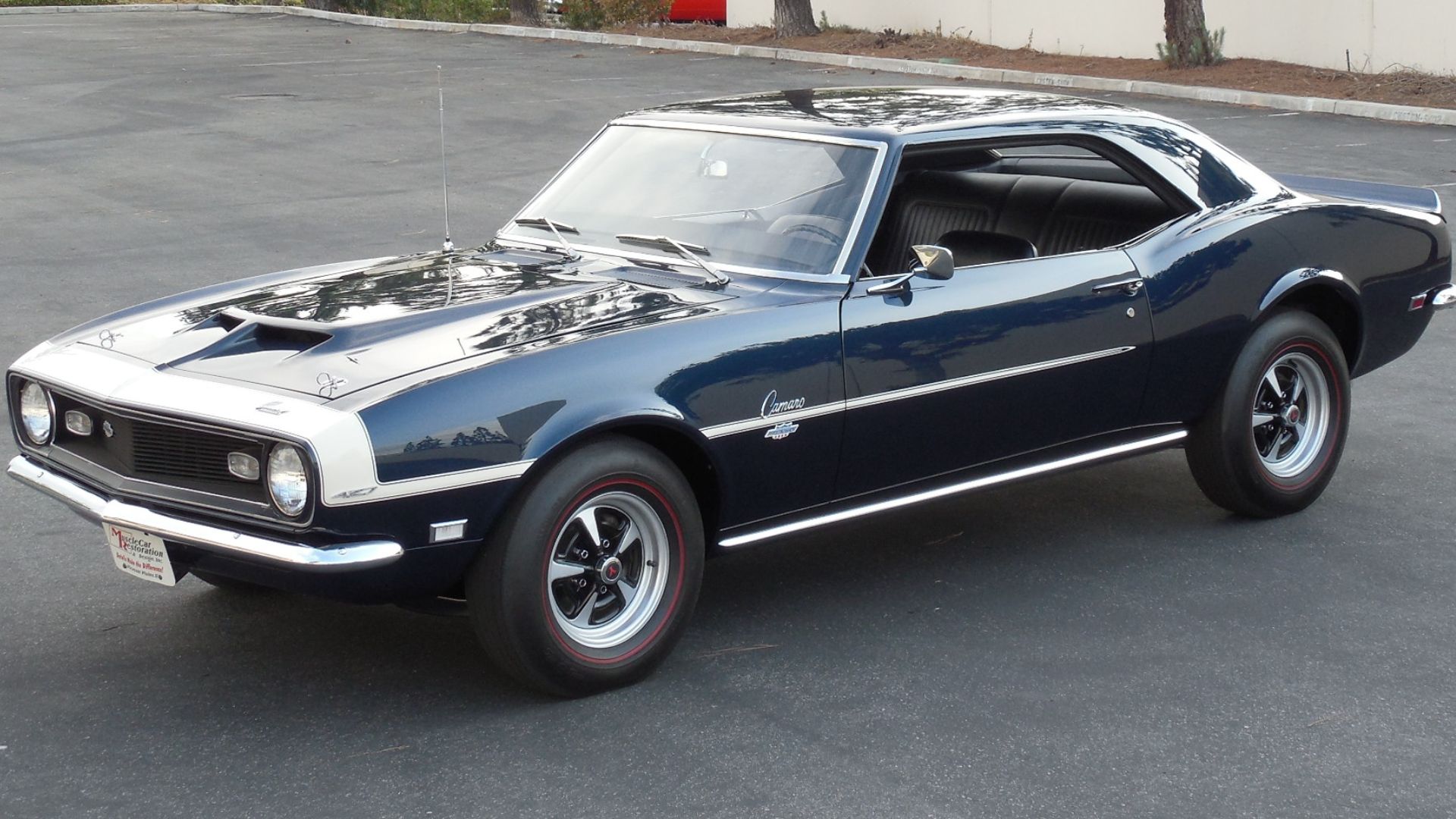
An average car, by contrast, is one whose identity rests on appearance, or whose drivetrain, hood or exhaust has been swapped. For related reading, see our spec sheets for the Plymouth Superbird and the 1969 Camaro ZL1, our originality guide to the Boss 429 KK number, our look at a big-block 1968 Camaro SS and our framework on whether pre-1973 American muscle is a good investment.
Ever seen a “T/A” that turned out to be a regular Challenger wearing the right stripes? What gave it away?
Sources
- Muscle Cars Illustrated, 1970 Dodge Challenger T/A
- Wikipedia, Dodge Challenger (1970)
- Fast Lane Only, “When Dodge built the T/A 340 and what it’s worth now”
- Classic.com, Dodge Challenger T/A (1st gen) market page
The collector car market, every weekday morning.
Auction results, price moves and what’s crossing the block, read in four minutes. Free, from Modern Car Collector.
No spam, unsubscribe in one click. Or read more about the Brief.


 Eve Nowell