

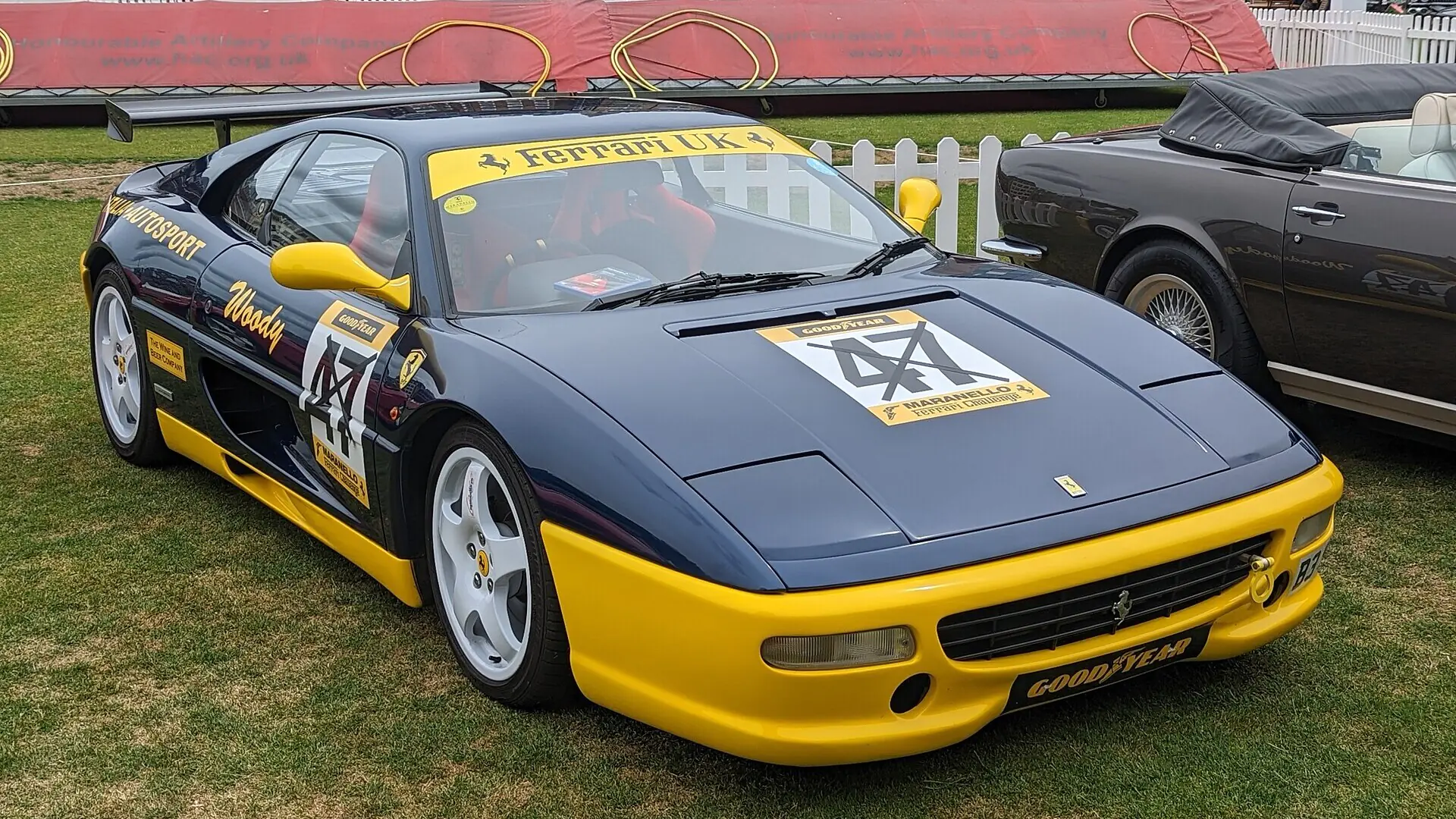
The Ferrari F355 spent two decades as the Ferrari you could still buy for the price of a nice sedan. That ended this year. Hagerty’s October update shows F355 values up an average of 19% in a single quarter, and a driver-quality coupe now costs more than $200,000 (Hagerty Media, October 8, 2026). Below: production numbers, special editions, the weak points that cost real money, and where values stand as of October 8, 2026, so you can separate a good F355 from an average one.
Ferrari F355 at a glance
| Item | Detail |
|---|---|
| Model | Ferrari F355 (1994–1999), successor to the 348 |
| Introduced | 1994 Geneva Motor Show |
| Body styles | Berlinetta, GTS (targa-style removable roof panel), Spider (convertible) |
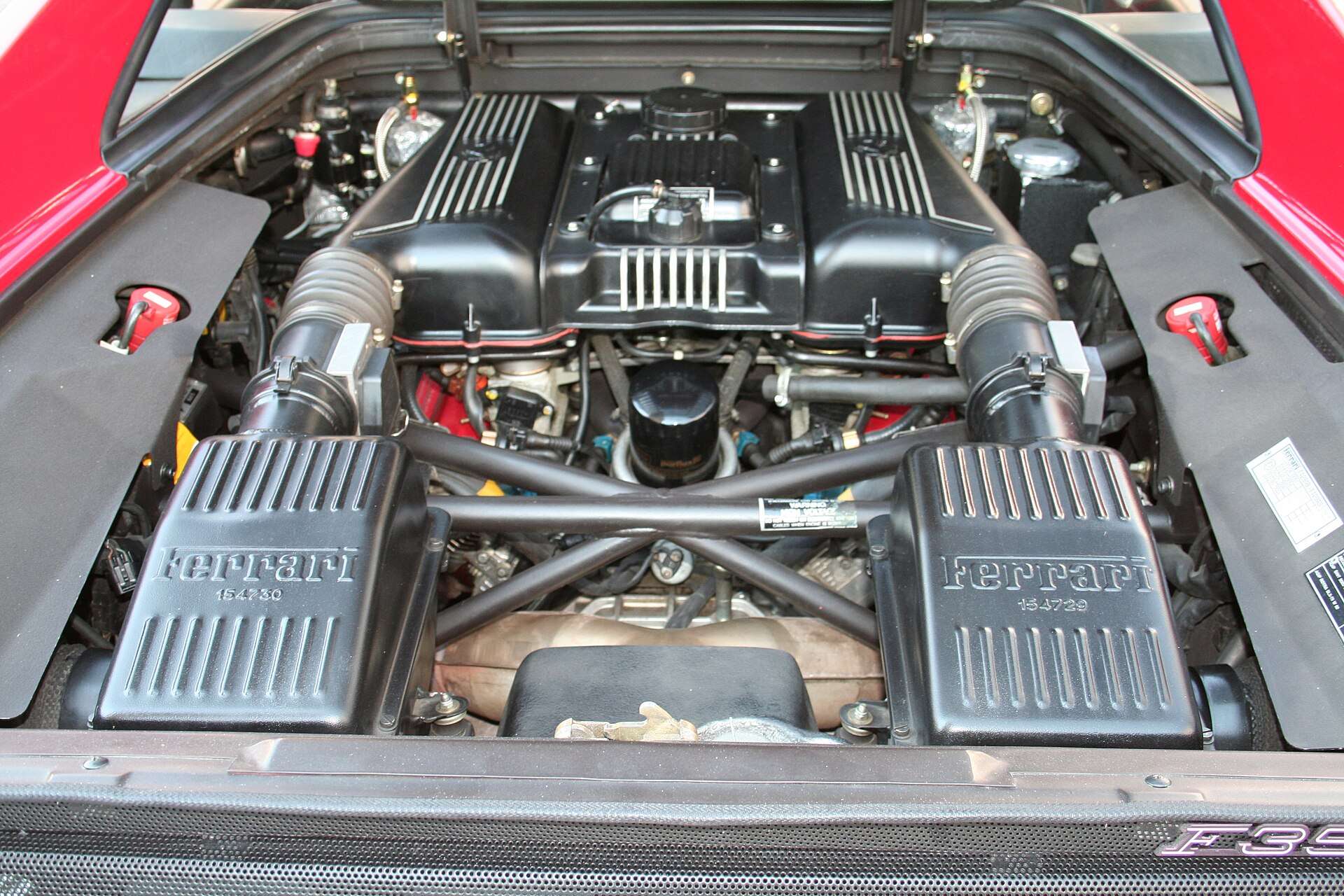
| Engine | 3,495 cc (3.5-liter) mid-mounted V8, five valves per cylinder, dry sump, titanium connecting rods, 11:1 compression |
| Output | 375 hp (380 PS) at 8,250 rpm; 363 N·m (about 268 lb-ft) at 6,000 rpm |
| Transmission | Six-speed manual; F1 paddle-shift option from 1997 |
| Curb weight | About 1,483–1,497 kg (3,270–3,300 lb) |
| Total production | 11,273 including 108 Challenge cars |
| Hagerty reference | Driver-quality coupe over $200,000 (October 2026) |
Specifications and production counts are from Wikipedia’s F355 entry, cross-checked with Octane’s buying guide. Where sources disagree, we say so.
Production totals
Wikipedia’s breakdown, which adds up cleanly to the total, is as follows. Octane gives the total as just over 11,000, consistent with these figures.
| Body style | Total | Manual | F1 paddle-shift |
|---|---|---|---|
| Berlinetta | 4,871 | 3,829 | 1,042 |
| Spider | 3,717 | 2,664 | 1,053 |
| GTS | 2,577 | 2,048 | 529 |
| Challenge (race, manual only) | 108 | 108 | 0 |
| Total | 11,273 |
The F1 gearbox arrived in 1997 and is the car’s most debated variable. Manual cars outnumber F1 cars in every body style, and Octane says a manual gearbox typically adds 20% to 40% to a car’s price on the UK market. That premium is the single biggest swing factor after condition.
Engine and drivetrain
The F355’s V8 grew its stroke to 77 mm from the 348’s 75 mm and added five-valve cylinder heads, which is what lets it rev to 8,500 rpm. Engine management was Bosch Motronic 2.7 in 1995 and moved to the M5.2 unit from 1996 onward, according to Wikipedia; Octane places a Motronic upgrade alongside the 1997 F1 introduction, so sources vary by a year and the factory data for a specific chassis should be confirmed. Ferrari also gave the car a flat underbody with a diffuser, an idea borrowed from its Formula 1 program.
Special editions and options
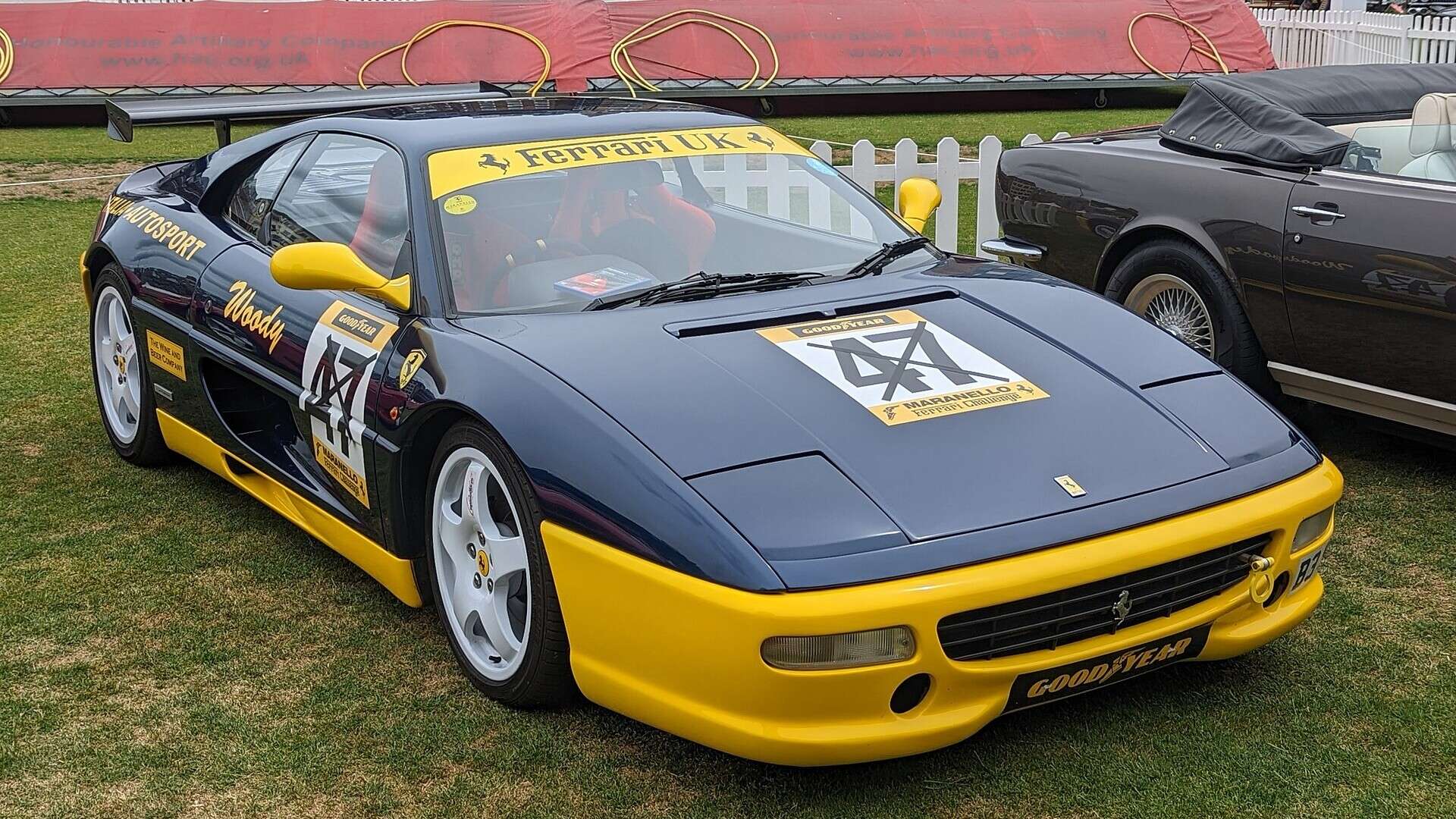
- F355 Challenge (1995 onward). A factory racing kit of about $30,000 produced 108 cars, all manual, with a roll cage, racing seats, Brembo brakes and Speedline wheels. Wikipedia notes that some sources claim over 300 conversions, which is unverified, so documentation matters.
- Serie Fiorano (1999 Spider). A limited run of 100 planned units, with 104 reportedly built, most for the US (74 F1 and 26 manual). It carries a Competizione-derived suspension, drilled brakes, a competition steering rack and carbon-fiber trim.
- Rarest regular combinations. By Wikipedia’s counts, the GTS with the F1 gearbox is the scarcest of the regular body-and-transmission pairings at 529 cars, against 1,042 F1 Berlinettas and 1,053 F1 Spiders.
Identifying details to verify
- Body style and transmission against the build record: the Berlinetta, GTS and Spider all exist as both manual and F1 cars, so confirm what the car left the factory with, not what the listing says.
- Engine management and model-year features that changed in the mid-1990s; ask a marque specialist to confirm the chassis against the correct specification.
- Challenge and Serie Fiorano claims, which need factory documentation rather than visual similarity.
- Completion of the November 2009 US recall of roughly 2,400 1995–99 cars, in which improperly placed screw clamps could damage fuel lines and let fuel leak into the engine bay.
Common weaknesses
Octane’s buying guide, which we use here for the list below, calls the F355 “robust when cared for,” and the weak points mostly punish neglect.
- Cambelt service. Due every three years or 30,000 miles, and the factory procedure requires removing the engine. Missing or undocumented belt service can mean severe engine damage.
- Exhaust manifolds. Prone to cracking; many cars have had repairs or replacements.
- Exhaust bypass valves. Can rattle at idle; parts are expensive.
- Clutch and F1 hydraulics. Clutch life of roughly 15,000–30,000 miles on F1 cars and about 30,000 on manuals; check both hydraulic systems for leaks.
- Suspension. Adaptive dampers can fail, at roughly £1,200 each in Octane’s UK pricing; broken springs and seized handbrake cables are also common.
- Corrosion. Inspect the steel engine cradle, the rear buttresses on Berlinetta and GTS cars, and the sill plates; magnesium wheels can corrode.
- Interior and roof. Leather can shrink in sun; the Spider’s hydraulic roof can fail through pump, ram or sensor faults.
Current value range
The reliable current US figure is Hagerty’s: a driver-quality F355 coupe can cost more than $200,000, and the model gained an average of 19% last quarter, with high-mileage cars and ultra-low-mileage cars in rarer colors both finding enthusiastic buyers. For a recent live example, see our report on a white six-speed F355 with 34,943 miles offered at no reserve. Octane’s older UK ranges, which run from roughly £60,000 to £150,000 and above, are useful for relative pricing between body styles and transmissions but predate this year’s rise, so they should not be read as current. We would treat $200,000 as an entry marker for a clean coupe and expect low-mileage manuals, GTS cars and Fiorano and Challenge examples to sit well above it.
What separates a good F355 from an average one
- Documented belt service. Invoices showing engine-out belt changes on schedule are the first thing to read.
- A manual gearbox. It carries the largest premium and the cleaner driving story.
- Unrepaired structure. Clean cradle, buttresses and sills, with no hidden previous repairs.
- Healthy manifolds and clutch. Cracked manifolds or a worn clutch are real money.
- Original or correctly specified details. Color, interior and wheels as delivered, with recall work completed.
- Low mileage with continuity. Mileage matters, but a continuously serviced 40,000-mile car is usually a better buy than a 12,000-mile car that sat.
For related reading, see why engine number 44 matters on Lewis Hamilton’s F40, how Michael Jordan’s 550 Maranello reached $2.7 million, our BMW Z8 spec sheet, and the same Hagerty report’s headline mover in the 997.2 GT3 price move. For an older V12 Ferrari with a different set of originality questions, see today’s Lot of the Day, a 1965 330 GT 2+2.
Manual or F1: is the gated shifter worth the premium to you, or is the paddle-shift car the smarter buy at these prices?
Sources
- Wikipedia, Ferrari F355 (production, specifications, special editions, recall)
- Octane, Ferrari F355 buying guide (weaknesses and UK pricing)
- Hagerty Media, October 8, 2026 (quarterly change and current value reference)
Values are as of October 8, 2026. This is a reference article, not investment advice.
Lead image: Calreyn88 / Wikimedia Commons, CC BY-SA 4.0.
The collector car market, every weekday morning.
Auction results, price moves and what’s crossing the block, read in four minutes. Free, from Modern Car Collector.
No spam, unsubscribe in one click. Or read more about the Brief.
Related Posts:
- Austin-Healey 3000 vs Sunbeam Tiger vs Triumph TR6:…
- Toyota Supra Mk IV Turbo (1993–1998): Collector Spec Sheet
- Delta Integrale vs. Escort Cosworth vs. Celica…
- BMW 850CSi vs. Maserati Shamal vs. Mercedes 600 SEC:…
- Syclone vs Lightning vs 454 SS: Three '90s Super…
- The 10 Most Expensive Toyota Supras Ever Sold at Auction
 Kyle Matthews
 Shawn Henry