

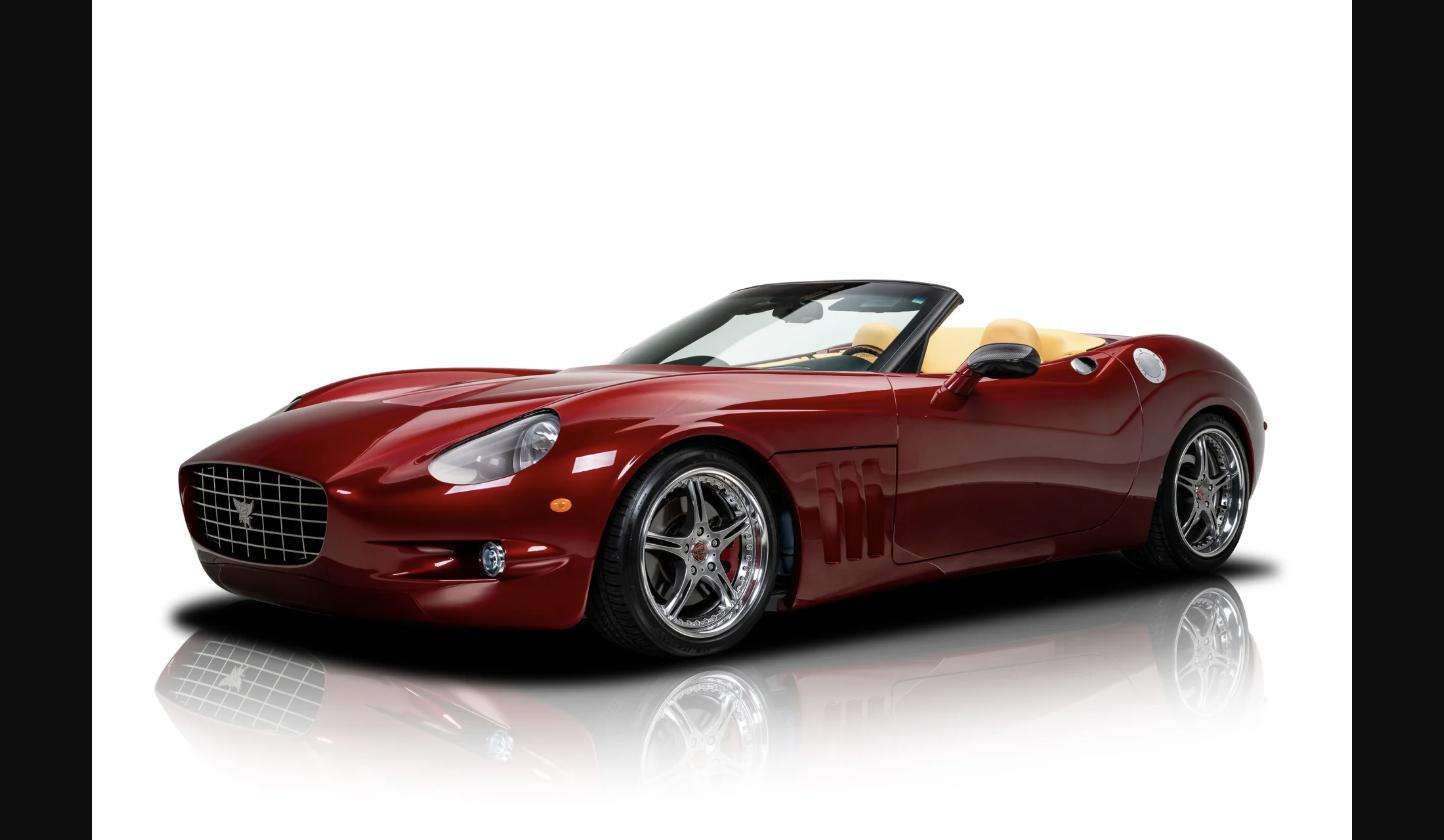
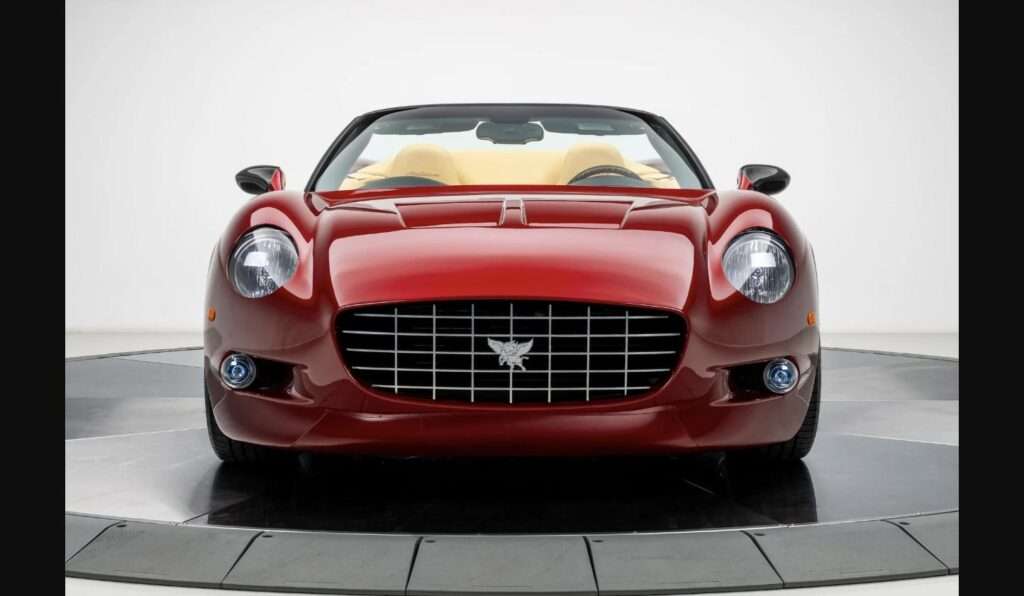
At RK Motors in Charlotte, a burgundy roadster with a $119,900 price tag wears a grille badge that has nothing to do with Chevrolet. The instrument cluster reads “Anteros.” So does the sill plate. Pop the composite clamshell hood and a supercharged LS2 V8 sits nestled in carbon-fiber panels, wearing a heritage that has almost nothing to do with the platform underneath it. Chevrolet built the chassis. Somebody else entirely built the car.
This is a 2005 Anteros, serial number 00002, and it is one of the earliest documented examples of a coachbuilt program that most collectors have never heard of and most auction houses have never catalogued. That obscurity is precisely why it matters.
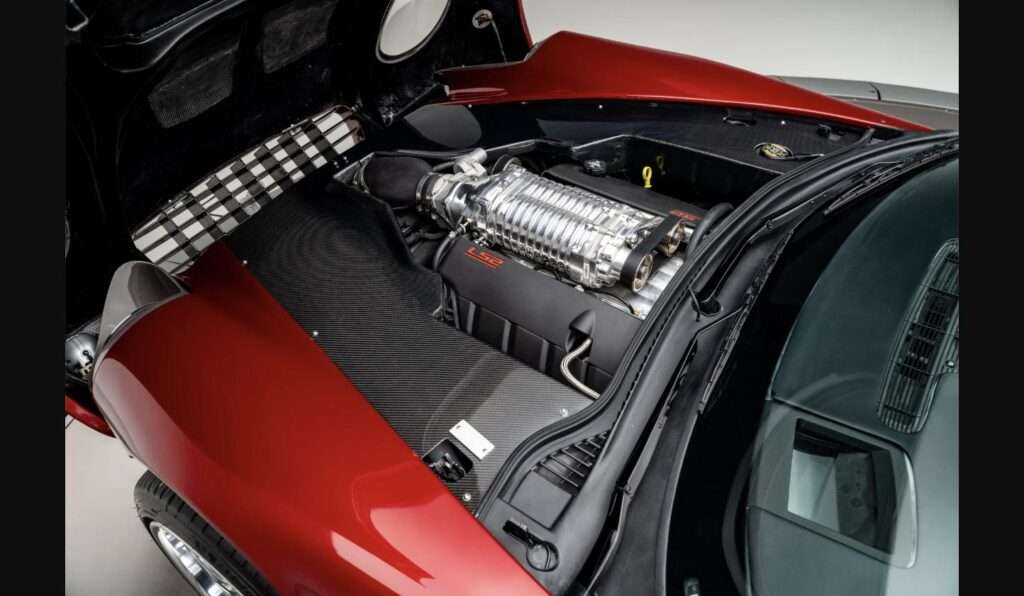
Strip away the badge and the bodywork, and the underpinnings are pure sixth-generation Corvette: a 6.0-liter LS2 backed by a Magnuson supercharger, a 4L65E four-speed automatic, and the independent suspension and four-wheel disc brakes GM engineers had already sorted out. None of that is the story. The story is what California-based Anteros Coachworks did with it. Working in tiny numbers, believed to total fewer than 100 cars, the company reskinned the C6 in hand-formed composite bodywork inspired by Italian grand tourers, with carbon-fiber mirror caps, fuel-filler surrounds, and engine bay panels layered over a completely reworked interior of leather, burl wood, and bespoke instrumentation. That pairing, European-inspired coachwork over American muscle, is a recurring theme in this market, one we explored in our coverage of European elegance meeting American muscle at a recent Lucky Collector Car Auction sale.
Coachbuilding did not end with Pininfarina, Bertone, and Zagato. It simply stopped being fashionable, and it stopped happening at scale. By the time Anteros unveiled its roadster prototype at the 2005 SEMA show, the era of a customer ordering a bare chassis and having an independent atelier clothe it in custom bodywork was considered a relic of the pre-war Duesenberg and Packard era, not something happening quietly in California using Corvette running gear. Serial 00002 is a reminder that the practice never actually disappeared. It just moved from Turin to a small American shop working in low volume on GM components, the same basic transaction that once defined luxury motoring, only using a different donor chassis.
That lineage is worth taking seriously precisely because Modern Car Collector readers already understand how seriously the market takes coachbuilt Detroit-era Packards, as with the 1935 Packard Twelve Series 1208 Seven-Passenger Sedan we covered recently. The instinct to dismiss a Corvette-based specialty car as a costume next to that kind of formal coachwork is understandable. But the underlying logic, a proven chassis wearing bespoke, low-volume bodywork built to a customer’s specification, is the same logic. What changes is the donor car and the era, not the principle.
Serial number 00002 is not just a low number for the sake of novelty. RK Motors describes this car as believed to be among the earliest carbon-fiber production examples the company built, which suggests Anteros’s construction methods were still being refined this early in the run. In small-batch manufacturing, the first cars off the line often differ meaningfully from later, more standardized production, whether in materials, fitment, or detailing. Collectors who pursue early-production examples of any limited-run car, from the first Shelby Cobras to the earliest Saleen Mustangs, do so because those cars document a manufacturing process before it matured. An early Anteros is no different in principle, even if the name carries none of that established cachet yet.
Condition supports the case. At 1,258 miles, this Anteros has barely been driven since it left Anteros’s hands, finished in Jewel Red over tan leather with the carbon-fiber accents, wood-rim wheel, and embroidered bucket seats that defined the build. It comes with its serial-number identification plaque, the kind of small documentation detail that matters enormously for a coachbuilder with no factory archive, no heritage department, and no certification program to fall back on. For a niche builder like this, the plaque and the paperwork are the provenance.
None of this means Anteros belongs in the same investment conversation as a numbers-matching Cobra or a documented Zagato Alfa. It does not, and Modern Car Collector readers should not mistake scarcity for blue-chip status. What it does mean is that the car is a genuine artifact of a specific, under-documented moment: small American coachbuilders experimenting with GM’s LS-based performance parts right as the broader restomod movement, the kind we detailed in this LS3-powered 1962 Corvette restomod, was proving that Corvette drivetrains could support ambitious custom bodywork without sacrificing drivability. The Anteros took that idea further than almost anyone, building an entirely new body rather than modifying an existing one.
Collectors rarely pay a premium for horsepower alone. They pay for moments that document how an idea got built, and low-volume coachbuilders operating in obscurity almost always look more significant in hindsight than they did when new. That is the case for approaching a car like this. The Anteros nameplate has no auction track record to speak of and no established collector base, which cuts both ways: there is real execution risk in buying something this obscure, but there is also nowhere for the price to go but toward greater recognition if the broader market ever catalogs America’s specialty coachbuilders the way it has begun cataloging Italian ones.
Serious buyers considering a car like this should treat it the way they would any low-volume specialty vehicle with no formal registry: verify the serial number and production position directly against whatever records the builder or its successors still maintain, confirm the mileage and ownership history independently rather than relying on any single account, and go in understanding that liquidity in this category is thin. This is not a car to buy for a quick flip. It is a car to buy because the story is real, well-documented in this specific example, and still cheap relative to what it actually represents: an American coachbuilt curiosity from the last decade before that kind of hand craftsmanship became almost impossible to find at any price.
The collector car market, every weekday morning.
Auction results, price moves and what’s crossing the block, read in four minutes. Free, from Modern Car Collector.
No spam, unsubscribe in one click. Or read more about the Brief.

 Kyle Matthews
  Eve Nowell