

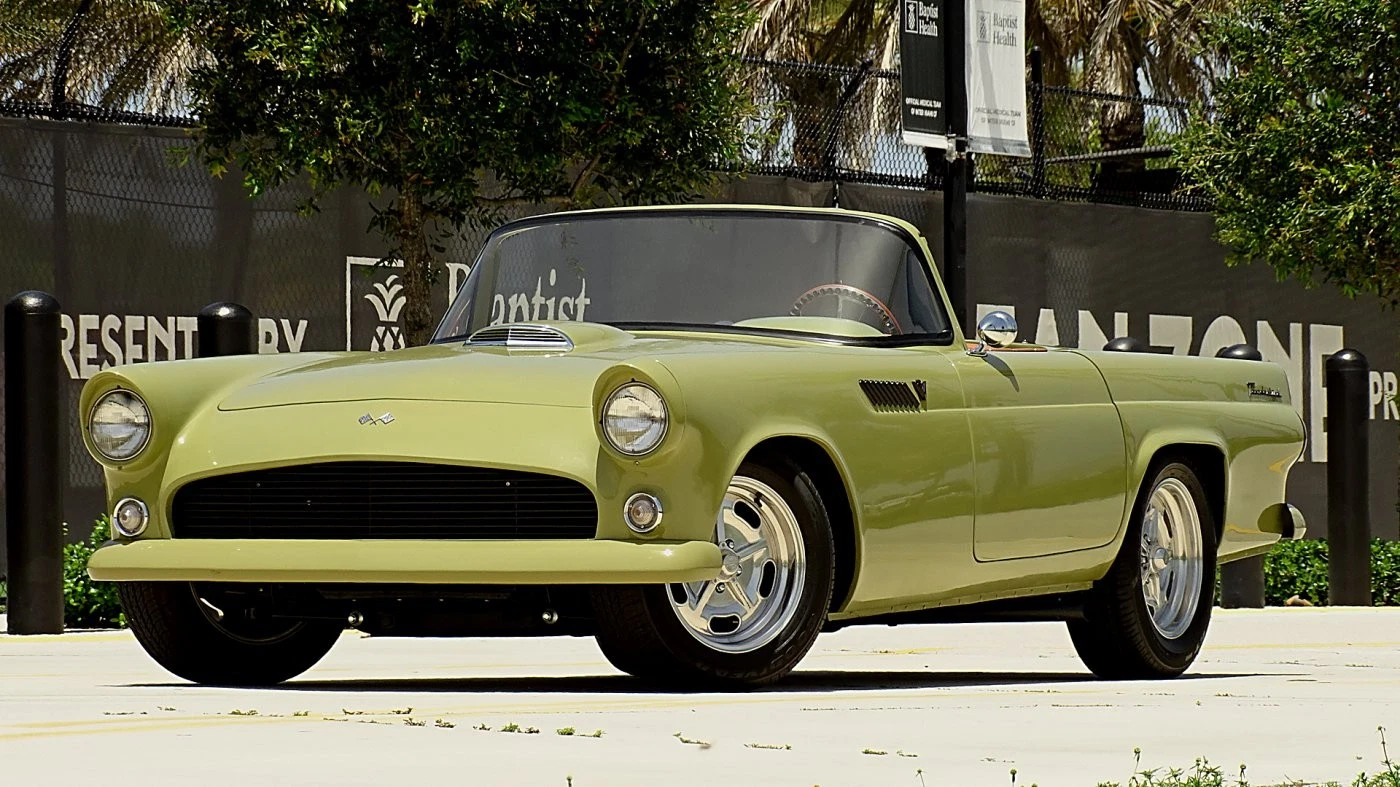
A Fort Lauderdale dealer has listed a 1981 Shay reproduction of a 1955 Ford Thunderbird on eBay Motors at $24,500, under a headline that experienced buyers have learned to read carefully: $60,000 invested. The car is finished in green, shows 1,250 miles, and carries a 302-cubic-inch Ford V8 and a three-speed automatic beneath a fiberglass body that is, from twenty feet, a convincing early Thunderbird.

It is also one of roughly 200 ever built, which makes it dramatically rarer than the car it imitates. And it is worth a fraction of that car. That contradiction is the most instructive thing on the listing, and it has nothing to do with the asking price.
The VIN Tells You What You Are Actually Buying
The eBay listing lists the year as 1955 and, three lines down, the model year as 1981. Both are technically disclosed. Only one of them is the car.
The VIN reads 1HWTC31A7BE009108. Seventeen characters, with a “B” in the tenth position — the model year code for 1981. That is not a quirk of this particular car. The 1981 model year was the first in which the National Highway Traffic Safety Administration required every passenger vehicle sold in the United States to carry a standardized 17-character VIN. Shay’s Thunderbird reproduction arrived at precisely the moment American vehicle identity became federally codified, which is why this replica has a legitimate, decodable, manufacturer-issued VIN rather than a state-assigned tag or a kit-car serial. The title is clean and it is a 1981 title. Registration, insurance, tax treatment, and every future sale follow the 1981, not the 1955.
This is more than pedantry. It is the entire pricing mechanism. If you want the longer version of how identity documents drive value, our guide to reading a collector car’s documentation covers what a VIN can and cannot establish.

Shay Motors Was Strange, and It Was Also Completely Real
Harry J. Shay founded the Model A & Model T Motor Car Reproduction Corporation in Wixom, Michigan in the spring of 1978, renaming it Shay Motors Corporation in November 1980. According to the Shay Model A Club’s company history, Ford waived its design patents to make the venture possible — and then did something no other replica manufacturer has managed before or since. Shay’s cars were retailed through franchised Ford, Lincoln and Mercury dealerships, displayed in new-car showrooms as traffic bait. Some dealers reported 200 to 600 visitors in a single day.
Roughly 5,000 Model A roadster reproductions were built under a federal safety exemption capped at 10,000 units. Thunderbird production began in late 1980 and reached about 200 cars before the company collapsed. Shay filed for Chapter 11 reorganization on March 29, 1982 against some $9.5 million in debt; the assets were liquidated that July and bought by Camelot Motors in April 1983 for $2.4 million, which continued limited production into 1986.
Read that again, because it is the part the market keeps overlooking. This is not a kit assembled in a garage from a catalog. It is a titled, factory-built automobile from a licensed manufacturer that operated for four years, sold through the franchised network of the company whose car it copied, with a Manufacturer’s Statement of Origin and a selling dealer on the paperwork. That is more institutional history than most replicas will ever accumulate.

And the Market Still Says Twelve Thousand Dollars
CLASSIC.COM tracks 51 public Shay sales across all body styles. The average is $12,110, in a range running from $7,150 to $19,800. That upper figure is not a Thunderbird — it is a 1930 Model A roadster pickup — and it represents the highest price any Shay of any description has publicly brought. This car is asking roughly a quarter more than the ceiling of the entire marque.
Now compare the original. Ford built 16,155 Thunderbirds for 1955, at a base price of $2,695, with a 292-cubic-inch Y-block making 193 or 198 horsepower depending on transmission. There are currently 424 genuine 1955 Thunderbirds advertised for sale in the United States, starting around $16,499, and CLASSIC.COM’s benchmark for first-generation cars sits near $39,088. We have covered the real thing when good examples surface, including a 1955 convertible at Mecum Indy and a no-reserve 1956 at Henderson.
So the replica is roughly eighty times scarcer than the car it copies, and the car it copies is roughly three times the money. Supply is not the binding constraint on either one.
Rarity is a multiplier, not a value. Applied to genuine demand it produces extraordinary numbers. Applied to none, it produces nothing. Collectors do not pay for how few were made — they pay for how many people want one, and rarity only decides how hard they have to fight for it.
What $60,000 Bought, and Why It Does Not Come Back
The mechanical package is sensible: a 302 Ford V8, a three-speed automatic, rear-wheel drive, air conditioning, and 1,250 indicated miles. Nothing exotic, nothing fragile, and parts availability is essentially infinite. As a driving proposition it is arguably more usable than a correct 292/Ford-O-Matic car, and considerably cheaper to maintain.
Two details matter for anyone weighing the Shay as a collectible rather than a cruiser. The car wears modern polished five-spoke wheels and contemporary radials in place of the period-style rims Shay supplied, and the cabin has been retrimmed in red. Both are tastefully done. Both also move the car further from the only version of a Shay with a credible long-term case: an unmodified, documented example presented exactly as the factory delivered it in 1981. On a genuine collector car, a sympathetic modification can add. On a replica, it subtracts the single argument the car has.

But build spending does not return, even on cars the market genuinely loves. We made that case recently about a flawless 810-horsepower RTR Mustang that will not bring what it cost to build. On a car the market has never loved, the shortfall is not a shortfall — it is the entire premise. Every dollar of improvement on a replica is measured against a ceiling set by the badge you did not get.
The lesson is not that restomods are bad investments. Restomods perform extremely well when the car underneath is one collectors already want, which is why a modernized 1957 Thunderbird or a reengineered Jensen Interceptor can command real money. The variable is never build quality. It is the identity underneath the build.
There Is a Case for the Shay. It Is Not the One Being Made.
The listing sells the 1955. The interesting asset is the 1981.
If the Shay Thunderbird ever becomes collectible — and there is a plausible path — it will not be because it resembles a Thunderbird. It will be because it is a surviving artifact of a bankrupt Michigan manufacturer that persuaded Ford to let its franchised dealers retail reproductions out of new-car showrooms, built roughly 200 of them, and died in eighteen months. That is a story with documents, dealer paperwork, corporate filings, a production ledger, and a finite survivor population. It is researchable, verifiable, and genuinely unusual.
That is the same logic now rewarding small-series American coachbuilding, as we saw with the second coachbuilt Corvette to leave its builder’s shop, and the logic that lets a licensed continuation like a Shelby GT500CR cost more than an original Mustang. The market will pay for verifiable manufacture. It has never paid for imitation.
The Shay’s problem is that it is almost always marketed as the car it copies, which permanently caps it in the replica bracket. Its only escape route is to be sold as what it actually is.

What a Serious Buyer Should Verify
- The original MSO and selling-dealer paperwork. This is the single document set that separates a Shay from a kit car, and the only thing likely to ever support a premium. Ask before you bid, not after.
- Whether 1,250 miles is since new or since a rebuild. The listing notes 27 available vehicle-history records, which is considerable activity for a car claiming 1,250 lifetime miles. There may be a perfectly ordinary explanation. Get it in writing.
- How your state titles it. Replica and reproduction titling varies widely, and a car branded “replica” or “specially constructed” in one state can complicate registration, inspection and resale in another.
- Agreed-value insurance, in writing, before purchase. Replicas are routinely undervalued at claim time by carriers that price them off the body style rather than the build.
- Serial number against Shay production records. The marque club community maintains registries; a documented position within the roughly 200-car run is the most collectible thing about this car.
The Bottom Line
At $24,500 this is, on the recorded evidence, a $14,000 to $18,000 car wearing a $60,000 receipt. That is not a criticism of the car, which appears nicely finished and barely used, nor of the seller, who has disclosed the 1981 model year plainly. It is a description of a market that has had forty-five years to think about Shays and has arrived at a stable answer.
Buy it if you want the shape, modern running gear, and cheap parts, and you have made peace with what the title says. Buy it at a number that reflects the marque’s own history rather than Ford’s. And understand that at $16,499 there are genuine 1955 Thunderbirds on the open market, and at this money there are several honest collector cars that will not need explaining.
A replica can borrow a shape. It cannot borrow a history. What makes the Shay worth a second look is the history it earned on its own — and until sellers start pricing that car instead of the one on the badge, the market will keep answering with twelve thousand dollars.
The collector car market, every weekday morning.
Auction results, price moves and what’s crossing the block, read in four minutes. Free, from Modern Car Collector.
No spam, unsubscribe in one click. Or read more about the Brief.


 Kyle Matthews