

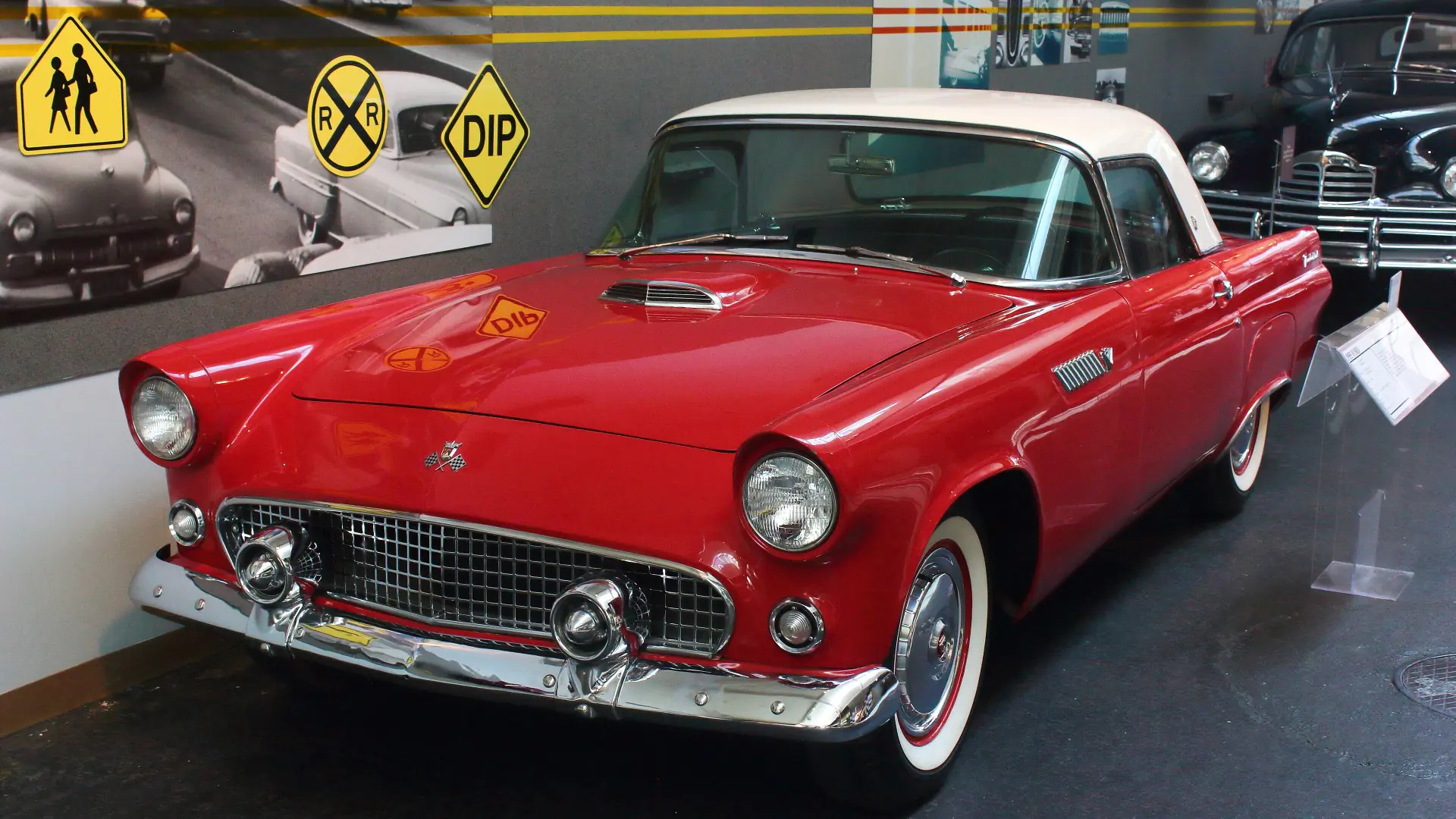
On Oct. 22, 1954, the Ford Thunderbird went on sale as a 1955 model. Ford had shown the two-seater at the Detroit auto show on Feb. 20, 1954, built the first production car on Sept. 9 and announced it to the press on Sept. 23, according to Old Cars Weekly. Its premise was simple and, at the time, unusual: a V-8 two-seater sold as a “personal car” rather than a sports car. Seventy-two years later, the market still prices it that way, as a very good cruiser rather than a trophy.
What Ford put on sale on Oct. 22, 1954
The Thunderbird grew out of the one-off 1953 Ford Vega concept, which drew enough interest to move from show stand to showroom, according to the Hagerty Price Guide’s model history. Old Cars Weekly reports a starting price of $2,695 before federal taxes and delivery charges, and says Ford vice president L.D. Crusoe pushed the project toward luxury rather than competition. The body-on-frame chassis used existing Ford parts, which also shortened development.
Every 1955 car had a 292-cubic-inch Y-block V-8 rated at 193 hp with the three-speed manual or 198 hp with the optional Ford-O-Matic, a 102-inch wheelbase, roll-up windows, and a removable fiberglass top as standard, with a fabric top available as an option. Road tests cited by Old Cars Weekly put 0–60 mph at roughly 8.8 to 11 seconds and top speed near 120 mph. Quick for 1955, but not what Ford was selling.
Why it outsold the Corvette
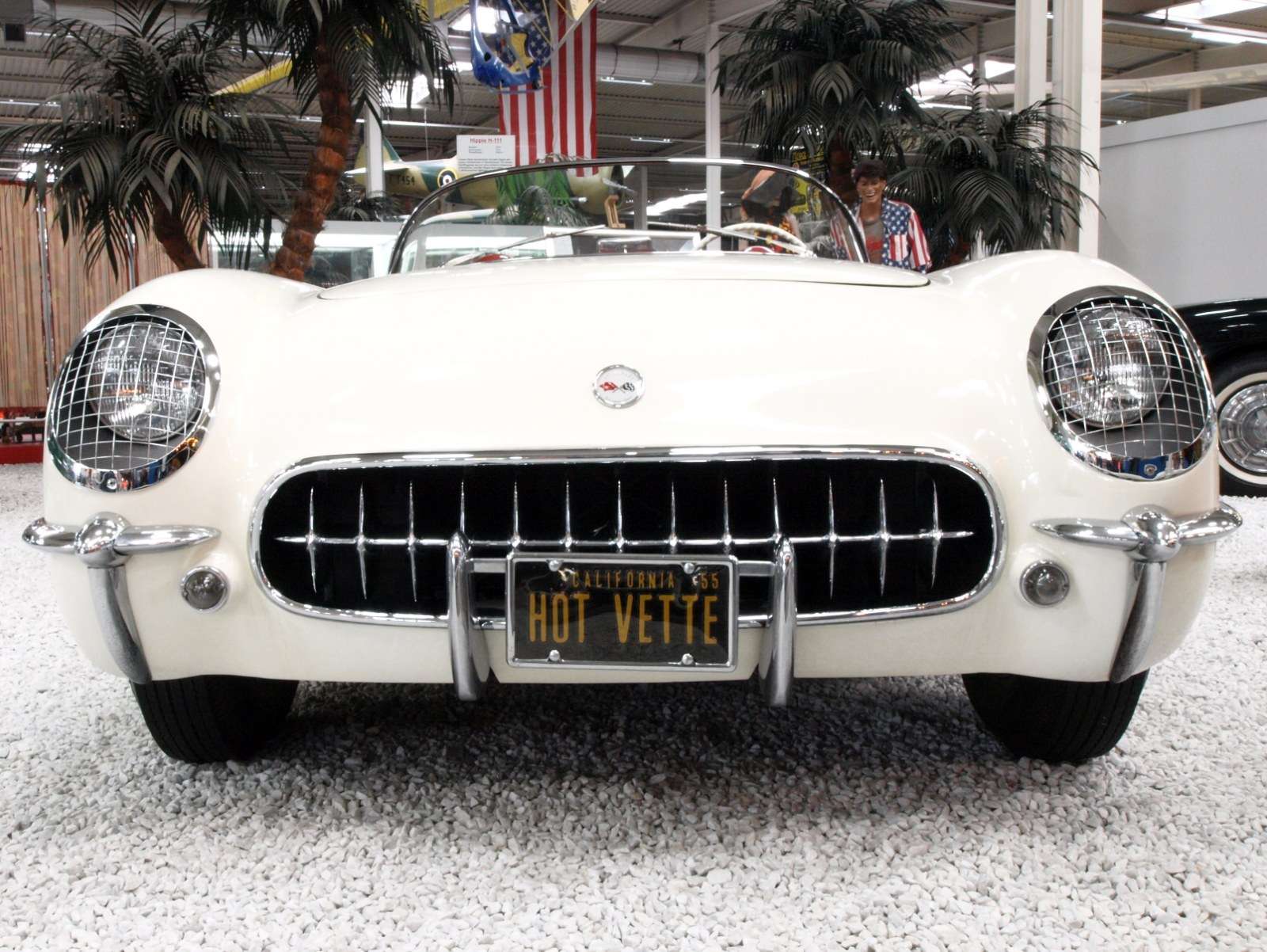
Ford planned to build about 10,000 Thunderbirds for the first model year. More than 3,500 orders came in within days of the on-sale date; Hagerty counts five days and Old Cars Weekly counts ten, so accounts differ on the exact window. The final tally for 1955 was 16,155 cars, per Wikipedia’s production table, against roughly 700 Chevrolet Corvettes.
That gap is the useful part of the story. The two cars shared a 102-inch wheelbase and an almost identical price: $2,695 for the Ford, about $2,700 for the Corvette. What separated them was the pitch. Chevrolet’s Corvette had spent its first two years as a six-cylinder sports car with side curtains, while Ford offered V-8 power and roll-up windows in a car meant to be comfortable first. Buyers took the second idea in large numbers. Ford did not out-engineer Chevrolet; it chose a different customer.
The two-seater lasted only three model years. Wikipedia lists production at 16,155 for 1955, 15,631 for 1956 and 21,380 for 1957, a total of 53,166. The 1957 car was the last of the original run, and the Thunderbird became a four-seater for 1958.
What the market is paying in 2026
Hagerty’s Price Guide for October 2026 values a 1955 Thunderbird convertible with the 292/198 hp engine at $22,400 in #3 (Good) condition. The guide shows a quarterly change of −5.1%, an annual change of −2.2% and a three-year change of −21.7%. Across 1955–1957 Thunderbirds, Hagerty tracked 202 sales in the last 12 months totaling $8.1 million, an average of $40.1k, with the number of cars sold up 9%.
Recent results show the spread. A 1955 convertible with an automatic and 89,900 miles sold for $30,228 on Hagerty Marketplace on Oct. 12, and a manual-transmission car with 48,000 miles brought $29,190 on Bring a Trailer on Oct. 9. Over the past three years Hagerty records 1,184 public-auction sales of 1955 Thunderbirds, from $4,480 at the bottom to $660,000 at the top; the guide does not say what drove the high end, so treat it as an outlier rather than a benchmark.
The reading is straightforward but should not be pushed too far. These are guide values and tracked sales, not a forecast. What the data does support is that a car built in tens of thousands trades on condition, originality and documentation, not scarcity. For context, our look at a Shay Thunderbird replica found the market for the copy sitting below the genuine car, and later Thunderbirds keep surfacing at auction, including a 1956 convertible offered at no reserve at Henderson and a restored 1963 car headed to Mecum Indy 2026.
What collectors should verify
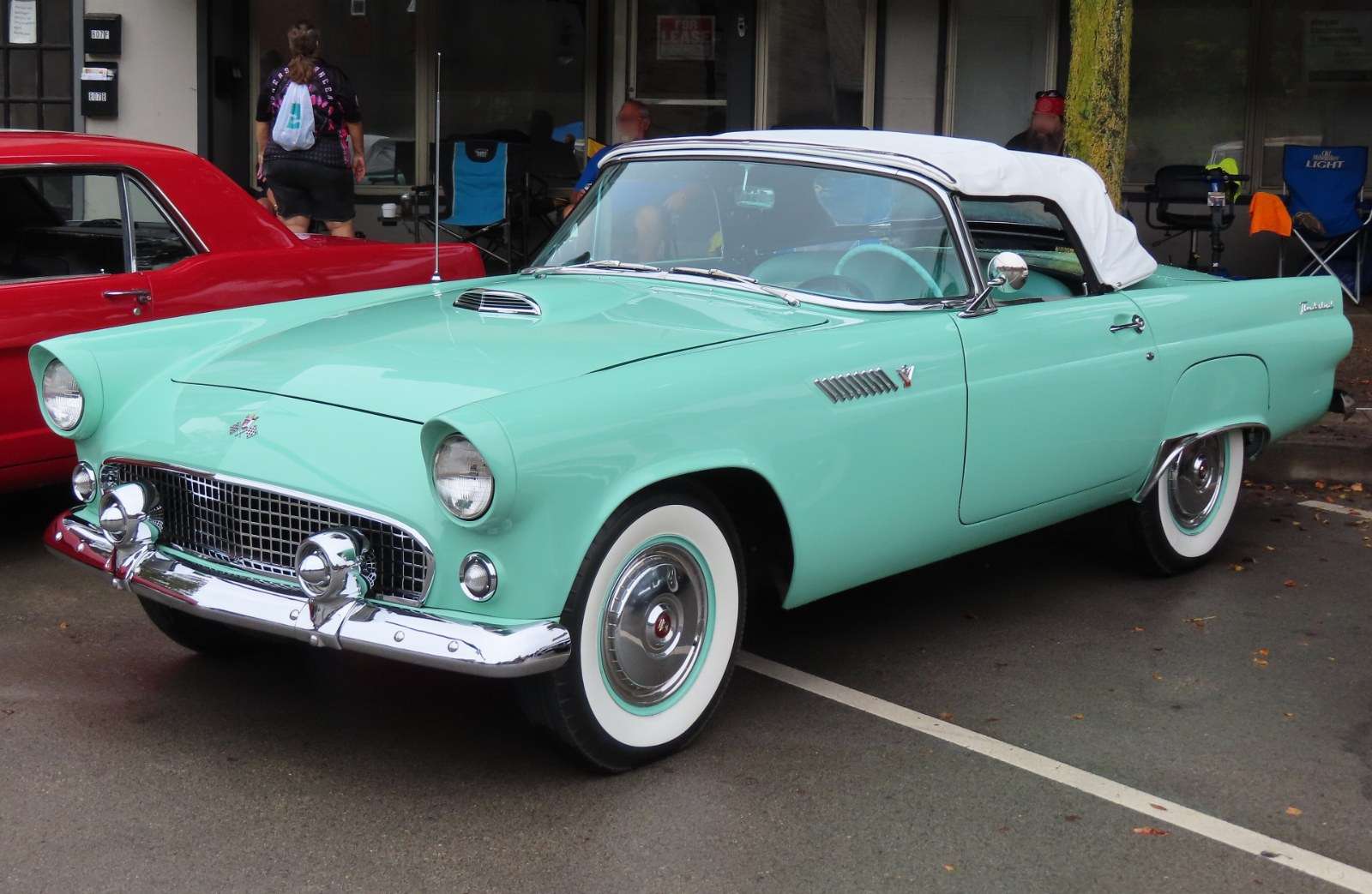
Start with the tops. The fiberglass hardtop was standard and the fabric top an option, so confirm which tops come with the car and that the hardtop is original to it. Next, match the powertrain to the paperwork: 193 hp belongs with the three-speed manual and 198 hp with Ford-O-Matic, and Hagerty’s guide lists power brakes, power steering and power windows as optional equipment, so document which options the car actually carries. Odometer readings on cars this age rarely tell the whole story, and a specialist inspection from someone who knows the marque is worth more than a seller’s description. Finally, confirm that the car is a factory Ford and not one of the replicas built to resemble it.
Why it matters
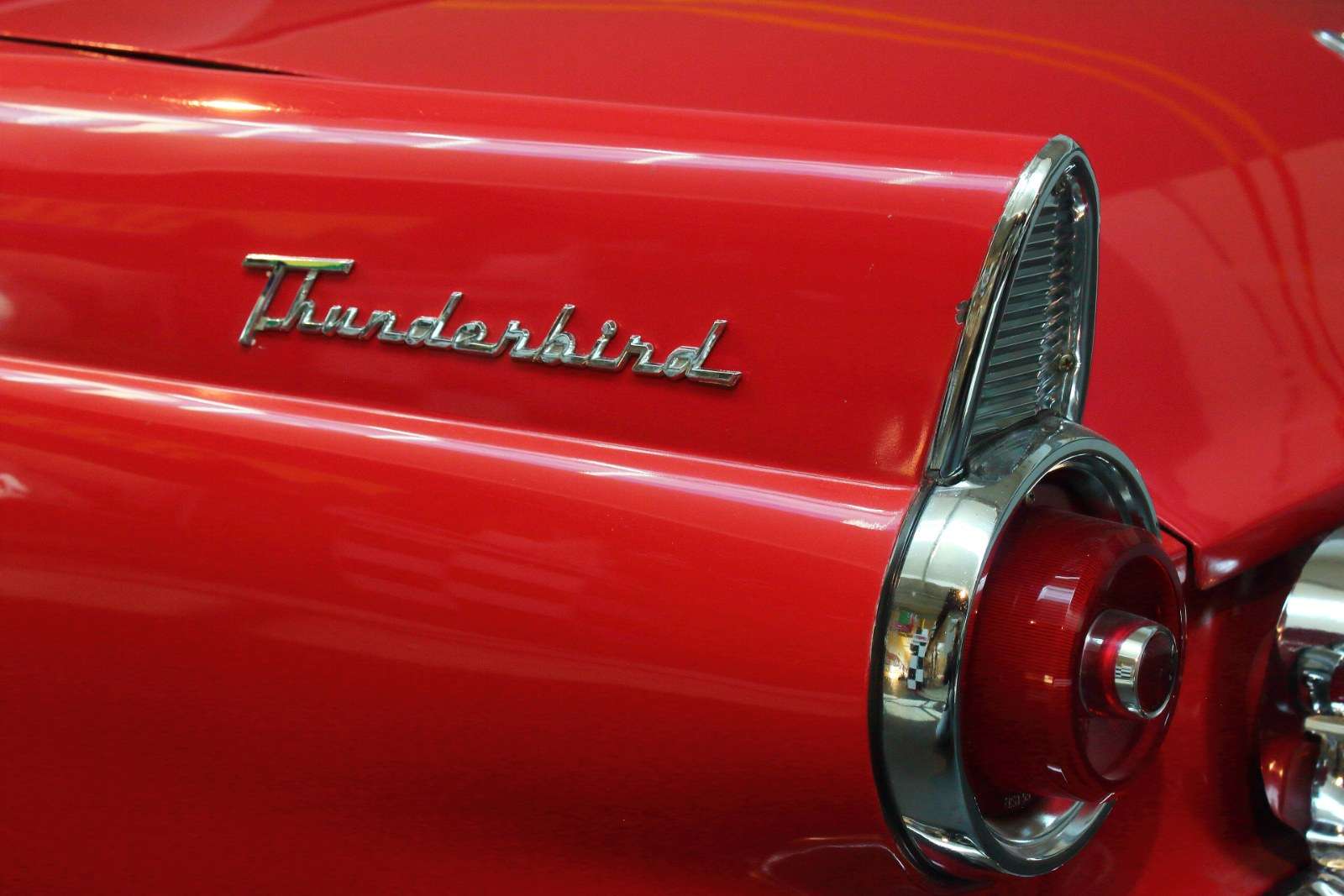
The Thunderbird mattered because it changed what Detroit thought a two-seater was for. Ford took the proportions Chevrolet used for the Corvette and sold the car on comfort, V-8 power and personality, and Old Cars Weekly credits it with helping create the personal-luxury segment. Detroit answering a rival’s idea with a new category is also the story of the 1958 El Camino, and the Corvette’s own early history continues in this 1956 Corvette barn find.
For collectors, the lesson is to separate historical weight from market scarcity. A car that sold 16,155 units in its first year, against Ford’s plan for 10,000, is a landmark, but it is not rare, and the October 2026 numbers price it as a car to enjoy. That is not a criticism. It is the reason a documented, correctly equipped first-year Thunderbird remains one of the more accessible ways to own a piece of 1950s Detroit history.
The collector car market, every weekday morning.
Auction results, price moves and what’s crossing the block, read in four minutes. Free, from Modern Car Collector.
No spam, unsubscribe in one click. Or read more about the Brief.
 EL Puckett
 Shawn Henry