

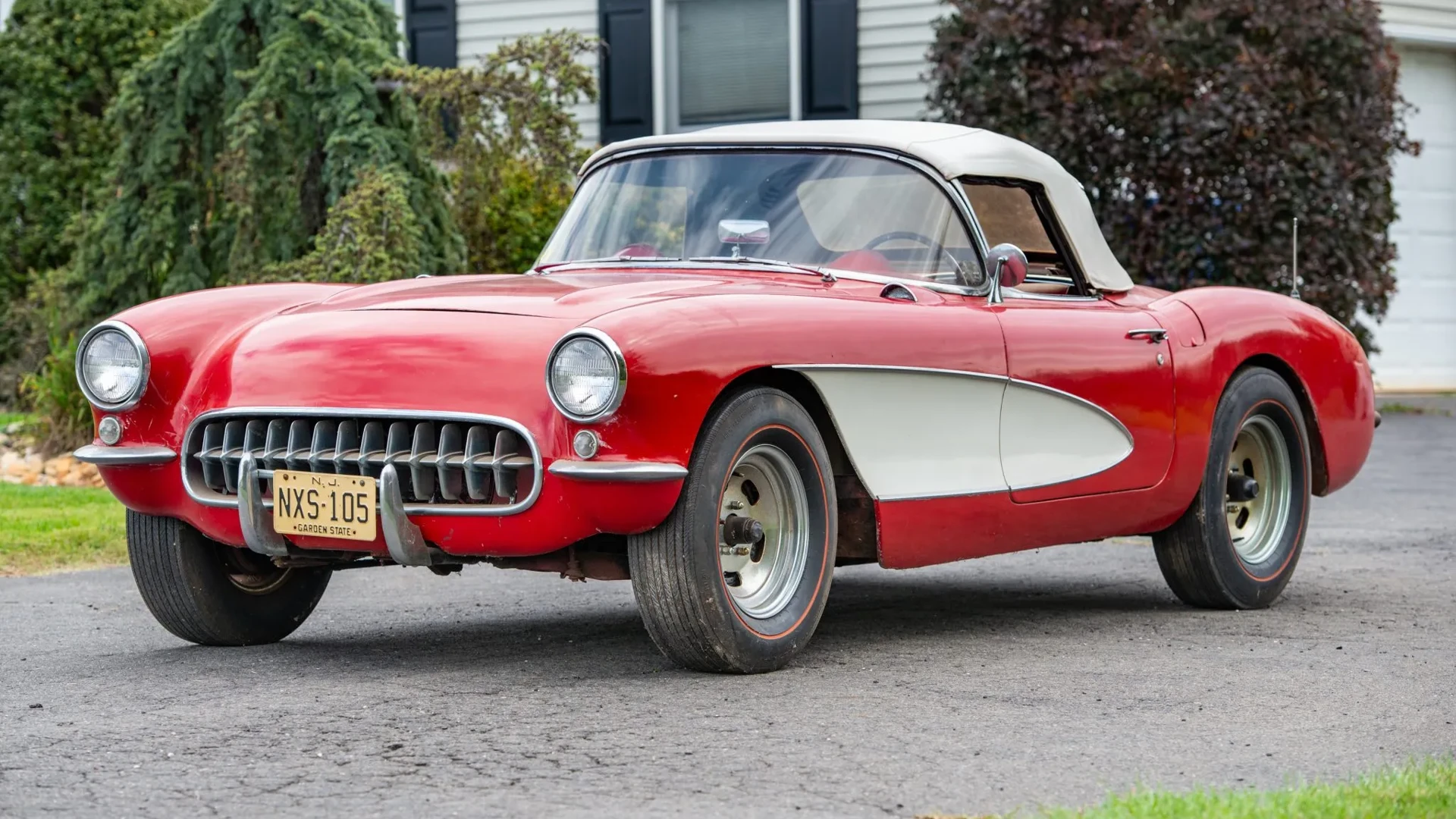
Every barn-find Corvette gets sold on the same premise: time stopped. In the case of the red 1956 Corvette now finishing its run on Bring a Trailer out of Columbus, New Jersey, that is true. But the clock did not stop in 1956. It stopped somewhere around 1970, after the car had already lived a full first life as somebody’s hot rod.
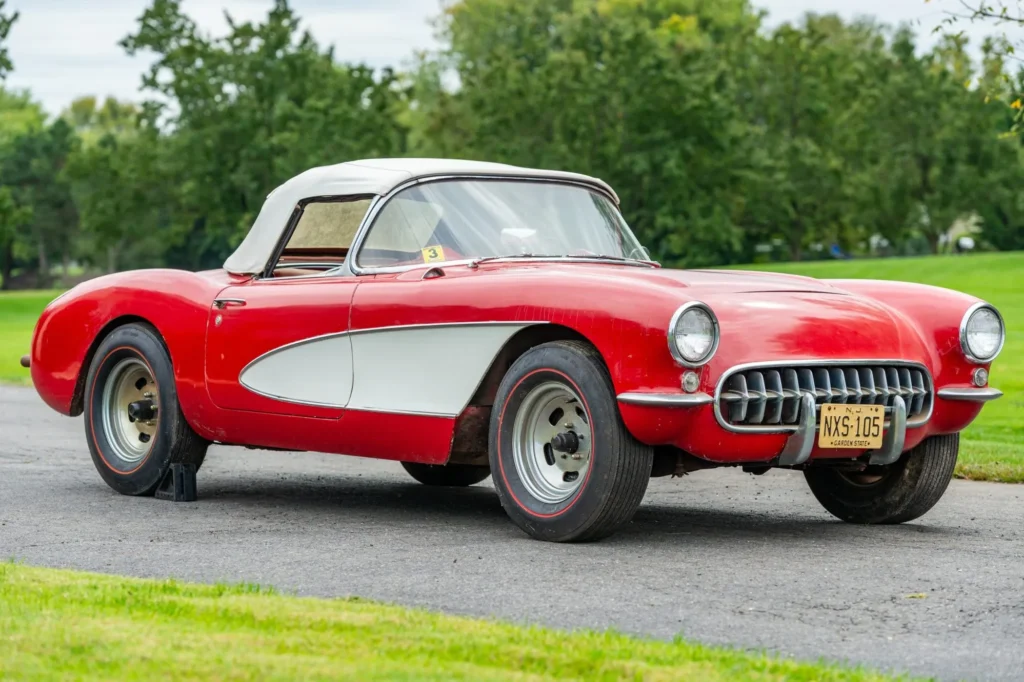
That distinction is the whole story. The seller’s father bought chassis E56S001387 in 1968, drove it into the 1970s, and then put it away under a tarp in a garage, where it sat for more than fifty years. What the garage preserved was not a factory Corvette. It preserved a 1960s Corvette, red paint, small-block swap, Holley carburetor, finned aluminum valve covers, redline tires and all. The question for whoever wins it is not how to bring it back. It is which decade to bring it back to.
What the Garage Actually Preserved
Read the listing as a collector would, and the inventory is precise. The car was repainted red in the mid-1960s; the seller believes it left the factory in Arctic Blue, one of the six lacquer colors offered for 1956. The engine bay holds a 327ci V8 installed during the 1960s, which dates the swap to no earlier than 1962, when the 327 arrived in the Corvette. The engine stamp pad is blank. A separate 265ci block, the displacement this car would have carried from St. Louis, comes with the sale, along with a crankshaft and a set of unused .030-over pistons. Its stamp pad is blank too.
The rest reads like a well-kept time capsule rather than a restoration candidate in distress. Red vinyl bucket seats, matching carpets and door panels, the twin-cowl dash with its 140-mph speedometer and center-stack tachometer, a signal-seeking AM radio, a heater, a clock. A white soft top. Slotted 15-inch wheels on redline tires the seller dates to the 1960s. The odometer shows 52,000 miles. With a fresh battery the engine turned over and the lights worked. It does not run, the rear window is clouded, the taillight bulbs are missing, and there is rust on the underside components. The title is clean.
Fifty years in a garage preserves condition. It does not preserve originality. That was settled long before the door closed.
Why the 1956 Corvette Is the One That Matters
It helps to remember what a 1956 Corvette represents. The 1953 to 1955 cars were roadsters with side curtains, and most of them were sold with a six-cylinder engine and a two-speed automatic. They were handsome and they were slow, and by 1955 the Corvette’s survival inside General Motors was a genuine open question.
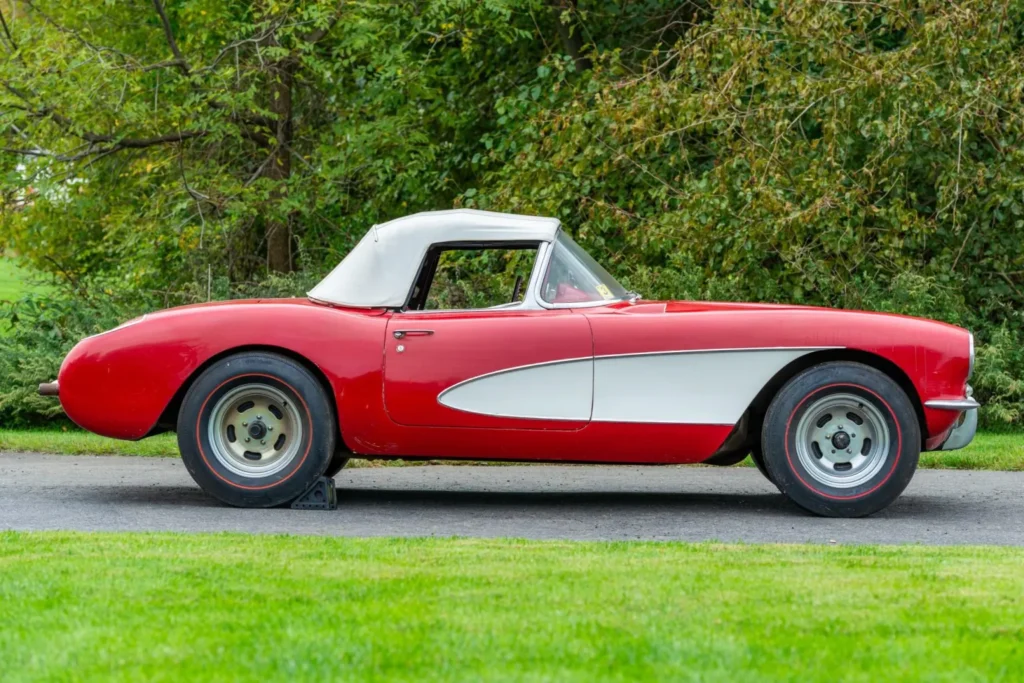
The 1956 model answered it. The body was redesigned with the sculpted side coves that would define the C1, exterior door handles, and roll-up glass windows, which made it a true convertible. The 265ci small-block V8 became the foundation, a three-speed manual was standard, and options included a power-operated top, power windows, and a removable hardtop. Production totaled 3,467 cars. Zora Arkus-Duntov’s flying-mile runs at Daytona Beach that year gave the car the performance credibility it had been missing. Put plainly, 1956 is the year the Corvette stopped being a styling exercise and became a sports car.
That history explains why this particular car got the treatment it did. By the mid-1960s, a ten-year-old Corvette was a used car with a fiberglass body that would not rust and an engine bay that would accept whatever Chevrolet was building now. Dropping a 327 into a ’56 was not vandalism. It was the obvious move. The car is a document of how these Corvettes were actually used during the years when nobody considered them collectible.
The Blank Stamp Pad Problem
Here is the detail serious buyers should dwell on. In the C1 market, correctness is a hierarchy, and the engine sits near the top of it. A Corvette that retains its original engine, verified by date and suffix codes on the stamp pad and supported by casting dates that fall correctly before the car’s build, occupies a different tier than one that does not. We have written before about how a stamp pad can say more about a car’s identity than its VIN, and how a replacement engine reshapes the value of even a blue-chip Corvette.
On this car, neither block can make that argument. The 327 is plainly a period swap. The 265 is described as the removed engine, but a blank pad carries no codes that tie it to this chassis, and blank pads are commonly associated with service replacement blocks or with pads that have been machined. It may be the engine that came out of this car in the 1960s. It may not be the engine the car left St. Louis with. Unless a buyer can establish otherwise through casting dates and physical evidence, the honest working assumption is that factory-original drivetrain is not available here at any price.
That changes the arithmetic of restoration. A buyer who spends to return the car to Arctic Blue with a correct 265 ends up with a well-restored, non-original-engine 1956 Corvette, a perfectly good car, but one whose value is capped by the very thing money cannot fix. For reference, RM Sotheby’s sold a 1956 Corvette carrying a 1994 restoration for $69,500 in Fort Lauderdale in 2015. A full concours-grade C1 restoration can consume a large share of that figure on its own. When the numbers are gone, the provenance is what is left to sell.
Provenance Is the Asset
And the provenance here is better than the headline suggests. This is a single-family car since 1968, which means 58 years of continuous custody, with the seller answering questions directly on the listing on behalf of the original buyer. According to the seller, there were no accidents during the family’s ownership and no visible signs of prior damage, the fiberglass is uncracked though the paint has checked in places, and the interior was likely redone before 1968, since the original color was not red. That is a coherent, checkable narrative, and it is rarer than it should be in a segment where most cars have passed through many hands and several restorations.
It also means the car’s modifications are datable. Most modified C1s have layered histories that are impossible to untangle. This one appears to have been changed once, in a specific decade, and then left alone. That is what makes it interesting to a certain kind of collector, the same instinct that has driven interest in original-paint Corvettes and unrestored survivors generally. It will never qualify as a factory survivor. It may qualify as something more unusual: an untouched period-modified car.
Three Paths, and the One Least Taken
The next owner has three realistic options.
- Restore to factory specification. Strip to bare fiberglass, confirm the original color through physical evidence under the red, rebuild a correct 265 with the included parts, and pursue judging. The result is attractive, but the car becomes one of many restored 1956 Corvettes, with the drivetrain question permanently attached.
- Restomod. Modern chassis, brakes, and drivetrain under a C1 body. Commercially popular, but it erases the very history that makes this example distinct. As we noted when a 1963 Impala traded its show-car life for a pro-street build, every build direction forecloses others.
- Recommission and preserve. Make it safe, fuel system, brake hydraulics, tires, and cooling, and leave the red paint, the 327, the Holley, and the period wheels exactly as the 1960s left them. Keep the 265 parts with the car as documentation.
The third path is the least common and, for this car, the most defensible. Restoration capital is best spent where originality can be recovered. Here it largely cannot, so the more valuable act is to protect what is genuinely irreplaceable: an unbroken record of how a 1956 Corvette looked and drove in the hands of an ordinary New Jersey owner in the late 1960s. Several commenters on the listing arrived at the same conclusion instinctively. Get it running, get it stopping, and drive it.
What the Bidding Says
As of this writing, with roughly four hours remaining before the scheduled 4:07 p.m. Eastern close on October 20, bidding stood at $21,000 after twelve bids, with more than 5,100 views and 655 watchers. The watcher count is the more revealing number. Interest is broad; commitment is cautious. That is a rational response to a non-running car with an unverifiable drivetrain and known underside rust, and it tells us the market is pricing this as a project, not as a barn-find lottery ticket.
That discipline is healthy. The barn-find premium has been inflated in recent years, as we discussed in our look at what today’s listings are really saying, and a buyer paying for dust and narrative rather than substance usually regrets it. Here, the bidding appears to be pricing the car for what it is.
What Serious Buyers Should Verify
- The frame. Fiberglass hides a steel chassis. The listing notes underside rust; the frame rails and body mounts determine the real budget more than anything visible from above.
- The original color. The Arctic Blue claim is the seller’s belief, not a documented fact. Physical evidence beneath trim, in the door jambs, and behind panels should settle it before any repaint decision.
- The 265 block. Casting number and casting date will indicate whether it is plausibly a 1956 Corvette block. A blank pad will not prove it belonged to this car, but a correct casting date keeps the story credible.
- Factory options. A commenter spotted what may be a motor in the trunk area and asked whether the car has a power top, which was a 1956 option. If confirmed, it is a meaningful detail that should be preserved and documented.
- Recommissioning, not restarting. After half a century, the engine should not be fired until the fuel system, oiling, and cooling have been addressed. The fact that it turned over on the starter is encouraging, not conclusive.
- Family documentation. Photographs, receipts, or registration records from the 1960s and 1970s would materially strengthen the period-modified narrative. The 1968 purchase is the anchor; anything that fills in the years around it adds value.
The Modern Car Collector View
Take away the final price and this car still teaches something. A barn find is not a single category. Some are sealed factory originals. Others, like this one, are sealed snapshots of a later era, and their value lies in what that era did to them. Collectors tend to treat the second kind as a lesser version of the first and reach for the restoration catalog. Often that is the mistake.
This 1956 Corvette is not important because it sat for fifty years. It is important because it sat for fifty years immediately after being used the way people actually used Corvettes, and because one family kept it the entire time. Its next owner can make it one more correct-looking C1, or keep it as one of very few honest records of the decade when these cars were just fast, cheap, and fun. The first option is easy to buy elsewhere. The second is not.
The collector car market, every weekday morning.
Auction results, price moves and what’s crossing the block, read in four minutes. Free, from Modern Car Collector.
No spam, unsubscribe in one click. Or read more about the Brief.



 Kyle Matthews
 John Lloyd