

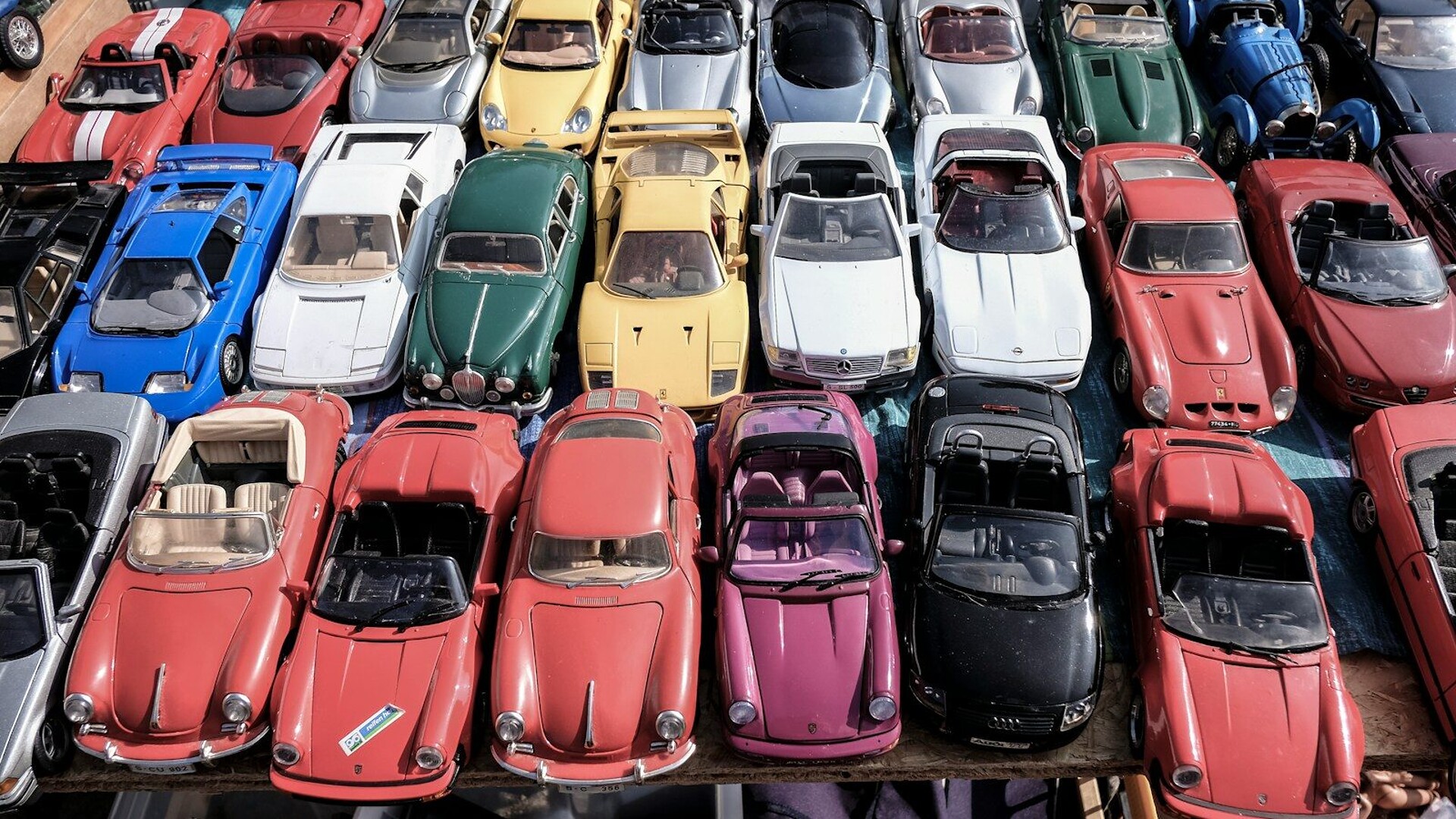
Four unrelated items crossed the wire in the last day: a consignment announcement for an $8.5 million Ferrari, a completed English auction, an unused 26-year-old Corvette, and an $8,600 craigslist curiosity. Read separately, they look like noise. Read together, they say the same thing — buyers are paying real premiums for documentation and originality, and treating everything else, including a car’s own paint and its seller’s rarity claims, as a starting point for negotiation rather than a fact.
A Ferrari Enzo With a Repaint and a Replacement Engine Still Carries an $8.5 Million Estimate
Broad Arrow Auctions confirmed this week that a 2003 Ferrari Enzo, chassis 131631, will headline its second annual Las Vegas sale at Wynn Las Vegas on October 31, with a pre-sale estimate of $6.5 million to $8.5 million. The car shows fewer than 18,000 miles and carries Ferrari Classiche certification, and on paper it reads like a straightforward blue-chip supercar consignment.
The file underneath is more complicated. The Enzo was delivered new in Rosso Corsa, was later repainted Nero by an owner, and was returned to its original red by Carrozzeria Zanasi in Maranello. Its original engine was swapped under Ferrari warranty early in the car’s life for a known valvetrain issue, and a Nevada owner’s moderate accident damage was repaired by Ferrari of Las Vegas in 2006. None of that is disqualifying — Classiche certification confirms the car is a genuine Enzo, not that every component is original to it — but at this price level, the gap between “certified” and “numbers-matching, one-repaint, one-owner” is exactly the kind of thing that determines whether a car sells at the high or low end of its estimate. Collectors watching the Enzo market have seen this tension before with cars like Jenson Button’s Enzo, where ownership pedigree did a lot of the pricing work; this one will have to make its case on paperwork instead. Broad Arrow’s Las Vegas debut in 2025 grossed $13.7 million on an 82 percent sell-through rate, a useful baseline for judging whether the Enzo’s estimate is realistic against the house’s own recent form, and it follows the same team’s find of a rare 1964 Porsche 904 Carrera GTS earlier this year.
A Documented DB6 Vantage Outsold a Field of Recreations and Military Oddities at Ascot
Historics’ “Pace of Autumn” sale at Ascot Racecourse on September 12 hasn’t drawn much attention outside the UK trade press, but its results are worth a look because of how clearly they separate documented cars from everything else. The top lot was a 1967 Aston Martin DB6 Mk. I Vantage, a matching-numbers 4.2-litre example with just four owners from new, which sold for £205,920 — more than double the next result.
That next result was a 2020 Mercedes-Benz G-Wagen associated with content creator Mat Armstrong, at £102,960, followed by a 1959 Jaguar XK150S fixedhead coupé at £77,792 and a 1978 Ferrari 308 GTB at £68,640. Below that, the sale turned into a lesson in what a story is worth without paperwork behind it: a Z3-based “250 SWB tribute” made £32,032, a 1960 Daimler Ferret Scout Car — a Cold War-era military vehicle — brought £27,456, a Mini Cooper S “Group 5 recreation” sold for £25,740, and a genuine, numbers-irrelevant 1973 Jaguar E-Type Series III V12 2+2 closed at just £20,020. That last result is the one worth sitting with: a real E-Type, in a less collectible late-production 2+2 configuration, sold for less than a recreation of a much smaller, lighter car. Spec and originality are doing more pricing work than the badge on the bonnet. For collectors tracking where British GTs are headed, it’s worth comparing against the $1.3 million estimate on a rare 1965 DB5 convertible and the market’s ongoing appetite for documented, race-ready Jaguar XKEs — and against a 308 GTSi from a named estate collection, where provenance is the entire pitch.
A 50-Mile Corvette Time Capsule Shows What “Unused” Is Worth in the C5 Market
A 2000 Chevrolet Corvette coupe currently on Bring a Trailer out of Carthage, Missouri, has covered 50 miles since it left the showroom 26 years ago. Finished in Torch Red — the most popular color on the 2000 model year — with the optional transparent roof panel, LS1 V8, and black leather interior, the car presents as close to as-delivered as a quarter-century-old production car can. Bidding stood at $22,000 as the auction entered its final days, with the listing noting the tires and other rubber components will need attention before the car sees regular use again — a reasonable caveat for any vehicle that has spent most of its life parked rather than driven.
The C5 generation isn’t a blue-chip collector car by any conventional measure, which is exactly what makes this result worth watching: it’s a signal about how far the “unused example” premium now reaches down the price ladder. The same logic that pushed a 40-mile 1992 Dodge Viper RT/10 into time-capsule territory is showing up on a car that a lot of collectors still think of as a used daily driver, and it sits alongside continued strength in the C5’s better-known forebears, from an award-winning 1967 427/390 convertible to a 1963 split-window coupe currently on the market in Utah.
An “Only 25 Came to America” Ford Consul Capri Is a Reminder to Check the Math on Rarity Claims
A 1964 Ford Consul Capri listed on Craigslist near Brooktrails, California, for $8,600 is being sold on the claim that only about 25 examples of the model reached North America in 1964 — out of roughly 1,007 built before Ford discontinued it. It’s a plausible number. It is also, by the reporting site’s own account, entirely unverified: no documentation accompanies the claim, and it rests on the seller’s word.
That distinction matters more than the car itself. Forty years in California storage have been kind to the body — the floors show only surface corrosion, and the trunk pan is described as perfect — while the interior has cracked and split, the windshield needs replacing, and the car does not currently run. None of that is unusual for a barn find at this price point. What is worth flagging is the gap between a rarity claim that sounds right and one that’s been checked, the same distinction that turned up when MCC looked into the buried Ferrari Dino that Los Angeles never forgot: good stories move fast, and it’s worth doing the homework before the number in the headline becomes the number on the title.
Put the four side by side and the price points span nearly three orders of magnitude, from $8,600 to $8.5 million. The market isn’t treating them as separate conversations. Whether it’s a Classiche-certified supercar, a numbers-matching British GT, a garage-kept modern classic, or a barn find with a good story, the buyers showing up right now are paying for what can be proven and negotiating hard on everything else.
The collector car market, every weekday morning.
Auction results, price moves and what’s crossing the block, read in four minutes. Free, from Modern Car Collector.
No spam, unsubscribe in one click. Or read more about the Brief.
Related Posts:
- Record Ferraris, Rare Icons and 15,000 RPM: The Week…

- The Collector Car Market Paid Up for Certainty This…

- A 1969 Corvette L88 Convertible Is at $160,000. The…
- Collector Car Market Brief: Sampras's BMW Z8, Two…

- Five Built, Three That Count: How to Read the MCA…

- Collector Car Market Brief: A Belgian Record at…
 Kyle Matthews