


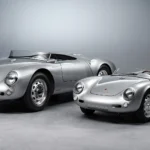
In 1953, a mid-engined Porsche was photographed on a pier in Queens with the Manhattan skyline behind it. On Thursday, October 15, Porsche returned to the same pier to unveil the Mission S, and the choice of location was the message: the company’s first super sports car, the 550 Spyder, and its next one are meant to read as the same idea, seventy-three years apart.
The headline that followed concerned powertrains. Chief executive Michael Leiters, as reported by Automotive News, said there will be no battery-electric version of the platform because “there is no demand, in this segment, for an EV there.” It is a clean sound bite and it will be read as a verdict on electric supercars. We think a different word matters more. Porsche calls the Mission S not a one-off hypercar but a “permanent and versatile addition” to its range, positioned above the 911. For collectors, the powertrain decision is the smaller story. The bigger question is whether a permanent supercar can ever be a scarce one.
What Porsche has actually confirmed
Less than the coverage suggests. The Mission S is a vision model, presented under the company’s “Sportwagenschmiede ’35” strategy. Tobias Sühlmann, Porsche’s Vice President Style, describes it as a fundamental strategic direction that Porsche will “soon” carry into its product portfolio. The release confirms a mid-engine layout and nothing else under the skin: no engine type, no output, no production date, no volume.
What it does confirm is design lineage, and it is specific. Porsche cites the round headlamps and fenders of the 911, the shut lines of the G-model, the flat front and “car-in-car” rear concept of the GT1, the roofline of the 959, radiator-fan cooling in the manner of the 917, and a wheel based on the 928’s dial design. Inside are five round instruments with an analogue needle tachometer, no permanently mounted central display and no passenger screen; a retractable mount handles a phone when the driver wants one. The exterior colors shown are Firn White Metallic, Light Red Metallic and Black Chrome.
Halo cars were moments. A line is a business.
Porsche’s own release invokes the 959 but does not name the Carrera GT or the 918. Collectors will place the Mission S in that lineage anyway, and the comparison is useful precisely because of what it exposes. The 959 was a statement about all-wheel drive and turbocharging. The Carrera GT, 1,270 built, was a carbon-fiber V10 car with a motorsport bloodline. The 918 Spyder, limited to 918 units, was the plug-in hybrid argument. Each marked a moment, and each was capped by design. The Carrera GT’s run in the market this year says collectors are still paying for that kind of moment, not for the nameplate.
A permanent model changes the arithmetic. Porsche has said nothing about how many Mission S cars it intends to build, and that number will decide most of what follows. A line built for years behaves like a business; a numbered run behaves like a collectible. Collectors rarely pay a premium for a name. They pay for the moment a name was at its most daring, and a moment needs edges.
Why “no EV” is a signal, but a narrow one
Leiters was speaking about demand in one segment, and it should not be stretched into a rule. Other makers have drawn similar lines in the same part of the market, as we noted when Pagani joined Lamborghini in walking away from electric supercars. But the picture is not uniform: our reporting on Ferrari’s $40 million electric first shows that at the very top of the market, one-off buyers behave differently from the customers a production supercar is built for.
The more durable inference is about expectations. A combustion-only flagship tells existing Porsche collectors the brand intends to keep building the kind of car they already value, which tends to make a current generation easier to understand and a future one easier to place. That is a statement about confidence, not a forecast about values, and we would not treat it as one.
The details that may age well
The interior deserves more attention than it has received. A fixed screen dates a car quickly; an analogue tachometer, physical gauges and a phone that docks only when needed do not. We made a related point in our look at which Porsches get to grow old. Vision models routinely lose their best ideas on the way to production, so this is a thing to watch, not a promise.
What serious buyers should watch
There is nothing to buy yet, and no allocation to chase. What matters is how Porsche answers four questions. First, volume: whether the production car is capped or open-ended. Second, whether early cars are numbered or specially specified, a path Porsche has used before, as in the Sonderwunsch 918 coupe story. Third, the powertrain and transmission, which Porsche has not announced; our report on the 2027 911 GT3 shows how closely buyers track engine character. Fourth, whether the production interior keeps the vision model’s restraint.
The pier in Queens gives the Mission S a pedigree. The powertrain statement gives it a position. What it still lacks is a number, and in the collector market the number is usually the story.
The collector car market, every weekday morning.
Auction results, price moves and what’s crossing the block, read in four minutes. Free, from Modern Car Collector.
No spam, unsubscribe in one click. Or read more about the Brief.


 Kyle Matthews