

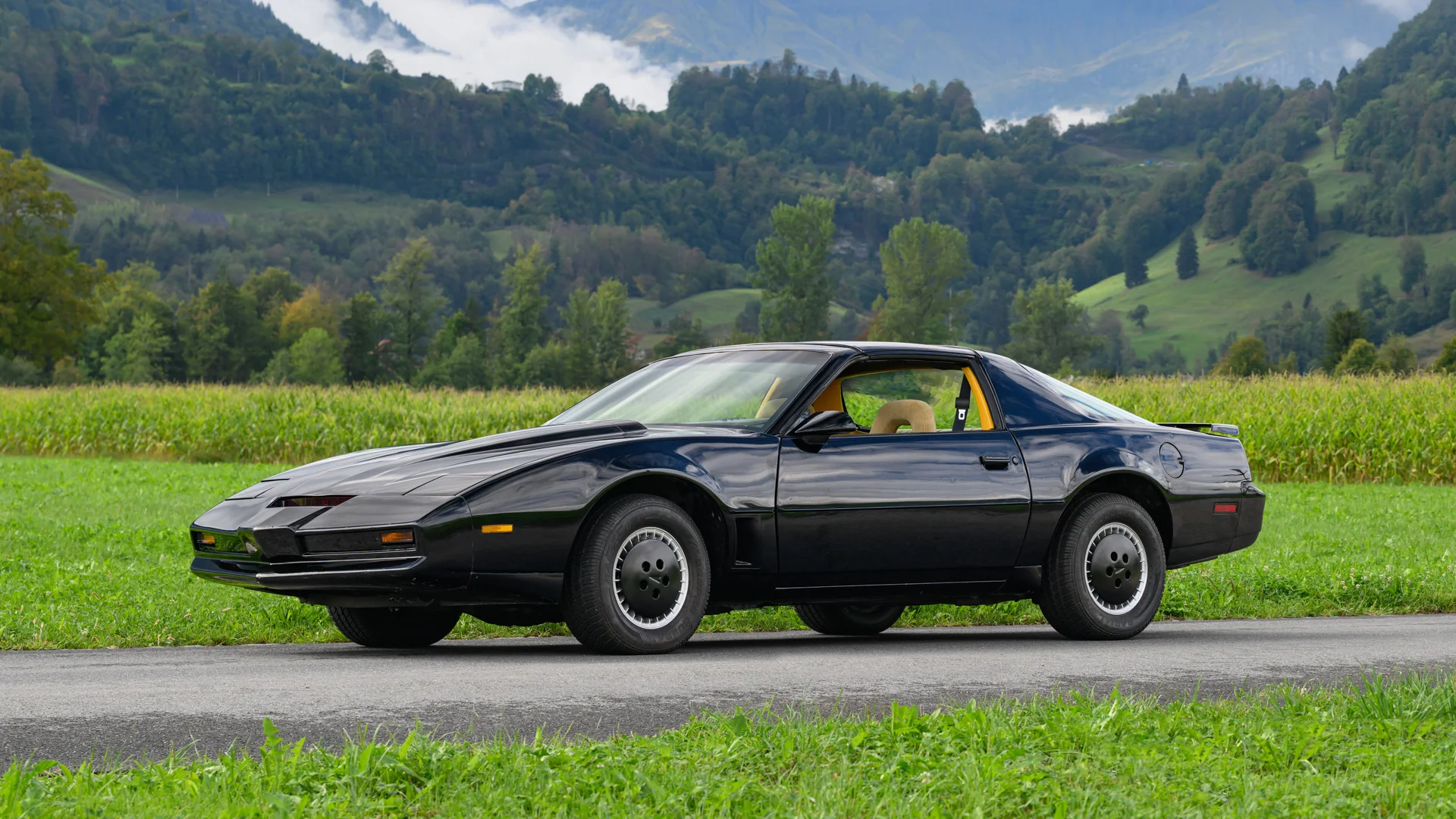
Most celebrity cars are sold on a single question: is it real? The Trans Am heading to Zürich this November asks a more useful one. Real what?
Broad Arrow Auctions will offer a 1982 Pontiac Firebird Trans Am as a K.I.T.T. tour car at its second Zürich sale on Saturday, November 7, at The Dolder Grand, staged alongside Auto Zürich. The estimate is CHF 250,000 to CHF 500,000. That is a spread of a quarter of a million francs on a single lot, and it is the most honest thing about the listing. It tells you the market has not yet decided what this car is.
Three kinds of K.I.T.T., and only one of them is a camera car
Collectors tend to flatten Knight Rider cars into one category. They are not one category. There are cars that appeared on screen, cars built by the studio to promote the show, and cars built afterward by owners and fans. Each carries a different kind of authority, and each trades on a different kind of paperwork.
Broad Arrow’s description places this car in the middle tier, and it is precise about it. According to the auction house, the Trans Am was originally owned by Profile Promotions, David Hasselhoff’s company, and served as his tour car. It was built to the specification of the television star car, and it arrives with what Broad Arrow calls an extensive archive of documents and photographs. The house describes it as an exact replica of the car used in the series. Nothing in the release claims it appeared on camera, and buyers should read the lot essay the same way: this is a car whose provenance is Hasselhoff, not Universal’s soundstage.
That distinction matters more than it first appears. A tour car exists to be seen. It was built so that an audience standing ten feet away could believe, for a moment, that the television set had parked in front of them. Its cultural function was the same as the screen car’s. Its documentary function was not.
Why the estimate is so wide
The reason is that there is no deep, clean comparable set. The few public reference points are an imperfect guide. Julien’s Auctions offered one of six studio promotional K.I.T.T. cars with a published estimate of $100,000 to $200,000, a car that reportedly toured with Hasselhoff in Austria in 1987 and retained about half of its original custom dashboard and electronics. A separate 1982 Trans Am sold by Hasselhoff himself through LiveAuctioneers in early 2021 carried a $175,000 to $300,000 estimate and drew leading bids reported above $450,000 before the close. Those are different cars with different documentation, sold into different moments, and a careful buyer should treat neither as a price list. What they do show is that the buyer pool for this subject is real, international and willing to overshoot estimates when the story is clean.
It is also why Zürich is an interesting room for it. Broad Arrow’s sale leans toward modern and late-twentieth-century material, including the Heidfeld-owned BMW 3.0 CSL and a Monteverdi 375/4 whose restoration file we argued would set its price. Both are cars where documentation, not the badge, defines the number. The Trans Am belongs to the same argument from the opposite direction. The badge is the most famous in the sale. The paper is the open question.
What serious buyers should ask before the gavel
The release does not publish the contents of the archive, and until the full catalog entry is available, the useful work is knowing which questions the archive has to answer.
Chain of custody. Does the paper trail run unbroken from Profile Promotions to the consignor, and does it include contemporaneous evidence of the tour use, such as event photographs, itineraries and invoices, rather than later recollection? Photographs of the car beside Hasselhoff at a dated event are worth far more than a signature added decades afterward.
The car beneath the costume. This is a 1982 Trans Am with television bodywork and electronics layered over it. How much of the original dashboard, scanner nose and interior theatrics survives, and how much has been renewed? As with the Pontiac documentation questions we have explored, the factory identity of the donor car should be established independently of the story told about it.
Condition versus function. The 1980s props that made these cars famous were never engineered for longevity. Buyers should establish what works, what is period and what is a restorer’s reconstruction, and decide whether they are buying a drivable Pontiac or a static display piece.
Where the car sits legally. A US-built car crossing a Swiss block raises practical questions about current registration, import status, VAT and onward export. Those costs fall on the buyer and can move the real number meaningfully. Confirm them against the conditions of sale before bidding.
What it says about celebrity provenance
We made a related point recently about a celebrity-owned Ford GT: the name on the title is rarely the premium. The premium is the evidence attached to it. Pop-culture cars are the cleanest test of that principle, because their appeal is emotional and their value is almost entirely documentary. The audience that watched a talking black Trans Am on Friday nights is now of an age to buy one, and cars that tie directly to the show, such as the Trans Am we have covered at auction before, sit in a segment where the Smokey and the Bandit and K.I.T.T. associations are part of the appeal.
The risk is that nostalgia is a thinner foundation than it feels. A buyer who pays for the character rather than the file is exposed if the next generation of collectors does not share the memory. A buyer who pays for the file, and who knows exactly which rung of the K.I.T.T. ladder this car occupies, owns something defensible whatever the cultural weather.
Which brings us to the observation worth carrying out of the room. Fame sets the audience. Paperwork sets the price. On November 7, we will learn how many bidders are willing to tell those two things apart.
Estimates and sale details are drawn from Broad Arrow Auctions’ published materials for The Zürich Auction 2026. Lot number and full archive details were not published at the time of writing. Lead image source.
The collector car market, every weekday morning.
Auction results, price moves and what’s crossing the block, read in four minutes. Free, from Modern Car Collector.
No spam, unsubscribe in one click. Or read more about the Brief.
Related Posts:
- Depreciation and Market Comparison of the Pontiac…
- Collector Car Market Brief: A One-of-Three Veyron…
- Collector Car Market Brief: A Belgian Record at…
- Collector Car Market Brief: A $56,000 190SL Project…
- Collector Market Brief: Ruf's Project Dragon and Two…
- Ferrari Monza SP2 Value Nearly Doubled in Three…
 Eve Nowell
 EL Puckett