
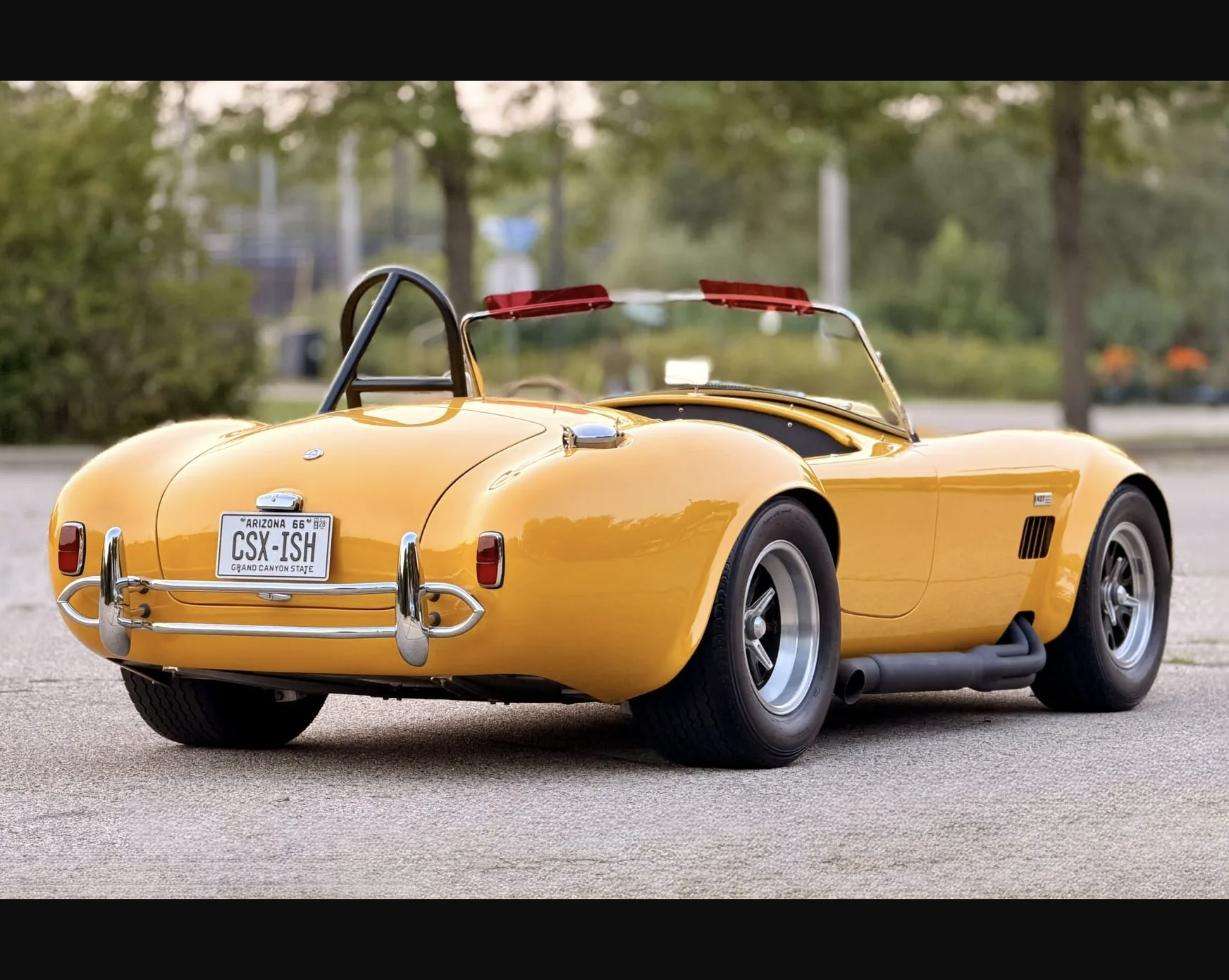
The name on a listing rarely changes what a car is worth. But when the seller of a Kirkham Motorsports 427 S/C is Colin Comer — the historian and author whose books on Shelby Cobras are the references collectors and authenticators reach for when a genuine CSX3000-series car comes to market — his decision to commission a tribute car rather than simply buy an original one is itself worth paying attention to. This Pearl Yellow roadster, chassis KMP344, is currently listed on Bring a Trailer with bidding at $120,000 and several days left on the clock, and the bid total is close to the least interesting thing about it.
Genuine 427 S/C Cobras are rare in a specific, well-documented way, not the vague way the word gets used to sell things. Shelby American built only a fraction of the planned run before Ford redirected Carroll Shelby’s attention to the GT40 program, and surviving originals now trade in seven figures. Modern Car Collector recently covered a 2009 completion built from one of the last unfinished factory chassis, offered at $890,000 with 4.4 miles on the odometer, and an ultra-rare 1966 car with its original drivetrain and body drew serious attention at Mecum Indy. Comer has spent much of his career helping buyers tell those cars apart from everything that merely resembles one, which makes his own choice to build rather than buy notable: even the most rigorous Cobra historian still wanted a 427 S/C badly enough to have one made new.
The car was completed by Bruce Robles, a former 1960s Cobra racer who later worked as a race engineer, including stints with the Commander Motor Homes Can-Am team and in F5000 alongside David Hobbs, per the listing. That background shows in the mechanical specification, which reads less like a catalog parts list and more like a period-correct race build. The FE-series V8 is a Bear Block Motors high-nickel side-oiler block, stroked to 482 cubic inches by Valley Head Service of Northridge, California, and assembled with Carrillo pistons, a SCAT crankshaft, Eagle H-beam connecting rods, and a COMP Cams Xtreme Energy hydraulic roller camshaft, among other race-grade components detailed in the listing.
The “side-oiler” designation is not a marketing term. Ford’s original top-oiler 427 starved its main bearings under sustained cornering load, exactly the condition Shelby’s cars faced at Sebring and Daytona; the redesigned block, with oil galleries rerouted to feed the mains first, is what made the 427 Cobra durable enough to race for hours instead of minutes, and it became the standard architecture for the street-legal S/C models that followed. A modern 482-cubic-inch interpretation of that same block, built with forged internals, is not a cosmetic gesture — it is a more thoroughly engineered version of the idea Shelby’s own engineers were chasing in period.

The bodywork carries its own piece of history. According to the listing, the Pearl Yellow paint is an homage to the Allen Grant/George Lucas “Executor”, the black-and-yellow #96 Cobra whose livery Grant — a Shelby American factory driver — designed with his friend, a young George Lucas, years before Lucas became known for anything else. Grant won at Santa Barbara and Candlestick Park in the Executor, then joined Shelby’s factory Daytona Coupe program in 1965, where a win at Monza alongside Bob Bondurant helped clinch Shelby American’s FIA GT manufacturers’ title that July. Choosing that specific color story, instead of a generic Shelby blue-and-white, is the kind of detail that signals real fluency in Cobra history rather than a build sheet assembled by catalog.

Kirkham Motorsports’ own reputation does some of the remaining work. The Provo, Utah, company has its aluminum bodies hand-formed in Poland by metalworkers with a background in MiG fighter-jet fuselage fabrication, and the finished cars are widely regarded within the Cobra community as the most dimensionally accurate reproduction on the market. A base Kirkham roadster alone lists near $150,000 with roughly a year’s lead time before delivery. Set against that baseline, a fully sorted example with a serious stroker engine, an established provenance, and a clean title, currently bid to $120,000 on Bring a Trailer, starts to look less like a discount curiosity and more like an efficient way into the segment — without the wait, and with a build story no factory order sheet could specify.

None of this makes KMP344 a substitute for a numbers-matching CSX3000 car, and it should not be bought or sold as one. It is titled in Arizona as a 1965 CBII Special Construction vehicle, a status that allows it to register as a specially constructed car exempt from the state’s emissions program under Arizona statute — a reminder that buyers considering any turnkey Cobra replica should understand how their own state handles kit and replica titling before they bid, not after. The same authenticity questions come up across the recreation market more broadly, from Porsche’s own factory-sanctioned 906 re-creation program to the flood of lower-effort kit cars that trade for a tenth of Kirkham money. The standard collectors should apply is consistent regardless of marque: a recreation’s value rests on documentation, craftsmanship, and who stands behind it, not on how convincingly it could pass for the real thing.

That is ultimately the case this listing makes. Collectors do not pay a premium for a shape that merely resembles a Cobra; plenty of those exist for a fraction of the money. They pay for the distance between a kit and a genuine build, and for the rare case when the person who built or vouched for the car has spent a career learning to tell the two apart. Comer putting his own name on this listing, rather than someone else’s, is the signature that actually matters here.
The collector car market, every weekday morning.
Auction results, price moves and what’s crossing the block, read in four minutes. Free, from Modern Car Collector.
No spam, unsubscribe in one click. Or read more about the Brief.
 Kyle Matthews
  Eve Nowell