

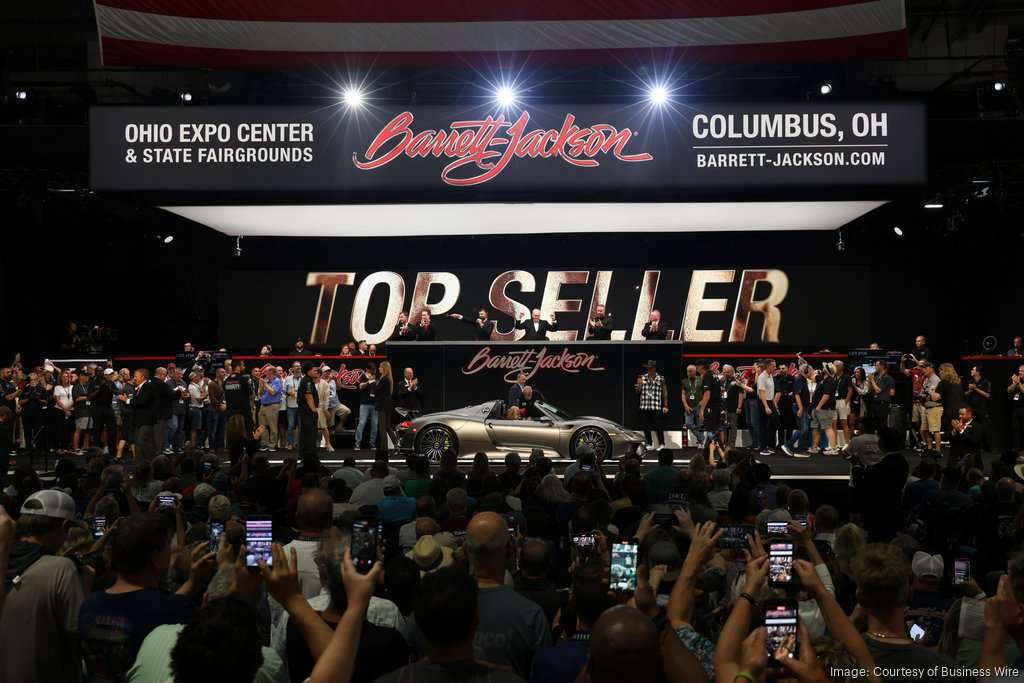
Barrett-Jackson rolled into the Ohio Expo Center & State Fairgrounds for its first-ever Columbus sale on June 25-27, 2026, and walked out with total auction sales of $38.1 million, according to the company. The headline figure breaks down into roughly $37 million in cars, about $1.1 million across 255 pieces of automobilia, and $240,000 raised through two charity lots. The detail that should grab any consignor’s attention, though, isn’t the gross. It’s the sell-through: per Barrett-Jackson, all 550 vehicles on the docket found buyers. A 100% sell-through rate is the auction equivalent of a sold-out show, and it tells you the room was full of people who came to buy, not browse.
The top seller was a 2015 Porsche 918 Spyder (Lot #736) at $2,695,000. That price is worth sitting with for a second. The 918 was Porsche’s plug-in hybrid hypercar, built in a run of 918 units, pairing a 4.6-liter V8 with two electric motors for a combined output north of 880 horsepower. When it was new just over a decade ago, it carried a sticker around $845,000 before options. The fact that a clean example now trades at more than triple its original MSRP is the clearest signal in this whole result: the ‘holy trinity’ hybrids (the 918, McLaren P1, and Ferrari LaFerrari) have graduated from used hypercars into blue-chip collectibles. Buyers are treating them like the analog supercar legends of the 1990s, not like depreciating exotics.
The result with the most history behind it, though, was an original 1969 Ford Mustang Boss 429 (Lot #743) that brought $1,045,000, which Barrett-Jackson called a new world auction record for the model. The Boss 429 exists because of a NASCAR homologation rule: Ford needed to sell a minimum number of street cars carrying its 429-cubic-inch semi-hemi V8 to make the engine legal for its Torino race cars. Roughly 1,350 were built across 1969 and 1970, each hand-assembled by Kar Kraft, with the engine bay physically widened to fit the massive motor. Originality is everything with these. A documented, numbers-matching example is a different animal from a restomod or a tribute, and a seven-figure hammer reflects exactly that premium on provenance.
Ford, in fact, owned this auction. Five of the top ten lots wore a Blue Oval, including a 2021 Ford GT ’66 Heritage Edition at $1,100,000, a 2022 Ford GT at $913,000, and a 2021 Ford GT Studio Collection at $863,500. The modern Ford GT is a useful case study in how a car can be collectible from birth: Ford hand-picked buyers through an application process and attached a multi-year resale restriction to early cars, which throttled supply and kept values firm in a way few new performance cars manage. Add three licensed ‘Eleanor’ Mustangs from the Gone in 60 Seconds lineage in the top ten, and the Columbus docket reads like a love letter to American performance with a few European exclamation points.
There’s a practical layer underneath the spectacle that new bidders routinely overlook: the buyer’s premium. Barrett-Jackson noted that figures like the $1,100,000 Ford GT include buyer’s fees, meaning the hammer price and the price you actually pay are two different numbers. Premiums in this corner of the market commonly run around 10%, so a $1,000,000 hammer can become roughly $1,100,000 out the door before tax and transport. The insurance and ownership math matters too. A car that just set a public auction record effectively resets its own agreed-value baseline, which means the buyer should expect their collector-car insurer to want fresh documentation, and the next comparable sale will be measured against this number whether the seller likes it or not.
The two charity lots were the feel-good footnote with real dollars behind them. A 2022 Ford Bronco built in collaboration with Cincinnati Bengals quarterback Joe Burrow brought $90,000 for the Joe Burrow Foundation, and a custom 2025 Chevrolet Silverado 1500 Z71 designed by defense-tech firm Anduril Industries sold for $150,000 benefiting the Call of Duty Endowment, which helps place veterans in jobs. Barrett-Jackson said the two lots pushed its all-time charity tally past $172 million. Celebrity-and-cause cars like these tend to trade on story rather than spec, so values are notoriously hard to predict and shouldn’t be read as comps for a standard Bronco or Silverado.
The reader takeaway: a 100% sell-through in a brand-new market is a strong signal, but it cuts both ways. For sellers, momentum in the room is real and a fresh region means fresh buyers. For buyers, a fully sold docket is also a sign of an aggressive room where it’s easy to overpay, so set a walk-away number before the gavel and remember the premium sits on top of it. Either way, the move that protects you is the same one that always has: verify the documentation, the numbers-matching status, and the ownership history yourself rather than trusting the energy of the tent. Barrett-Jackson says Las Vegas is next, September 10-12, so there will be another data point soon enough.
The collector car market, every weekday morning.
Auction results, price moves and what’s crossing the block, read in four minutes. Free, from Modern Car Collector.
No spam, unsubscribe in one click. Or read more about the Brief.
Related Posts:
- On a Boss 429 Mustang, the KK Number Is the…
- Record Ferraris, Rare Icons and 15,000 RPM: The Week…

- The Hybrid Hypercar Has Arrived — and a Porsche 918…

- The Collector Car Market Paid Up for Certainty This…

- Two Boss 429s, Two Very Different Stories: A White…
- Weekly Roundup: Everything Modern Car Collector…

 Kyle Matthews