

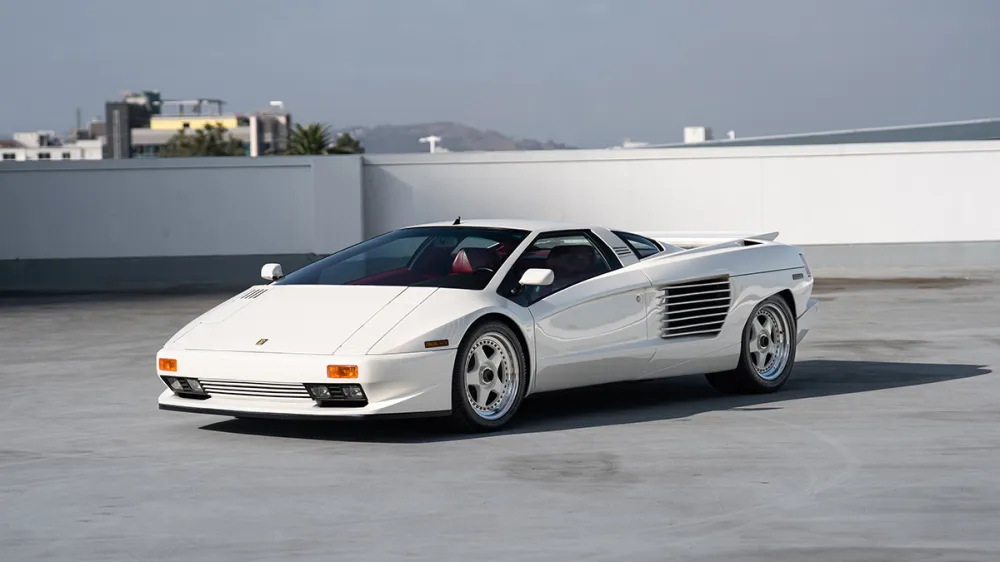
When RM Sotheby’s brings the original 1988 Cizeta-Moroder V16T prototype across the block during Monterey Car Week this August, the number attached to the lot will be $1.4 million to $1.8 million. That number is not the real story. The real story is chassis 001 itself, the only Cizeta ever built that actually belonged to the man whose name is stamped across its flanks: the record producer and composer Giorgio Moroder.
The V16T began as a shared grievance. Moroder and Claudio Zampolli, a former Lamborghini engineer and test driver who had opened an exotic car workshop in Los Angeles, met in the early 1980s convinced that Italy’s supercar establishment had gone soft. Their response was a car built entirely outside the factory system: financed by a Hollywood-adjacent fortune, engineered by a man who had spent years underneath Lamborghini chassis, and unconstrained by any board of directors.
The body came from Marcello Gandini, and that lineage matters more than most casual readers realize. Gandini had originally drawn a sharper, more uncompromising successor to the Countach for Lamborghini itself, only to see Chrysler’s new ownership tame the design into what eventually reached showrooms as the production Lamborghini Diablo. Zampolli and Moroder effectively rescued Gandini’s rejected vision and built it, uncompromised, around their own running gear. Placed next to the Countach it was meant to follow, the V16T reads less like an imitation and more like the car Lamborghini’s own studio never got permission to finish.
Under the skin, the V16T’s real party trick wasn’t the double-stacked headlights. It was the engine mounted transversely behind the cabin: a 6.0-liter, sixteen-cylinder unit built by mating two V8 blocks around a shared crankshaft, rated at 540 horsepower and mated to a five-speed manual transaxle. No other small, independent constructor of the era attempted anything close to it. Bugatti would later reach a similar conclusion with the Veyron’s W16, but Zampolli got there first, with a fraction of the budget and none of the corporate safety net.
That ambition came at a cost. The V16T debuted at the 1988 Los Angeles Auto Show, yet didn’t reach production until 1991, by which point the Moroder-Zampolli partnership had already come apart over financing. Roughly ten examples were ultimately completed before the company folded, making it one of the smallest production runs of any purpose-built V16 road car in history. For collectors, that kind of orphan status cuts both ways: exclusivity is guaranteed, but so is total reliance on a small circle of independent specialists for parts and expertise, since there is no factory heritage department left to call.
With only ten cars in existence, rarity was never going to be in question. What actually separates chassis 001 from the other nine is documentation. It remained in Giorgio Moroder’s personal collection until 2022, the only V16T that can claim an unbroken, provable line back to the man who financed and named the entire project. In a marque with no corporate archive to authenticate a build sheet, that kind of continuous, single-owner history performs the same function an archive would for a Ferrari or Porsche buyer, and it is worth considerably more than simply being the first car off the line.
Condition backs up the paperwork. The car underwent a comprehensive restoration by Canepa Design in 2018, a shop with a long-standing reputation among specialists for exotic and competition machinery, followed by a further detailing pass from Rex Nguyen in 2024. The double-stacked headlights and other theatrical details are said to remain fully functional rather than decorative afterthoughts, which matters more to serious buyers than any styling flourish, because it speaks to mechanical completeness rather than cosmetic restoration alone.
The lot also arrives bundled with a one-of-one NFT containing an EP of music composed by Moroder, a digital three-dimensional scan of the car, and rendered artwork from a digital artist. It’s a curious artifact of how auction houses have experimented with courting a different, more digitally fluent kind of bidder, but it shouldn’t be mistaken for the investment case. In twenty years, what will still matter to collectors is the engineering and the ownership record; the broader NFT market has already taught the industry hard lessons about how quickly that kind of digital ephemera can lose relevance.
That restraint shows up elsewhere in this year’s Monterey lineup, too. A Lola T70 originally modified for Dan Gurney is crossing the block at Bonhams’ inaugural Laguna Seca sale on the strength of a documented chassis modification rather than reputation alone, while RM Sotheby’s own Monterey sale includes a Ferrari Formula 1 chassis tied to Michael Schumacher’s championship season, valued for its raced history rather than its spectacle. The V16T fits the same pattern. The low end of its new estimate is only about $36,500 above what chassis 001 brought in 2022, a modest, disciplined gain that says more about a market maturing after its post-pandemic runup than about any sudden rediscovery of 1980s Italian exotica.
For anyone seriously considering a bid, the diligence checklist for chassis 001 looks nothing like the one used for a numbers-matching Ferrari. There’s no matching-numbers convention to apply to a car built essentially as a one-off within a ten-car run. What matters instead is the paper trail connecting the car directly to Moroder, confirmation that the V16 and transaxle fitted today are the units built into the car at completion, and independent verification that Canepa’s restoration preserved the original mechanical character rather than simply refreshing it cosmetically. Collectors rarely pay a premium for an engine layout alone, no matter how audacious. They pay for an unbroken line back to the person who made the car matter in the first place, and on that measure, chassis 001 is not just the first Cizeta ever built. It is the only one that will ever be able to prove it was Giorgio Moroder’s.
Image via Karissa Hosek/RM Sotheby’s
The collector car market, every weekday morning.
Auction results, price moves and what’s crossing the block, read in four minutes. Free, from Modern Car Collector.
No spam, unsubscribe in one click. Or read more about the Brief.
Related Posts:
- Weekly Roundup: Everything Modern Car Collector…

- BMW Is Bringing Two Concepts to Monterey Car Week.…

- Record Ferraris, Rare Icons and 15,000 RPM: The Week…

- Everything Modern Car Collector Covered Last Week
- Ferrari F50 Value Nearly Tripled in Two Years.…
- Ferrari Daytona SP3 Value Jumped 168% in Ten Months.…

 Shawn Henry
  Kyle Matthews
  Eve Nowell