

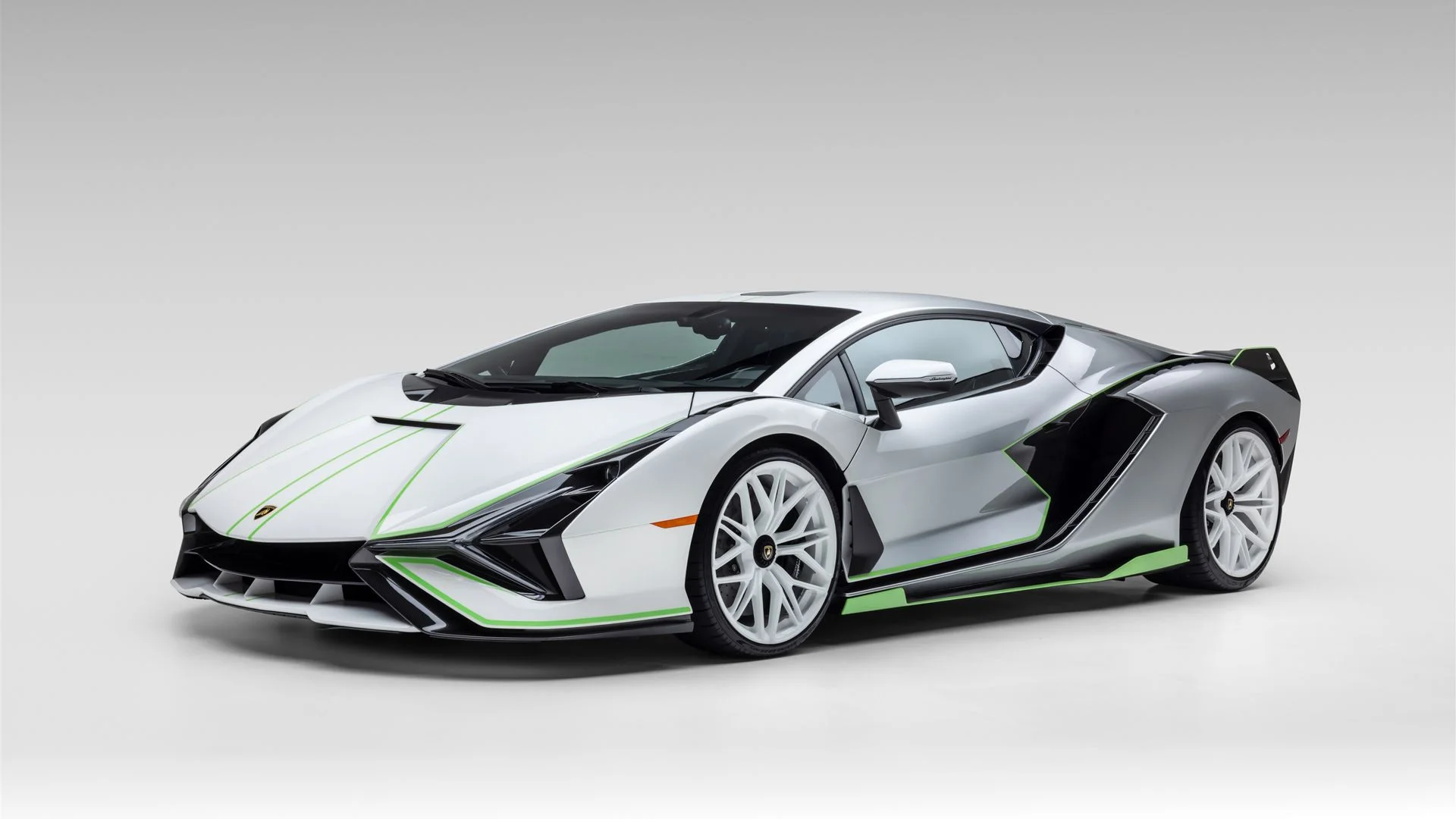
A 2020 Lamborghini Sián FKP 37 with 284 miles on the odometer, one owner since new, a clean CARFAX report and its original window sticker will cross the block at Broad Arrow’s Quail Auction on August 14. On paper, it is about as close to a time-capsule example as this model will ever produce for public sale. Its presale estimate is $2.5 million to $3 million.
That is the easy part of the story. The more interesting number is the one nobody puts on a catalog page: Lamborghini sold all 82 examples of the Sián, at $3.6 million to $3.8 million before options, before a single customer car had been built. This particular coupe left the factory carrying more than $260,000 in additional options. Add that up and a car estimated today at $2.5 million to $3 million was, in effect, close to a $4 million transaction the first time around. That gap between what the first owner paid and what the market is now willing to underwrite is more informative than the car’s rarity, and it is where this story actually begins.
A genuine engineering milestone, not just a limited run
The Sián earns its place in Lamborghini’s history independent of any auction result. Unveiled in September 2019 and developed by Centro Stile director Mitja Borkert from his own Terzo Millennio concept, it was the first Lamborghini road car built with any form of electrification. The name itself signaled the break: rather than borrowing from a fighting bull, as nearly every prior flagship had, Lamborghini reached into Bolognese dialect for a word that translates roughly as flash, or lightning. The FKP 37 suffix is a direct homage to engineer Ferdinand Karl Piëch, born in 1937.
Mechanically, the car leans on the Aventador SVJ for its carbon fiber monocoque, four-wheel steering and pushrod-actuated suspension, with the 6.5-liter V12 retuned to 774 horsepower before hybrid assistance. The interesting engineering is in what Lamborghini added: a compact electric motor built into the seven-speed transmission, drawing from a supercapacitor rather than a conventional battery. A supercapacitor stores less energy than a battery of equal weight, but it charges and discharges far faster, which let Lamborghini fully replenish it under braking and use it to fill torque gaps between shifts. Combined output reached 808 horsepower, enough for a 2.8-second run to 60 mph and a 217 mph top speed, and the added hardware weighed only about 75 pounds. We covered the car’s complete specification in our earlier report on this consignment.
The documentation is the real flex
For a car this young, paperwork does work that mileage alone cannot. This Sián was delivered new in March 2021 to a single private owner in Los Angeles and has stayed local ever since. Lamborghini of Newport performed a preemptive sixth-year service in April 2026, with invoices on file for close to $16,000, and the original window sticker still accompanies the car. None of that is glamorous, but it closes off every question a buyer would otherwise have to ask about gap years, gray-market servicing, or an unclear ownership chain. At this price point, a documented history is doing the same job that a matching-numbers block does for a vintage car: it tells the next owner exactly what they are underwriting. It is the same principle we explored in the case of a $40,000 motorcycle with impeccable provenance: the number on the invoice matters less than what the paper trail proves.
The specification adds another layer. Every Sián was configured through Lamborghini’s Ad Personam program, and this one wears a genuinely unrepeatable combination: Bianco Asopo fading into Grigio Liqueo, picked out in Verde Lampros accents that carry through to the Nero Cosmus leather cabin. No two Siáns left the factory alike, which is a point in the car’s favor for the collector who wants a piece that is unambiguously theirs. It is also worth remembering that total individuality cuts both ways. A one-off fade found nowhere else is a feature for exactly one buyer at a time, and narrower appeal at resale is the price of that exclusivity.
Manufactured scarcity is not the same thing as market demand
Here is the distinction serious collectors should hold onto: an oversubscribed order book measures the desire to gain access to a car. An auction estimate, years later, measures whether the open market agrees the car deserves to hold its value. Those are different questions, and the Sián has only recently begun answering the second one.
Every one of the 82 Siáns sold before production started, which proves Lamborghini priced access correctly, not that the broader collector market has independently tested the car’s staying power the way it has, say, a Miura. That model’s value today rests on six decades of trading history and a factory certification program built specifically to separate the genuine article from the merely presentable, a distinction we examined in depth around Lamborghini’s record Miura gathering at Pebble Beach. The Sián has had five years, one auction cycle, and a single data point.
It is also worth being precise about what a hybrid drivetrain does and does not mean for long-term collectability. The Porsche 918 Spyder launched the same way, as a fully subscribed, allocation-only hybrid hypercar, and it has since traded firmly into blue-chip territory, a progression we tracked in recent Barrett-Jackson results. That comparison matters because it rules out the lazy explanation that hybrid hardware caps a car’s ceiling with collectors. It does not. What separates the 918’s trajectory from the Sián’s current estimate is simply time, transaction history, and whether hindsight treats the technology as decisive rather than transitional. The Sián has not had the years the 918 has had to make that case.
What this means for buyers at Quail
A handful of things are worth weighing before this car crosses the block. An estimate that sits below the original all-in transaction price is not automatically a bargain signal; it may just as easily mean the modern hypercar segment is still finding its floor after the exuberance of 2021 and 2022. The bespoke color scheme is a genuine asset for the buyer who wants something no one else has, but it is fair to expect it to trade more narrowly than a more conventional Sián would. The documentation trail, on the other hand, is not a soft factor. At 284 miles with a clean CARFAX and the original window sticker, this is about as close to underwriting a known quantity as a five-year-old hypercar allows, and it deserves to be weighted accordingly regardless of where the hammer falls.
There is also a strategic reading that strengthens the Sián’s case over time. Lamborghini has since walked back plans for a fully electric flagship, and its leadership has publicly defended that decision as the market for pure EVs cooled faster than expected. Seen from 2026, the Sián was not a one-off experiment the company quietly abandoned. It was the opening move in the hybridization strategy Lamborghini is still running today, which retroactively makes it look less like a marketing exercise and more like a genuine inflection point in the company’s engineering history.
So, is the Sián genuinely significant, or simply expensive? The honest answer is both, for different reasons. Historically, it is the car that proved a Lamborghini V12 could accept electrification without losing its identity, a bet the company has since built its entire product line around. Financially, its case is still being made in real time, one consignment at a time. A sold-out order book only ever proves that people wanted to own the car. Waitlists measure appetite. Auctions measure conviction. What happens at Quail on August 14 will start to say whether the market wants to keep owning it.
The collector car market, every weekday morning.
Auction results, price moves and what’s crossing the block, read in four minutes. Free, from Modern Car Collector.
No spam, unsubscribe in one click. Or read more about the Brief.



 Shawn Henry
  Kyle Matthews
  Eve Nowell