

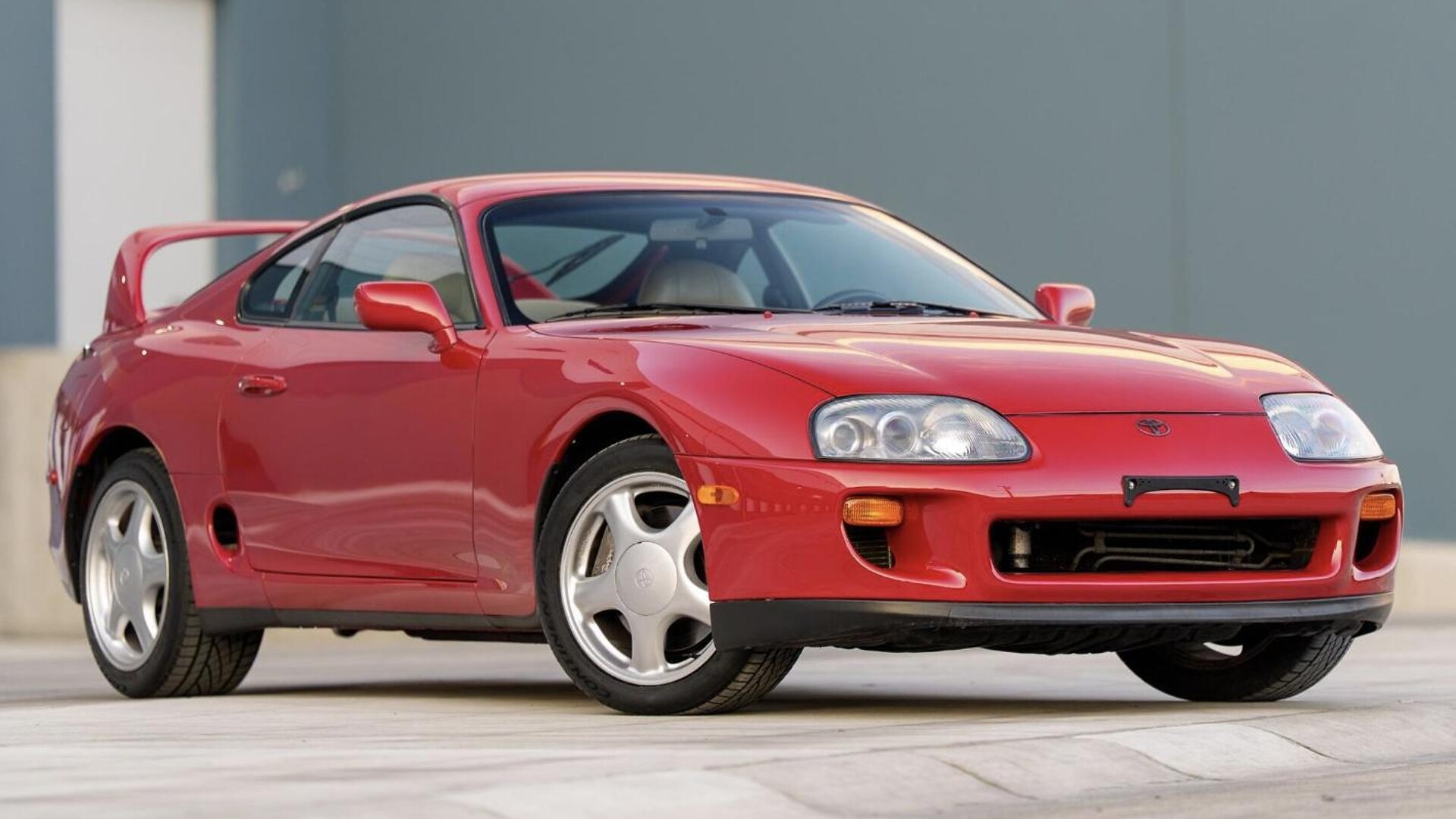
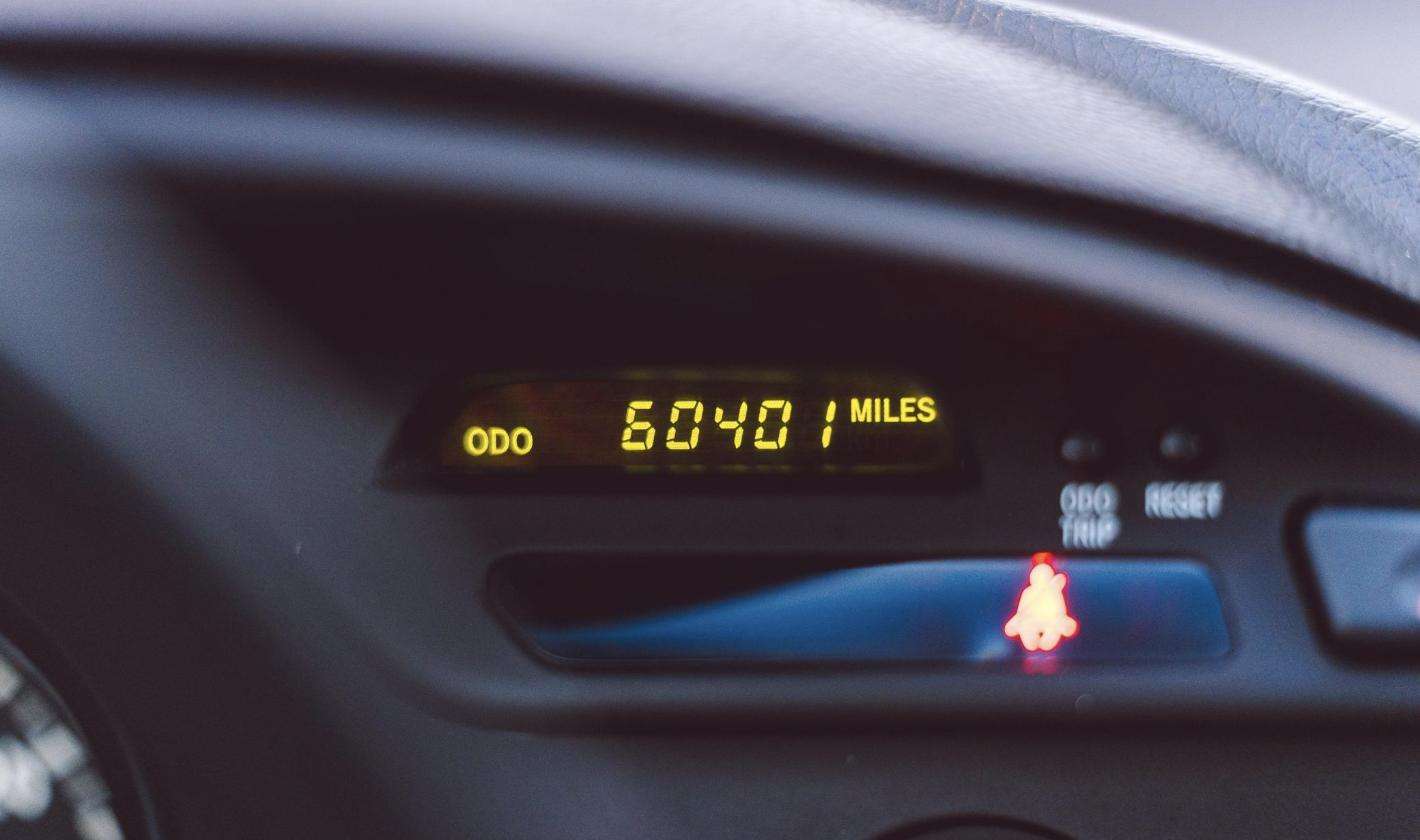
There is a 1993 Toyota Supra Turbo on Cars & Bids today that nobody would call perfect. Its front bumper, hood and quarter panels have been repainted. The front lip is cracked, there are chips in the paint, a seam has let go on the rear seat, and the seller discloses corrosion on underbody components. The odometer shows roughly 60,500 miles. And with a few hours left on the clock, fourteen bids have carried it to $122,359.
That figure will draw attention, but it isn’t the story. The story is what the bidders are paying for. This is not a time-capsule car, and the market knows it. What it is, according to the listing, is a two-owner, unmodified, Renaissance Red over Ivory Turbo with the Getrag six-speed, its original window sticker, and a paper trail. In the fourth-generation Supra market, those qualities have quietly become scarcer than low mileage. Collectors are no longer paying for perfection. They are paying for restraint.
The Car the Tuners Didn’t Get To
Toyota’s A80 Supra arrived in 1993 with the 2JZ-GTE, a cast-iron-block 3.0-liter straight-six fed by two sequentially staged turbochargers and rated in U.S. trim at 320 horsepower and 315 lb-ft of torque. Paired with the Getrag V160 six-speed, it delivered performance that embarrassed cars costing far more, and it did so with Toyota’s durability. That combination was the car’s gift and, for collectors, its curse.
Because the 2JZ could absorb enormous boost on a stock bottom end, the A80 became the default canvas for an entire generation of tuners. Single-turbo conversions, standalone engine management, aftermarket bodywork and wheels followed, and an enormous share of the surviving population was altered, often irreversibly, before anyone thought of these cars as collectible. The film franchise that made the Supra famous to a broader audience celebrated exactly that kind of car. The result is a market in which the unmodified example is the anomaly.
The supply was never large to begin with. Production figures compiled by the MKIV.com registry list 516 U.S.-market 1993 Turbo six-speed cars with the removable targa roof, and 135 of those in Renaissance Red. Across the entire 1993 to 1998 U.S. run, the same registry’s retail data counts roughly 4,000 Turbo six-speeds in total. Those are enthusiast-compiled figures rather than a Toyota archive release, and they should be treated as close approximations. But even allowing for error, the arithmetic is sobering: take a few thousand cars, subtract the ones that were wrecked, stolen, tuned or neglected over three decades, and the number of honest, stock, manual Turbos left in the United States is small and shrinking.
That is why the word “unmodified” in this listing’s headline carries more weight than the mileage. Seller notes report no modifications, and the factory equipment matches the window sticker: 17-inch wheels, limited-slip differential, rear spoiler, targa panel, leather, automatic climate control and the CD/cassette head unit. For a Mk IV, the rarest option is the one Toyota never listed: an owner who left it alone.
Why Mileage Has Stopped Being the Whole Argument
For years, the Mk IV Supra market was priced almost entirely on the odometer. The benchmark was set in March 2019, when RM Sotheby’s sold a 1994 Supra Twin Turbo Targa at Amelia Island showing less than 11,200 miles for $173,600. That sale told the market that a showroom-grade A80 belonged in a catalogue auction alongside European blue chips. It also established the idea that only the near-new cars truly counted.
The comparison that matters more today is humbler. In August 2024, a 1993 Supra Turbo six-speed showing about 34,000 miles was bid to $112,000 on Bring a Trailer and failed to meet its reserve. Two years later, a car with nearly twice the mileage and a disclosed partial repaint has already cleared that number with hours to spare. You can read that one of two ways. Either the market for clean, stock manual Turbos has firmed considerably, or bidders have decided that a known, documented, unmolested car with 60,000 miles is worth more than the mileage-first pricing model would suggest. The evidence supports both, and they point in the same direction.
We have seen the same pattern elsewhere in the Japanese market. A 240Z owned by one family since 1975 made the case that continuity of ownership can matter more than the odometer, and a modified R34 Skyline sedan on Cars & Bids showed how quickly a famous nameplate stops paying dividends once the factory specification is gone. This Supra sits at the other end of that line.
The demographic explanation is simple. The buyers now bidding on A80s are, in large part, the people who wanted one in 1993 and could not afford a car that stickered well into luxury-car territory. They are not shopping for a trailer queen. They want the car they remember, in the specification they remember, and they want to drive it. For that buyer, a fresh timing belt matters more than a four-digit odometer.
What a Serious Buyer Should Look At
Candor is this listing’s strongest asset, and a buyer should use it. Paint-meter readings are provided in the gallery, and the seller notes that the front bumper, hood and quarter panels have been refinished. Front-end paint on a sports car is often cosmetic, the price of stone chips at speed. Quarter panels can be a different matter. If the reference is to the rear quarters, that is welded bodywork rather than a bolt-on panel, and a buyer should want to know why it was refinished and whether the Carfax, which the listing describes as clean, tells the whole story. The underbody corrosion deserves the same scrutiny, particularly on a car titled in New Hampshire and now located in Washington State.
On the mechanical side, the paperwork is reassuring. Service documentation shows a timing belt, water pump, drive belt and spark plugs at 60,240 miles in July 2026, clutch master and slave cylinders along with a full fluid service in May 2026, and tires with 2025 date codes. The seller reports buying the car in July 2017 and adding only about 2,000 miles since, so the recent work reflects preparation rather than heavy use. The sequential turbo system is the A80’s most complex subsystem, and any buyer should confirm that the transition to the second turbocharger is clean under load; a documented pre-purchase inspection is worth more than any adjective in a listing.
Then there are the accessories, which collectors routinely undervalue until they try to find them. This car comes with two keys and the valet key, owner’s manuals, the original window sticker, service records, the targa-top removal tool, a tonneau cover, an indoor car cover, period literature and a spare OEM armrest assembly for the broken lid hinge. The window sticker in particular is the Supra equivalent of a build sheet: it ties the VIN to the factory specification and supports the “unmodified” claim with a document rather than an assertion. Its 0001849 serial also places the car early in the A80’s U.S. production.
Why This Car, and Why Now
It is worth asking why a collector would choose this Supra over a lower-mileage example, or over an NSX at similar money. The answer is that the A80 occupies a specific cultural position no other Japanese car of the era quite matches. The NSX is the connoisseur’s car, and the Lexus LFA is the modern Japanese supercar that forced auction houses to take the category seriously. The Supra is the people’s icon, the car a generation of enthusiasts built its tastes around. Icons with broad demand tend to hold liquidity better than connoisseur cars, because there are simply more buyers who care.
Timing plays a part as well. Toyota is winding down the BMW-based fifth-generation car, and our look at the GR Supra MkV Final Edition argued that the new car’s collectability depends on a very narrow slice of the run. The Mk IV has no such ambiguity. It is the Supra that defined the name, and stock examples keep appearing in more serious venues, including the trio of 1990s Toyota icons at Kruse’s Auburn Fall sale.
None of this makes the car a guaranteed investment, and it would be a mistake to treat it as one. A repainted, driver-grade example will always trade at a discount to a documented original-paint car, and that gap should widen as the best cars disappear into long-term collections. But the direction of travel is clear. As the pool of unaltered A80s shrinks, the market is learning to value them by the things that cannot be recreated: factory specification, continuous history and documentation. Low miles can be preserved. Originality, once cut away with a turbo kit, cannot be put back.
Remove the final price from this story and the lesson still stands. The fourth-generation Supra has crossed from a tuner’s car into a collector’s car, and the collectors have changed the rules. They will forgive a cracked lip and a refinished hood. What they will not forgive is a car that stopped being the one Toyota built.
The collector car market, every weekday morning.
Auction results, price moves and what’s crossing the block, read in four minutes. Free, from Modern Car Collector.
No spam, unsubscribe in one click. Or read more about the Brief.
Related Posts:
- Toyota Supra Mk IV Turbo (1993–1998): Collector Spec Sheet
- The 10 Most Expensive Toyota Supras Ever Sold at Auction

- Is the Toyota GR GT a Future Collector Car? Scarcity…

- 2026 Toyota GR Supra MkV Final Edition: Is It a…

- Kruse Auctions Lines Up a Trio of JDM Icons for…
- The Collector Car Market Paid Up for Certainty This…

 Eve Nowell
  Shawn Henry