

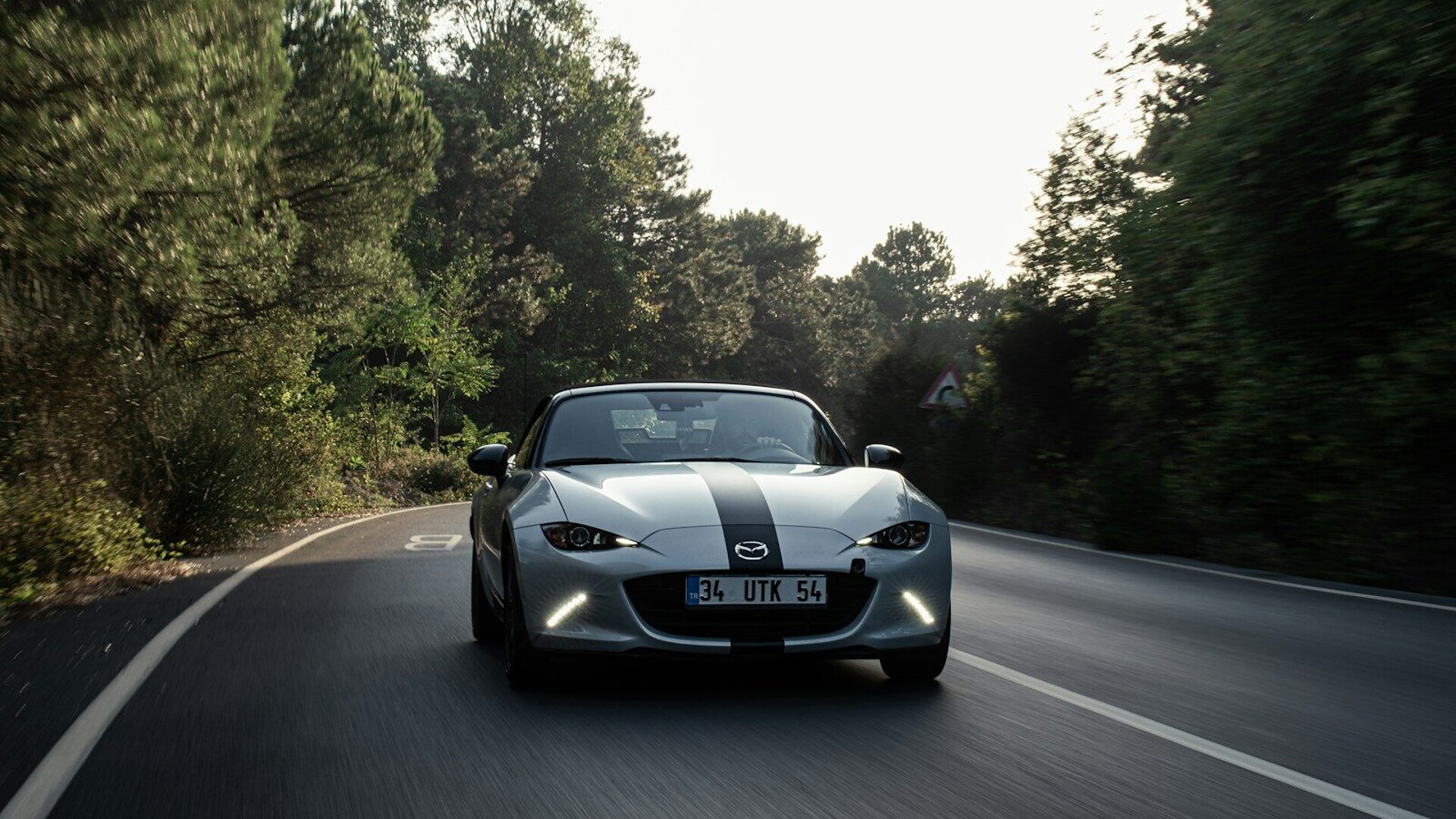
In June 2015, Mazda didn’t introduce the fourth-generation MX-5 with a stage presentation and a spec sheet. It built a four-day open-air music festival in the Stable Yard at the Goodwood Festival of Speed, handed the microphone to BBC Radio 6 Music’s Tom Ravenscroft, booked twenty acts chosen for taking what Mazda called “an unconventional approach to music,” and worked with a technology studio called Mogees to wire an MX-5 so festival-goers could play it like an instrument. On the lawn in front of Goodwood House, artist Gerry Judah suspended a 40-metre sculpture built around a genuine 787B Le Mans winner and Mazda’s LM55 Vision Coupe concept, twisted into shape by a construction method inspired by a modernist paper knife and Mazda’s “Kodo” design philosophy. The whole production ran under the hashtag #RaiseTheRoof, built, in the words of Mazda UK marketing director Claire Andrews, around wanting to “do something that has never been done before.”
Marketing spectacle is usually the last place collectors look for signal. Eleven years on, though, the ND MX-5 that all of that theater was built to launch has become one of the more interesting modern-classic stories in Mazda’s catalog — and the stunt, as it turns out, was more honest about the car’s character than most launch events ever manage to be.
The Circus Had a Point
Mazda has spent decades building its identity around feel over firepower. It is the brand that still races screaming rotary prototypes at vintage events long after everyone else moved on, and the only manufacturer ever to win Le Mans outright with a rotary engine. Turning a production roadster into a literal musical instrument is a strange way to sell horsepower. It is a perfectly consistent way to sell lightness, feedback, and the idea that a car should respond to a driver the way an instrument responds to a musician.
That argument happened to be true. The ND that debuted at Goodwood was 105 mm shorter and roughly 100 kg (220 lb) lighter than the NC generation it replaced, with a curb weight near 2,200 lb — a genuine rarity in an era when every new car generation gets heavier — built on Mazda’s SkyActiv architecture with electric power steering tuned to preserve road feel rather than mute it. It won World Car of the Year and World Car Design of the Year in 2016. None of that is glamorous copy for a press release, which may be exactly why Mazda chose to make the point with a beatboxer and a flute instead.
What the Market Says Eleven Years Later
The ND was never a limited-production car in the way that gives collectors goosebumps — global production has run continuously since March 2015. But the special editions Mazda layered on top of the standard car have already built a track record worth watching. A launch-year RF Launch Edition, finished only in Soul Red or Machine Grey with BBS wheels and Recaro seats, sold out separate limited allocations in the UK and the US within weeks of going on sale. The 2019 30th Anniversary Edition — 3,000 units worldwide, all finished in a unique Racing Orange with forged Rays wheels — sold out immediately at $34,995 for the soft-top manual, a real premium over a mechanically similar Grand Touring. Hagerty’s assessment at the time was that the surcharge bought something a spec sheet can’t measure: “a value to that which cannot be found on a spreadsheet but which is still very real” — exclusive paint, serial plates, and a future owner’s ability to say a specific car was one of three thousand. The 100th Anniversary Edition that followed in 2020, finished in Snowflake White Pearl, was rarer still: fewer than 700 units across Mazda’s entire model line.
The secondary market is where a thesis like this actually gets tested, and the early data is encouraging. UK auction results tracked by The Classic Valuer show the ND already trading with an 85 percent sell-through rate — well above what most twenty-year-old collector cars manage, let alone a car still in current production — with a median price near £21,800 and a documented, 3,000-mile 30th Anniversary example bringing £29,624, placing it in the top 20 percent of recorded ND sale prices. That is not blue-chip money. It is, however, a real and liquid market forming years before most cars earn one — and it’s forming around a generation Mazda has now confirmed is entering its final chapter. The next MX-5, codenamed NE, will arrive with some form of electric assistance; Mazda’s own design director has said a mild hybrid is “the least of the options” under consideration. The ND, meanwhile, is confirmed to continue in its current, unassisted form for the rest of the decade.
Why This Is the Real Story
That timeline is the thesis. The ND MX-5 will not be remembered as rare — a full decade of continuous production will see to that. It will be remembered, once the NE eventually arrives with a battery under the hood, as the last Mazda roadster built entirely around the company’s founding formula of jinba ittai, horse and rider as one, without an electron doing any of the work. Collectors have rewarded that kind of positioning consistently in other marques, once a manufacturer draws a clean line between what a car was and what its successor becomes.
Unlike most “end of an era” sales pitches, though, the ND isn’t leaving via a low-volume send-off edition timed for maximum scarcity. It is simply the version of the MX-5 that existed before hybridization arrived — built at whatever volume the market wanted, for a full decade, in the open. That is a less dramatic story than a 300-unit final edition. For a buyer thinking five and ten years out, it may be the more interesting one: the clearest expression of what the car was actually supposed to be, undiluted, produced long enough that an entire new generation of buyers will have grown up wanting one.
Collectors don’t usually treat a marketing stunt as a leading indicator. But look again at what Mazda actually staged in the Stable Yard in 2015: not a horsepower boast, but a car turned into a plaything, built on the premise that lightness and feel were the entire argument. Eleven years and a hybrid successor later, that argument hasn’t aged as theater. It has aged as a thesis statement.
What Serious Buyers Should Watch For
The pattern has a precedent inside Mazda’s own lineup. Clean, documented NA-generation Miatas from the late 1980s and early 1990s have roughly doubled in value over the past five years, according to market data reviewed by Autoblog, purely on the strength of originality and the shrinking supply of unmolested examples decades after nobody thought to preserve them. Nobody was making that argument about the NA in 2001, either.
For the ND specifically, the file that will matter is documentation: low-mile, manual-transmission cars in the special-edition liveries — Racing Orange 30th Anniversary cars, Snowflake White 100th Anniversary cars, and the earliest Soul Red RF Launch Editions — with complete service history, original paint, and an unmodified drivetrain. Hagerty’s own read remains the right framework: the intangible value of a numbered, historically specific edition doesn’t show up on a spec sheet, but it is “still very real.” A stock, well-documented example of any of these editions is a fundamentally different proposition from a well-loved daily-driver ND with an aftermarket exhaust and 90,000 miles, and the fundamentals that apply to any first collector-car purchase apply doubly here — the market is already beginning to price that difference in.
Mazda didn’t know, in 2015, that it was staging its own send-off party eleven years early. But for anyone taking the ND MX-5 seriously as a collector proposition now — while it is still in production, and before a hybridized successor changes the conversation for good — that is precisely what the Goodwood circus turns out to have been.
The collector car market, every weekday morning.
Auction results, price moves and what’s crossing the block, read in four minutes. Free, from Modern Car Collector.
No spam, unsubscribe in one click. Or read more about the Brief.
 Kyle Matthews
  Eve Nowell