
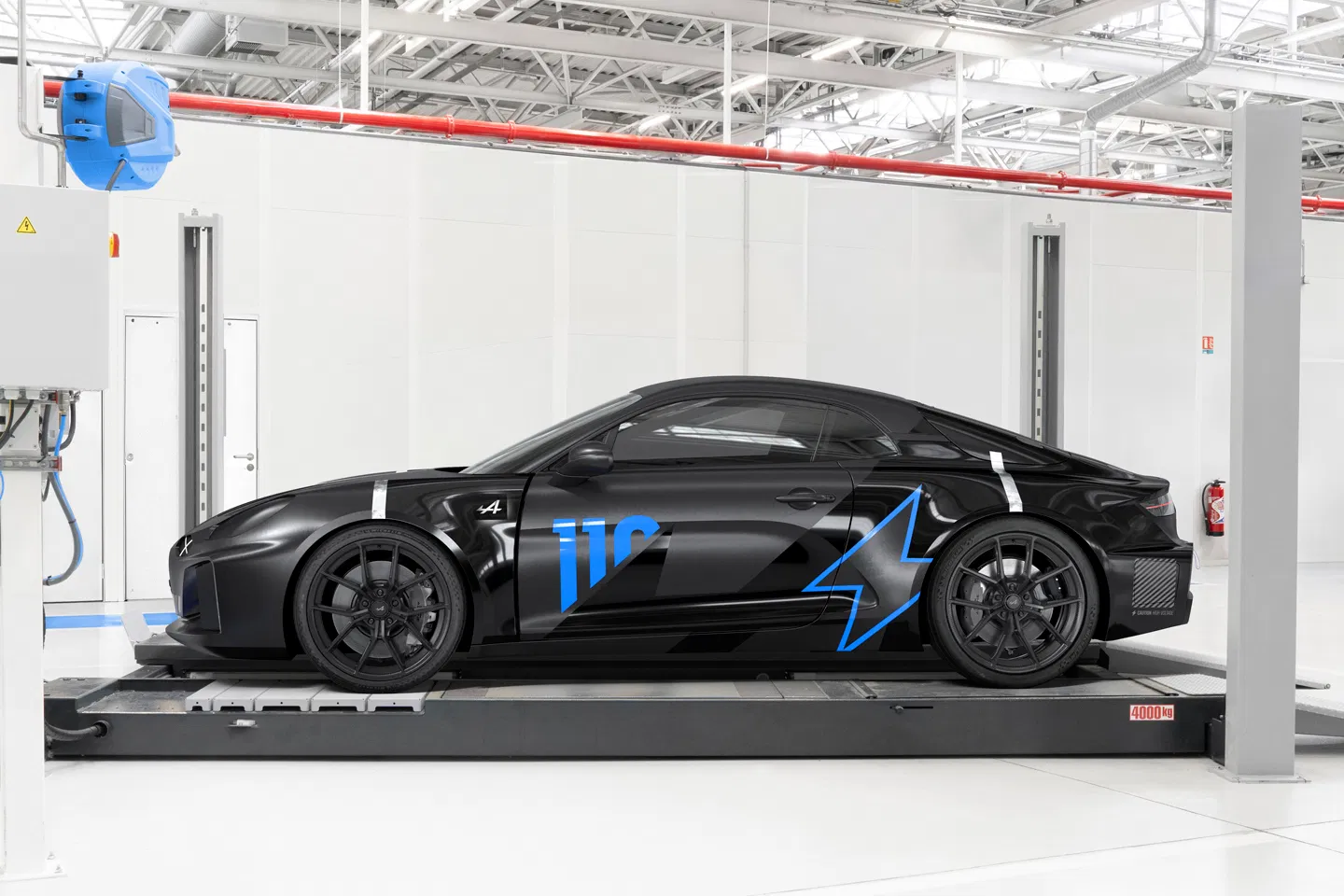
Alpine did something at Goodwood this week that most carmakers actively avoid: it hauled out a disguised engineering mule and let the public watch it work. The car is the A110 FUTURE, a rolling test bed for the third-generation A110, and it’s running the hillclimb every day of the Festival of Speed from July 9 to 12. The camouflage borrows the outgoing car’s body, so there’s not much to ogle. The story is underneath, where Alpine has built a bespoke electric platform aimed squarely at the one flaw that has quietly wrecked most electric sports cars: weight, and specifically where that weight lives.
Here’s the part worth understanding. Almost every EV uses a “skateboard” layout — one big flat battery slab spanning the floor between the axles. It’s cheap to engineer and packages well, but it forces a raised seating position and hands you a nose-to-tail weight split you didn’t necessarily want. For an SUV, fine. For a car whose entire personality is balance and low-slung agility, it’s poison. Alpine’s fix is the Alpine Performance Platform, an aluminium-intensive structure that splits the battery into two packs — one ahead of the cabin, one behind it — to hit a 40/60 front-to-rear balance. In other words, they’re using battery placement to fake the weight distribution of a mid-engine car, while keeping the driver low.
Related Articles
- The Best Tire Inflators, Pressure Gauges, and Flat-Spot Savers for Stored Cars
- Best OBD2 Scanners and Diagnostic Tools for Classic and Modern Collector Cars
Alpine says the packs use 800V cell-to-pack technology, and it’s worth clearing up what that actually means, because it gets muddled constantly. Cell-to-pack means the cells go straight into the pack, skipping the usual intermediate step of bundling them into separate modules first. Deleting that module layer saves weight and space and lets you cram in more energy — good for a car fighting the scales. The catch is repairability: with no modules to swap, damage to the pack is far harder and pricier to fix, which has real insurance consequences. A knock that would mean a module replacement on a conventional EV can threaten the whole pack here, and insurers price that risk into premiums and total-loss thresholds. Buyers should go in clear-eyed about that.
The 800V architecture isn’t just a fast-charging brag, either. Higher voltage means lower current for the same power, which allows thinner, lighter cabling and less heat — and less heat is exactly what lets a performance EV do repeated hard runs without the software throttling output to protect the battery. Alpine pairs that with a silicon-carbide inverter, which switches faster and runs cooler than older silicon parts, trimming energy loss and cooling mass. And crucially, power goes to a dual-motor rear axle — two motors on the back means it’s rear-driven and can genuinely torque-vector, feeding different torque to each rear wheel to rotate the car. That’s how you make a heavy EV feel playful instead of merely quick.
Now the skepticism. Alpine has released essentially no numbers: no power, no curb weight, no battery capacity, no range. Anyone quoting you a horsepower or kilogram figure is working from estimates, not the manufacturer. What’s certain is that even an aluminium-bodied, split-pack EV will land well above the outgoing A110’s celebrated sub-1,100-kg territory — that’s the unavoidable tax of hauling a battery around. The real engineering challenge was never making electric power; torque is the easy part. It’s managing mass and rotational inertia so the thing changes direction like an Alpine should. The split battery and rear torque vectoring are the whole bet.
Related Articles
- Ceramic Coatings vs. Wax vs. Sealant: The Best Paint Protection Products for Collector Cars
- Best Portable Car Lifts and Jack Stands for the Home Collector Garage
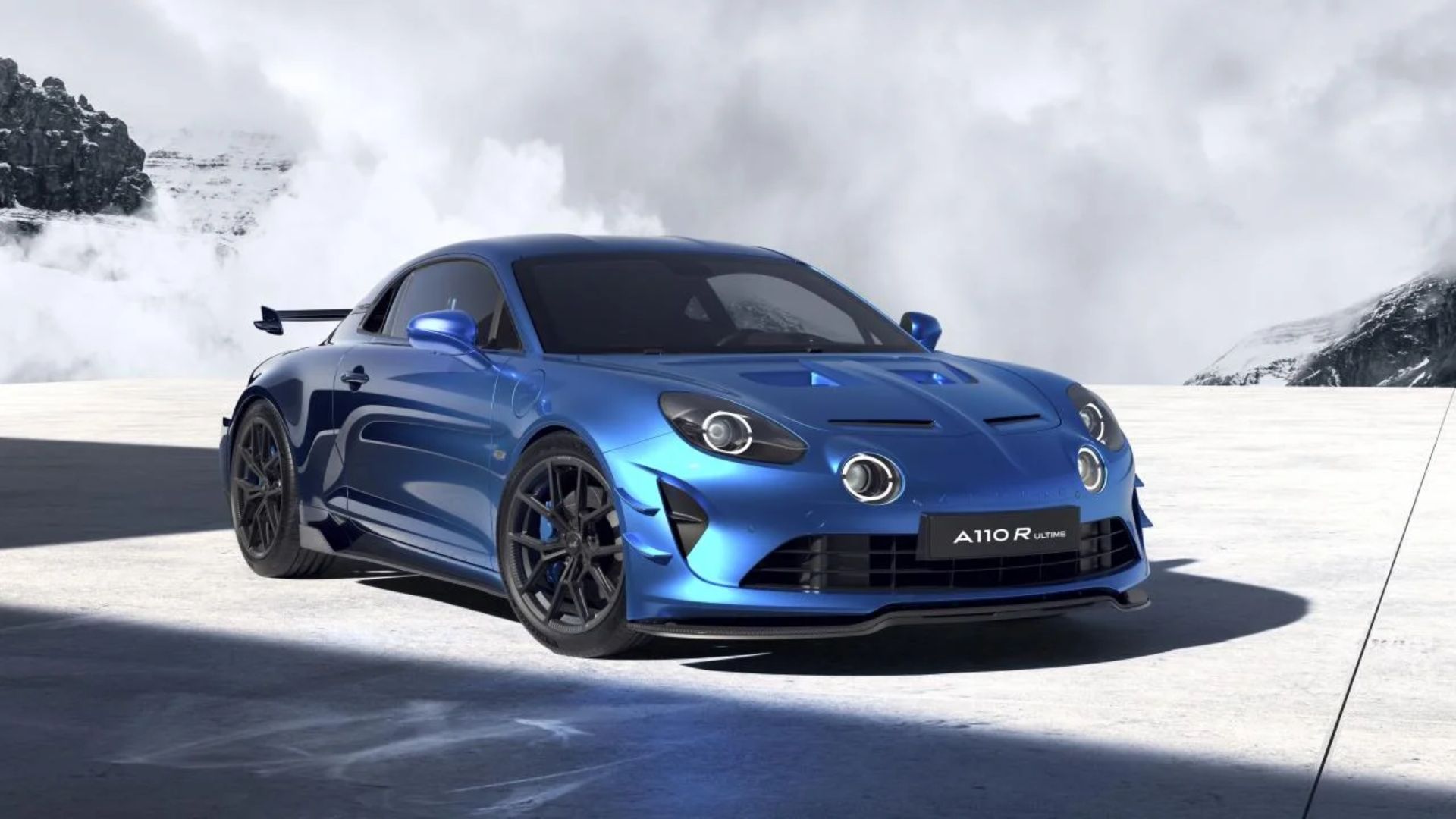
Some context on what’s ending. Alpine built its final second-generation A110 on July 1 — a 300-hp A110 R 70 in Alpine Blue — closing out 35,450 A110s built at Dieppe since 1969, of which 28,701 were second-gen cars. The practical takeaway cuts two ways: if you want the light, analog, combustion A110, that ship has sailed and clean examples of the last ICE cars will likely hold value well. And if you’re waiting on the electric one, judge it on cornering behavior and heat management over a full hill or lap, not on whatever power figure eventually gets announced. That’s the test Alpine set for itself by running this mule in public — and it’s the one that matters.
Images Via: Alpine
The collector car market, every weekday morning.
Auction results, price moves and what’s crossing the block, read in four minutes. Free, from Modern Car Collector.
No spam, unsubscribe in one click. Or read more about the Brief.
Related Posts:
- Is the Alpine A110 a Future Collector Car? Only Some of Them
- Record Ferraris, Rare Icons and 15,000 RPM: The Week…

- Alpine's One-Off A390 Art Car Is the Headline at…

- Goodwood Road Racing Club Comes to America: What…

- Lightning McQueen Joins the 2026 Goodwood Festival of Speed

- Alpine A110 R Ultime Debuts as the Most Extreme…