

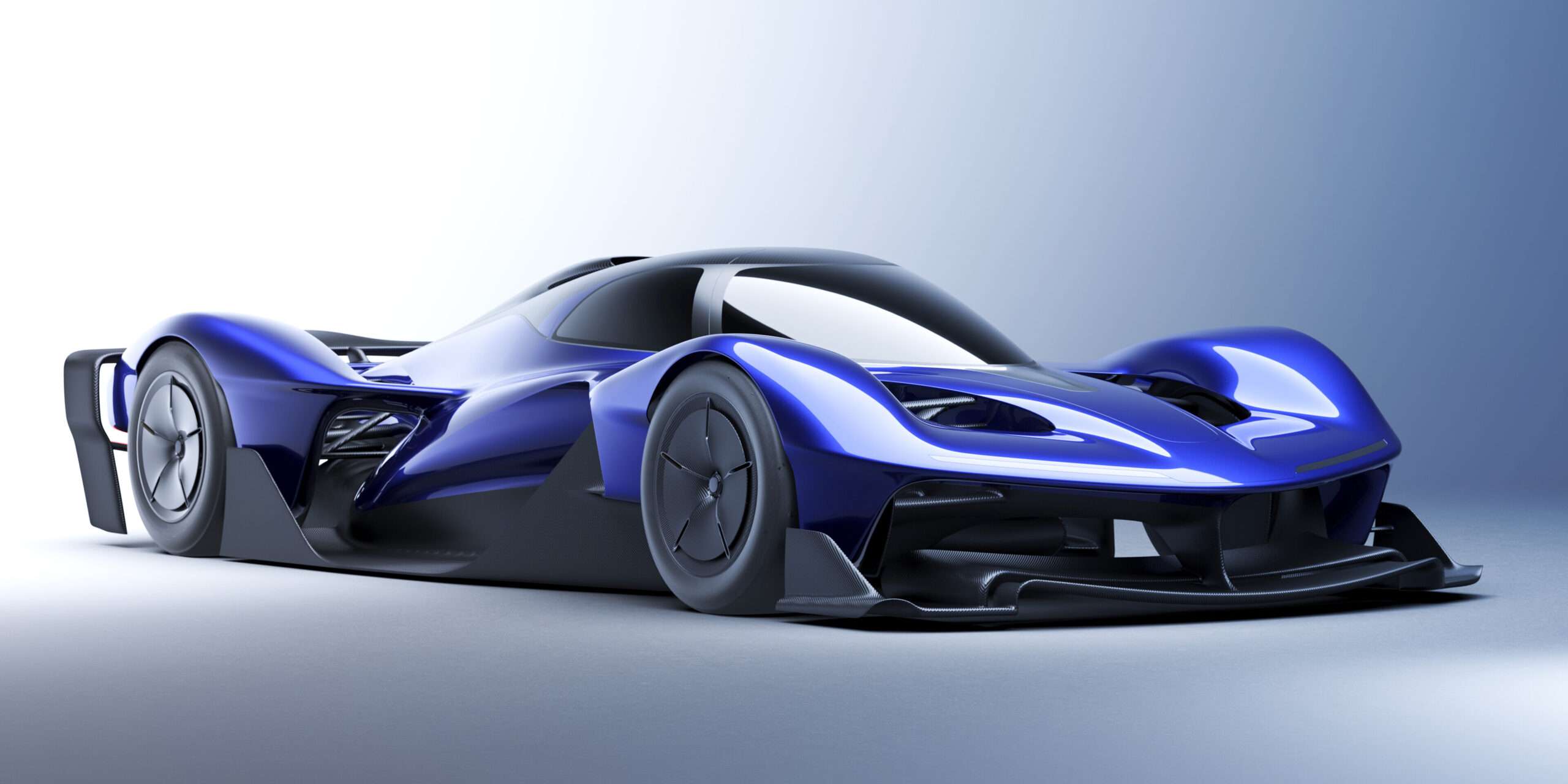
A genuine, high-revving V10 firing up in public in 2026 is not something anyone expected to witness again, yet here we are. Red Bull Advanced Technologies has finally run the RB17 in motion at the Goodwood Festival of Speed, its first dynamic outing after appearing as a static model back in 2024. Adrian Newey — who designed the thing before decamping to Aston Martin — is among the drivers taking it up the hill, alongside Red Bull’s Isack Hadjar, reserve driver Yuki Tsunoda, and Academy driver Alisha Palmowski. Red Bull is clear that these are demonstration runs, part of an ongoing testing and development program, not a flat-out assault. Nobody sane uncorks a bespoke V10 on Goodwood’s narrow, hay-bale-lined driveway.
The headline number everyone repeats is the combined output — Red Bull’s target sits around 1,200 hp from the naturally aspirated Cosworth V10 plus a hybrid assist, all fed to the rear wheels. Fine. But the parts worth understanding are the ones the spec-sheet crowd skips.
Start with the engine, because it’s a proper piece of engineering rather than a marketing prop. Cosworth built a bespoke 4.5-litre 90-degree V10 that spins to 15,000 rpm, and the 90-degree vee angle wasn’t chosen for packaging — it was picked because it resolves the engine’s first-order forces and moments to zero. In plain terms, that geometry lets the ten cylinders cancel each other’s primary shaking so cleanly that the whole car benefits in smoothness and noise. That’s the difference between a V10 that merely revs high and one that stays civilized doing it.
Related Articles
- Garage Climate Control: Best Dehumidifiers and Heaters to Protect Your Collection
- Win a 1-of-1 1970 ‘Cuda Convertible AND a 1,025-HP Demon 170 — And MCC Readers Get More Entries, Ends 7/9
How does it reach 15,000 rpm at all? Conventional metal valve springs go into “float” at extreme engine speeds — they can’t close the valves fast enough and the valvetrain loses control. Cosworth’s answer is Air Valve Spring technology, pneumatic springs lifted straight from Formula 1. It’s the same trick that let noughties F1 V10s — including the Cosworth TJ2005 in Red Bull’s debut car — scream past 19,000 rpm. Here it’s deliberately reined in.
And that restraint is the genuinely clever bit. The V10 is electronically limited to 15,000 rpm, not because it can’t spin higher but because Red Bull demanded an engine life of 24,000 kilometres between rebuilds. Anyone who remembers the V10 era knows those engines were often junk after a few hundred kilometres — a race weekend chewed through multiple units. A 24,000 km service life turns a Formula 1 fever dream into something an owner can actually flog at track days without a rebuild bill after every session. For a car you’ll only ever drive on circuit, that maintenance figure matters more than peak power.
Here’s a detail almost nobody will flag: Cosworth engineered the V10 to meet Euro 6 emissions legislation, despite the RB17 being track-only and legally exempt from it. Building emissions compliance into a car that never needs it is either future-proofing for a road-conversion path or simply Cosworth applying its standard hypercar recipe. Either way, it’s a regulatory choice worth noting.
Related Articles
- 10 Coolest Chevrolet Chevelles at Mecum Harrisburg 2026
- Market Movers: A Two-Speed Collector Car Market as the Top Sets Records and the Middle Cools
Mechanically, the V10 is a semi-stressed member, meaning it carries some of the chassis loads rather than hanging off a subframe, and it drives the rear axle through a lightweight carbon-fibre transmission. Cosworth quotes a top speed beyond 350 km/h — roughly 217 mph — which, tellingly, is lower than plenty of road-going hypercars. That’s the giveaway that the RB17 was built for cornering and downforce, not straight-line bragging; a track car trades terminal velocity for grip every time.
For the handful of buyers, the practical realities are stark. Just 50 will be built, and because it’s track-only, it can’t be registered or insured as a road car — it’s an agreed-value track asset that lives on trailers and circuits, with the usual implications for usage and resale liquidity. This is not a car you drive to lunch. It’s a private-circuit toy engineered to F1 intensity, and the fact that Red Bull is running it up a public hill at all, with Newey himself aboard, is the closest most of us will ever get.
Images Via: Cosworth
The collector car market, every weekday morning.
Auction results, price moves and what’s crossing the block, read in four minutes. Free, from Modern Car Collector.
No spam, unsubscribe in one click. Or read more about the Brief.
Related Posts:
- Record Ferraris, Rare Icons and 15,000 RPM: The Week…

- Red Bull Unleashes the RB17 Hypercar with V10 Muscle
- Delta Integrale vs. Escort Cosworth vs. Celica…
- Goodwood Road Racing Club Comes to America: What…

- The Aston Martin AMB 002 Isn't Collectible Because…

- Lightning McQueen Joins the 2026 Goodwood Festival of Speed