

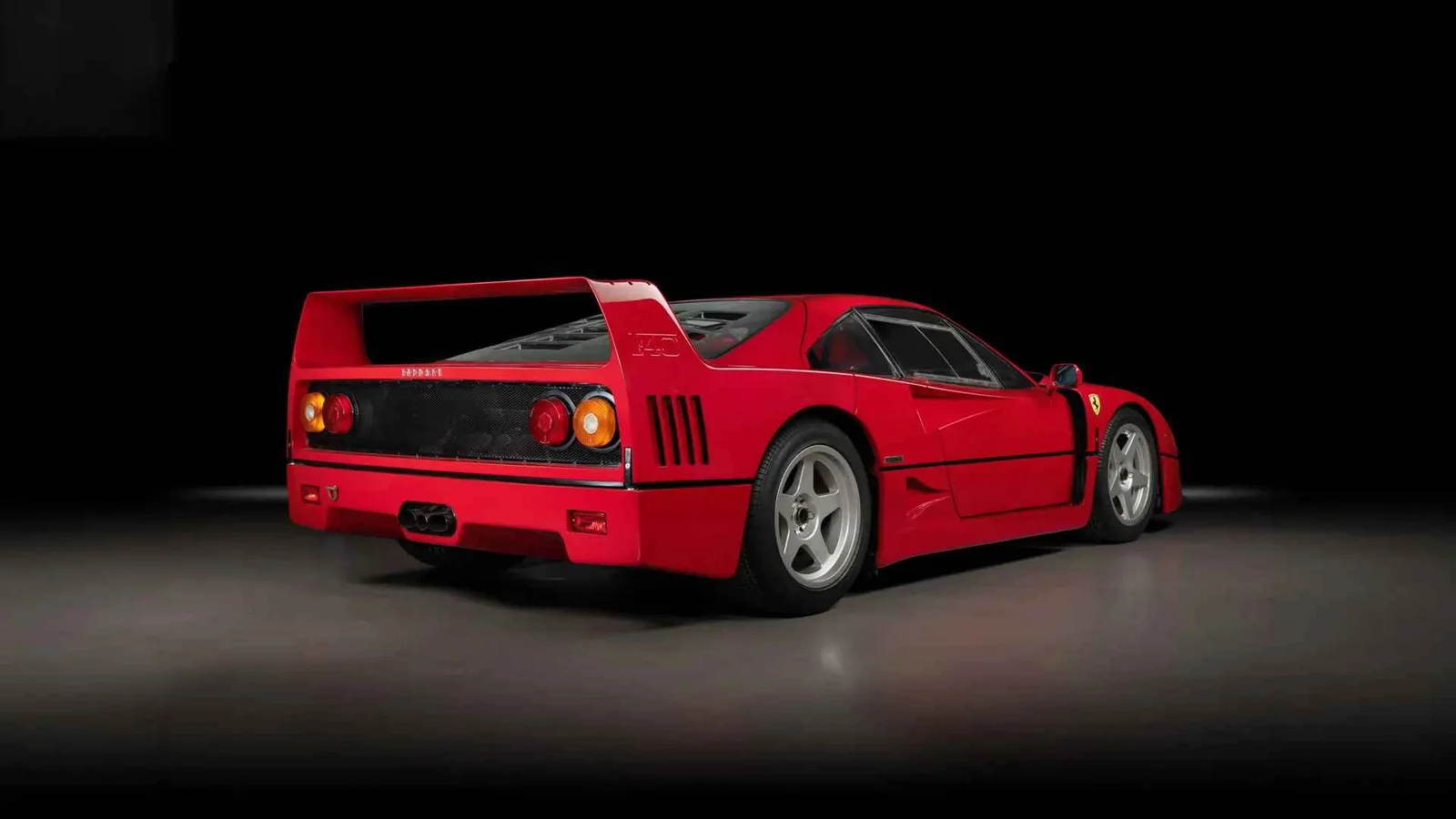
Modifying a blue-chip Ferrari is usually a fast way to torch its value. Weld in a roll cage, swap the exhaust, add a splitter the factory never sanctioned, and you’ve turned a collectible into a used car with a story nobody at the auction house wants to hear. And then there’s chassis 84642, a 1990 F40 that got substantially reworked in period and is estimated at £2.7–£3.2 million ($3.65–$4.35 million) precisely because of what was done to it. The difference between those two outcomes is entirely about who held the wrenches and who signed the work order.
The car crosses the block as Lot 136 at RM Sotheby’s Woodcote Park sale in Epsom, Surrey, on 8 July 2026. On paper it’s a 527-horsepower F40 with roughly 14,105 miles on it. In practice it’s one of the more interesting F40s to surface in a while, and the reasons are worth unpacking because they teach you how the top of the collector market actually assigns value.
Start with the name on the logbook. Jean Sage wasn’t a wealthy dentist who liked Ferraris. He ran Renault’s turbo-era Formula 1 program in the late 1970s and early ’80s, then moved to Ferrari France, operating as Charles Pozzi SA, where he ran the F40 IMSA campaign in the United States. This matters because when Sage sent his own F40 to a specialist for modifications in 1994, he was one of the few people on earth who understood exactly what the car could take and where to find the parts. That’s the crucial distinction. Most modified exotics get devalued because the changes are somebody’s guess. Sage’s changes were an insider’s blueprint, documented and period-correct.
Related Articles
- Dodge Charges $795 for Purple Haze, a 60th-Birthday Paint That Plays Hide-and-Seek With the Sun
- 1959 Chevrolet El Camino: A Pro-Touring Restomod Built for George Poteet at GAA Classic Car Auction
The specialist was Michelotto, and that single word is doing most of the heavy lifting on the estimate. Giuliano Michelotto’s shop in Padua is the outfit Ferrari sanctioned to build the F40 LM competition cars for Le Mans and the IMSA series—18 of them, all told. When Michelotto touched an F40, it wasn’t tuning; it was factory-adjacent race engineering. For chassis 84642, the shop rebuilt the original engine with a pair of I.H.I. special turbochargers and a lightweight exhaust, pushing output to 527 hp, up 49 from stock, and torque to a genuinely absurd 626 lb-ft—a 200 lb-ft jump over the factory figure. Then came the weight loss: lightweight front and rear clamshells and sliding windows shed 30 kg, the air conditioning came out, and F40 LM-style carbon-fiber buckets went in. Total savings came to 136 kg, which, as the build documentation points out, left this car both lighter and more powerful than either a standard F40 or an F50.
The listing describes the car as “non-cat, non-adjust,” and if you don’t speak F40, here’s why that phrase adds money. Later F40s got catalytic converters for tightening emissions rules, which choked the engine’s breathing, and an optional self-leveling adjustable suspension so owners could clear steep driveways. That hydraulic ride-height system was heavier, more complex, and notoriously troublesome. A car built without either is the leaner, sharper, purer specification collectors chase—so Sage started with the version enthusiasts already prize, then had Michelotto sharpen it further.
Did it work? In March 1995 the car ran official qualifying for the BPR Global Endurance round at Paul Ricard, up against four McLaren F1 GTRs, posted the quickest time in its GT4 class, and landed within six seconds of a full-house F40 LM. For something still registered for the road, that’s a serious result.
Now the skeptic’s paragraph, because a buyer at this level needs one. The car isn’t in exactly the trim Michelotto delivered. When it was imported into the UK and sold to its second owner in 1996, the Maurice Chabord exhaust and the roller-bearing turbos were pulled to make it more streetable, and it currently wears a Tubi exhaust. The air conditioning Michelotto removed is still gone. Anyone hoping to return the car to full 1994 competition specification would need to source those original pieces, so factor that into the fantasy. What survives, and what the auction house leans on, is the matching-numbers engine and gearbox plus the carbon buckets, Koni adjustables, F40 LM braking setup, twin-master-cylinder pedal box, and US-spec splitter.
Related Articles
- Pagani Joins Lamborghini in Walking Away From Electric Supercars
- Ferrari’s First EV Sells Out in China Despite Online Backlash Over Design
There’s a maintenance lesson buried in the service history, too. In October 2025 the car received new aluminum fuel tanks from Maranello Classic Parts at a cost of £37,000. That’s not a typo. F40 fuel cells are a known, expensive perishable—the rubber bladders age out whether you drive the car or not—and replacing them is one of the ownership costs nobody mentions in the brochure. The February 2025 service also covered new cambelts, which on any older Ferrari V8 are an interval item tied to the calendar, not the odometer, because the rubber degrades with time. Translation: an F40 is not a car you park and forget.
As for the money, the estimate sits above where a clean standard non-cat F40 typically trades, and the premium is the provenance stack: a motorsport-insider owner, a Ferrari-sanctioned builder, matching numbers, and a fat documentation folio including a Marcel Massini history report and the original Schedoni leather book. The market has been rewarding “story cars” over plain examples for years now, and this is about as strong a story as an F40 can carry without becoming a full LM—which trades in another postcode entirely. Whether it lands mid-estimate or blows through the top depends on how many bidders in the room value the Michelotto name the way Maranello once did.
For the eventual buyer, the practical takeaway is simple: this is a documented, sorted, recently serviced car with a paper trail that justifies the ask—but budget for the ongoing F40 tax, and decide before the hammer whether you’re buying it to preserve as-is or to chase the original Michelotto spec. Those are very different, and very expensive, ambitions.
The collector car market, every weekday morning.
Auction results, price moves and what’s crossing the block, read in four minutes. Free, from Modern Car Collector.
No spam, unsubscribe in one click. Or read more about the Brief.




 John Lloyd
  Shawn Henry