

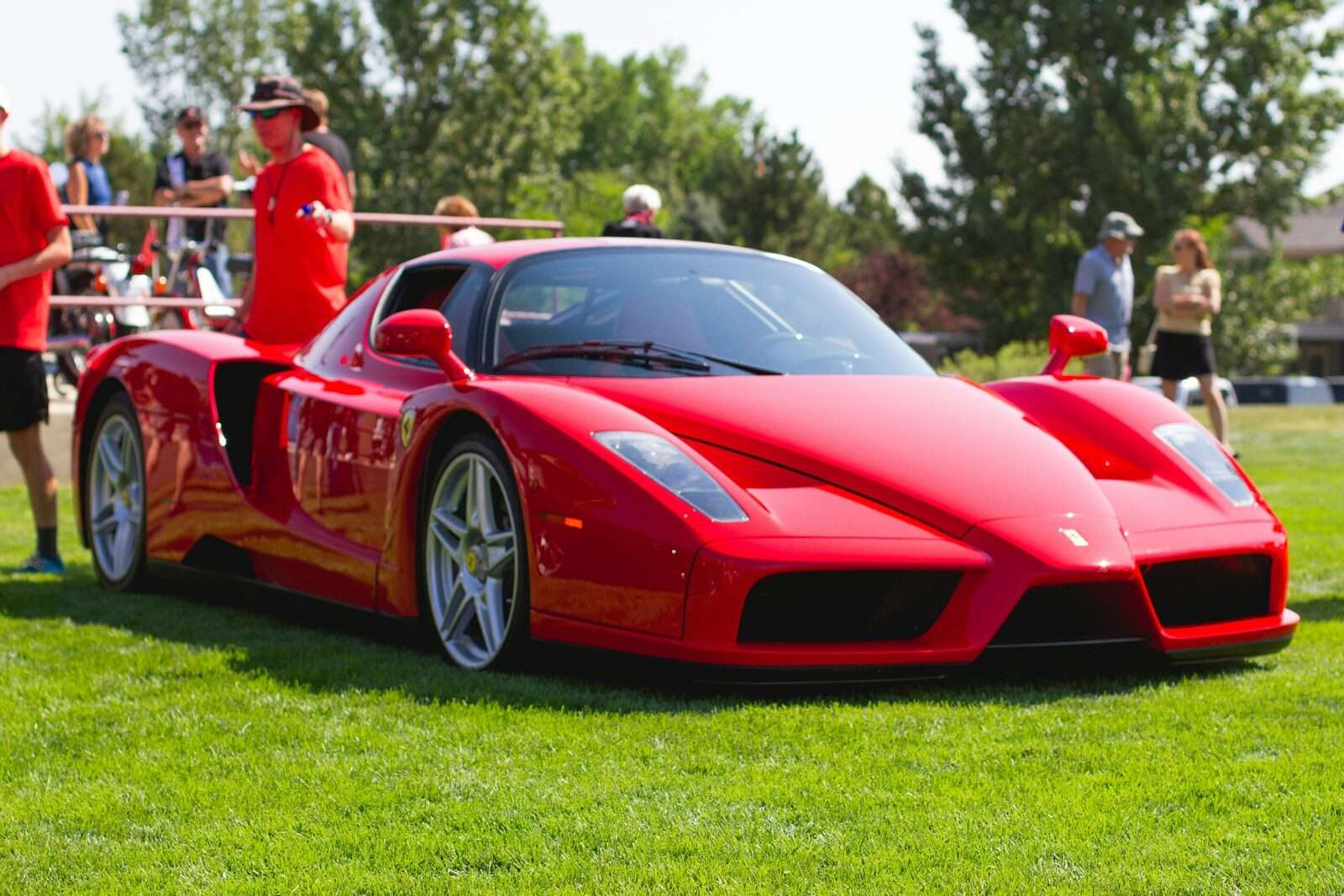
When a rare car surfaces with even rarer details, the collector world pays attention. A Ferrari Enzo with an exposed carbon fiber body has recently changed hands, and the new owner’s claims about the car’s exclusivity have sparked a debate that, for now, has no clean resolution.
Ferrari built 403 Enzo supercars in total, 400 of which were production models sold to customers at a then-staggering price of $659,330. The remaining three were development cars used internally to refine suspension geometry, engine tuning, and various components and systems — never intended for public ownership. That limited production run alone makes any Enzo a significant collector piece. In today’s market, finding one for under $4 million would be considered fortunate.
But the car in question is drawing attention for reasons beyond the standard Enzo story. The new owner has stated that their car is one of only three Enzos in the world finished with an exposed carbon fiber body — meaning the raw weave of the carbon panels is visible rather than painted over. That claim, however, is where things get complicated.
Conflicting accounts have clouded the car’s backstory. Some sources describe it as a singular, one-of-a-kind example. Others maintain Ferrari never produced any Enzo with an exposed carbon fiber finish from the factory, which would suggest the car was retrofitted at some point after delivery. Adding to the intrigue, what appears to be a modified wheel set, yellow brake calipers, and a revised interior have been noted on the vehicle.
The owner’s insistence that it is one of three, rather than one of one, carries some weight on its own terms. A truly unique car would carry greater monetary value, and there would be little incentive to understate that claim.
What is not in dispute is the Enzo’s place in Ferrari history. Unveiled in the early 2000s, the car represented the high point of the company’s analog era. It drew heavily on the automaker’s Formula 1 program, incorporating carbon fiber bodywork, carbon ceramic brakes, and a naturally aspirated 6.0-liter V12 producing 651 horsepower paired with a manual gearbox. The car weighed less than 1,500 kilograms, a remarkable figure for a machine of its performance class.
The Ferrari that followed it, the LaFerrari, moved into hybrid territory. The Enzo did not. That distinction has only deepened its legend among enthusiasts who prize the unmediated, combustion-only driving experience the car delivers.
Whether this particular example was born from the factory floor with its carbon fiber exposed or was transformed later, the car is visually arresting. Its provenance may be unsettled, but its status as one of the most striking Enzos in existence is not.
Source
The collector car market, every weekday morning.
Auction results, price moves and what’s crossing the block, read in four minutes. Free, from Modern Car Collector.
No spam, unsubscribe in one click. Or read more about the Brief.



 Eve Nowell