

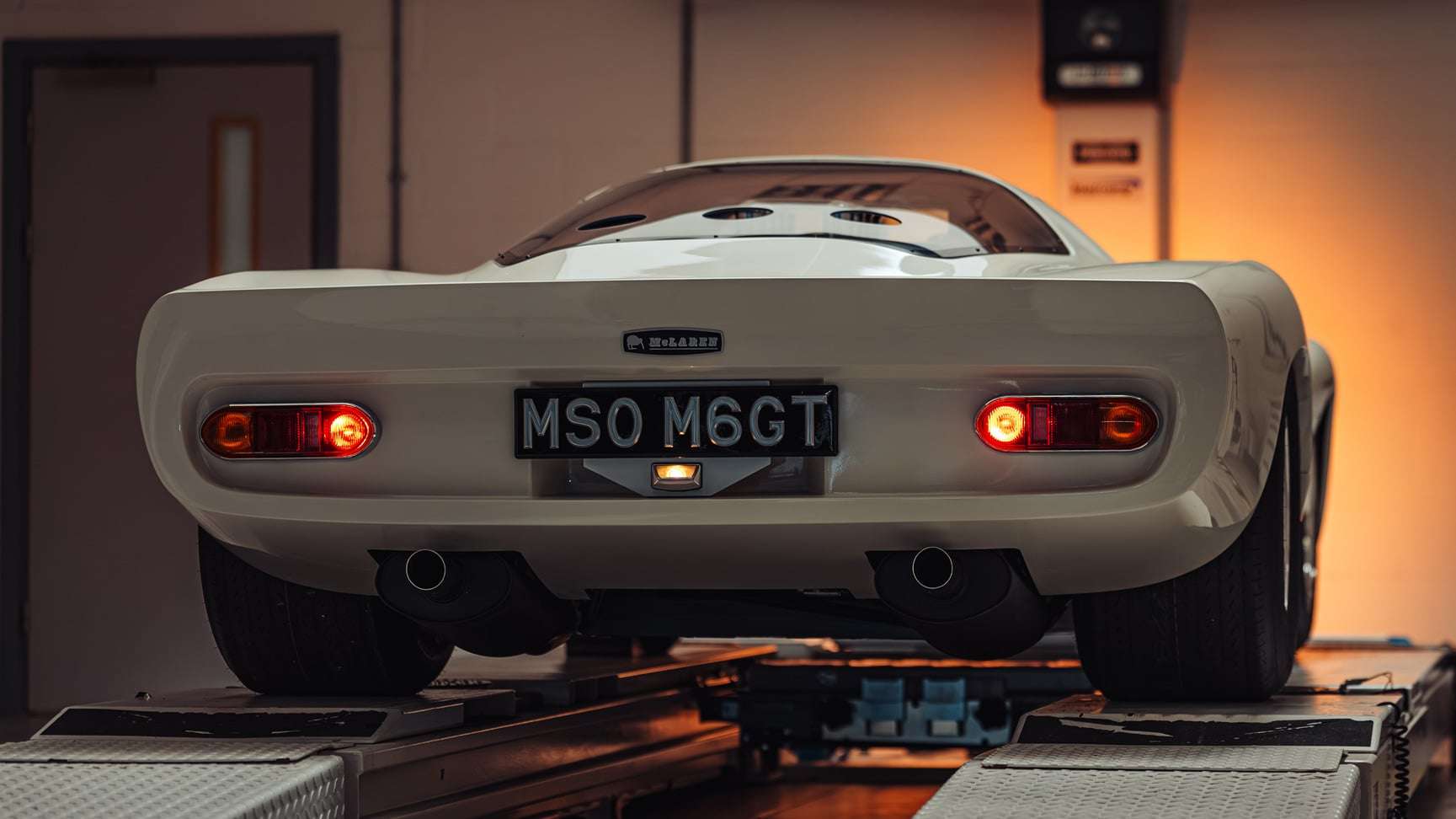
McLaren has pulled the wraps off a car it never actually built, and it’s calling the result a “restoration.” That word is doing some heavy lifting, but the car underneath the marketing is the real thing: the M6GT, the road-going supercar founder Bruce McLaren was chasing a full quarter-century before the F1 made the idea famous. It debuts this week at the Goodwood Festival of Speed, which runs July 9–12, and it’s worth understanding what McLaren Special Operations actually did here, because it’s more interesting—and more slippery—than the press photos suggest.
Start with the history, because it’s the whole point. In the late 1960s McLaren’s M6A was demolishing Can-Am, and Bruce wanted a closed-roof version that could double as a homologation special and a genuine road car. When a reporter asked him what he was really after, he described a civilised version of one of his racing cars. He built exactly one for himself, registered OBH 500H, and used it as a daily driver to and from the shop. Goodwood says he’d sketched out a run of 50 to take on Ferrari and the rest of Europe’s exotica. Then Bruce was killed testing a Can-Am car at the Goodwood circuit in 1970, at 32, and the road-car program died with him. The F1 didn’t arrive until 1992. The M6GT sat in the “what if” file for half a century.
Related Articles
- Two Boss 429s, Two Very Different Stories: A White Concours Restoration Meets a Black Jade Survivor
- Pristine 3k-Mile 2009 Ford F-250 Harley-Davidson Edition Hits No-Reserve Bring a Trailer Auction
Now here’s the part the word “restoration” glosses over. MSO didn’t restore Bruce’s original car—it built a new one. By McLaren’s own account, the chassis is from a different period M6A racer, the bodywork was pulled from original moulds the company dug up in the UK, and the hidden structure—roll hoop, rear frame support, internal clam reinforcement, wiring harness—was fabricated fresh. That’s a recreation with authentic bones, not a restoration in the sense a concours judge would use. It’s a meaningful distinction if you care about provenance, because a genuine survivor and a factory-built tribute are very different things on a valuation sheet, even when the same badge is on both.
The engineering headaches, though, were real, and they’re where the story earns its keep. The single hardest thing about faithfully rebuilding a 1960s British car in 2026 isn’t the big stuff—it’s the fasteners and bearings. Britain went metric decades ago, so MSO had to chase down imperial-era bearings built to standards nobody stocks anymore, and it brought in aerospace technicians to set period-correct dome rivets the old way. If you’ve ever tried to source an obsolete imperial bearing for a vintage project, you know this is genuinely miserable work: the tolerances, the fits, and the supply chain all disappeared two generations ago. The windscreen was another dead end—there’s no off-the-shelf glass for a car that was never mass-produced—so they scanned the original profile and had a specialist blow new panes to match. Goodwood pegs the whole job at 3,000 hours, with surviving mechanics from Bruce’s era on hand, one of whom apparently recalled shaping the original rear upright around a banana in the tearoom. That’s the kind of detail you can’t reverse-engineer from a scan.
Under the clamshell sits the smartest decision MSO made: they left it alone. Rather than dropping in a modern twin-turbo V8, the car keeps a period small-block Chevrolet paired with a five-speed manual, and McLaren specifically calls out the ‘camel hump’ cylinder heads matching original spec. For the uninitiated, those are the famous “double hump” castings—identifiable by the two bumps at the ends—prized in the ’60s as about the best-flowing factory small-block heads Chevrolet made. It’s a period-correct hot-rod choice, and it tells you the brief was authenticity over lap times. McLaren hasn’t published power or performance figures, which is telling in itself; this car isn’t meant to be benchmarked.
There’s a practical wrinkle worth flagging for anyone who fantasizes about McLaren selling these. It won’t, at least not this one. The M6GT is a one-off heritage piece, the first entry in MSO’s new heritage collection, and keeping it in-house sidesteps the modern regulatory nightmare a customer version would trigger. A new road-legal car built and sold today has to clear type approval, crash and emissions standards, and a raft of homologation that a 1960s Can-Am derivative would fail spectacularly. Continuation and heritage builds live in a narrow legal lane precisely because they aren’t offered as new production cars for public road registration. It’s the same reason Jaguar’s continuation D-types and Aston’s DB4 GT builds are the cars they are—period-faithful, often track-oriented, and carefully structured to avoid being treated as new type-approved vehicles.
Related Articles
- 10 Coolest Ford Mustangs for Sale Right Now
- Pristine 3k-Mile 2009 Ford F-250 Harley-Davidson Edition Hits No-Reserve Bring a Trailer Auction
For collectors and insurers, a piece like this is its own category. There’s no comparable sale, no auction record, no book value—so if it were ever insured privately it’d need an agreed-value policy backed by a bespoke appraisal, because a standard actuarial model has nothing to price against. McLaren won’t put a number on it, and honestly, a factory-built, founder-lineage one-off with the original moulds behind it is the kind of thing that gets valued by negotiation, not comparables.
The practical takeaway for the rest of us is simpler. The M6GT is a reminder that McLaren’s road-car story didn’t start with Gordon Murray and a carbon tub—it started with a Kiwi racer who wanted a streetable version of his Can-Am weapon and didn’t live to finish the job. MSO just finished it for him, imperial bearings and all. Call it a restoration if you like. It’s really a debt being paid.
Images Via: Mclaren
The collector car market, every weekday morning.
Auction results, price moves and what’s crossing the block, read in four minutes. Free, from Modern Car Collector.
No spam, unsubscribe in one click. Or read more about the Brief.





 Kyle Matthews
  Shawn Henry